“Free live chat” shows up in four completely different categories of products. A solo founder adding a chat bubble to a marketing site, a startup team replacing email threads, a SaaS company embedding messaging inside their product, and a support team managing WhatsApp and Messenger – all of them search for the same phrase and need completely different tools.
Picking from the wrong bucket wastes weeks. The setup is real, the agents get trained, the widget goes live, and then you hit the 50-conversation cap or discover that the feature you actually need costs $95/month extra.
This article groups 12 tools by what they actually do, with the real free-tier numbers – not “generous plan” hand-waving. Agents allowed, message caps, branding requirements, and what triggers the paid upgrade. You can read the section that matches your situation and skip the rest.
How to pick: four use cases for “free live chat”
Before looking at any live chat software, figure out what you’re actually trying to do:
Customer-facing website widget
A chat bubble on your marketing or e-commerce site. Sales or support handles inquiries. You want lead capture, support triage, maybe a basic chatbot. Tools built for this: Tawk.to, Tidio, Crisp, HubSpot Live Chat, Zoho SalesIQ.
Internal team chat
Replace email between coworkers. You need channels, file sharing, and maybe video. Tools: Slack (free tier), Microsoft Teams (free), Discord, Mattermost (self-hosted), Rocket.Chat (self-hosted).
Customer messaging via existing channels
If your customers are on WhatsApp or Telegram, meet them there instead of making them open another tab. Tools: WhatsApp Business, Telegram Business, Facebook Messenger via Meta Business Suite.
Chat embedded inside your product
Users chat with each other, with support agents, or with an AI assistant inside an app you’re building. This is the SDK use case – a website widget won’t do it. Tools: Chatwoot (open-source), Ethora Chat Widget + SDK (covered below).
The most common mistake
Most “best free live chat” lists mix all four categories without saying so. A website widget tool doesn’t work for embedding chat inside a mobile app. A team chat tool doesn’t work for customer support. Figure out your category first.
Hosted Website Chat Widgets
These are the chat bubbles you usually see on e-commerce platforms. Integration is typically simple: you only need to install a script tag, configure the widget, and then handle incoming conversations through a web dashboard.
Tawk.to
Actually free forever
Unlimited agents; Unlimited conversations; Branding: “Powered by tawk.to” included
Tawk.to is the most genuinely free option in this category. No agent limit, no conversation cap, no expiry. The business model is selling optional add-ons: $1/hour to hire a remote agent from their marketplace, and $19/month to remove the “Powered by tawk.to” branding. If you can live with the branding, the product costs nothing, period.
The UI is dated, and the mobile app has a middling reputation. Reports of occasional reliability issues on high-traffic sites. But for a solo founder or a small team that genuinely has $0 to spend on live chat, there’s nothing else in this list that competes on those terms.
Best for: solo founders, very small teams, anyone with a hard $0 budget who can tolerate the branding. Watch out: reliability questions at scale and an interface that hasn’t kept up with modern tools.
Tidio
50 conversations/month free
10 agent seats; Starter: $29/mo (100 conversations); Branding on free tier
Tidio has a well-designed interface and strong Shopify and WooCommerce integrations. The free plan gives 50 conversations per month – and “conversation” means any message thread a human agent responds to. On an active ecommerce store, 50 conversations last about a week.
The Lyro AI add-on is separate from the main plan and starts at $39/month for 50 AI-handled conversations. The free version gives 50 Lyro conversations as a lifetime quota – not per month. Once those are gone, the AI stops responding until you pay. Between the conversation cap, the Lyro add-on, and the Flows automation pricing, the real monthly bill for a real team is easily 2-3x the advertised price.
Best for: ecommerce stores on Shopify or WooCommerce that want clean UI and product-aware AI – on a paid plan. Watch out: the free tier is genuinely just a trial for most stores with real traffic.
Crisp
2 agents free
Unlimited messages; No chatbot on free tier; Mini: $45/workspace/mo
Crisp’s free tier is 2 agent seats with a website chat widget, shared inbox, and unlimited messages. No conversation cap, which is an advantage over Tidio. But no chatbot, no integrations, no email inbox, and no chat history beyond the current session. The free plan is functional, but barely – Crisp’s pricing structure essentially means you need the $95/month Essentials plan to get the features that made Crisp worth evaluating in the first place (AI chatbot, omnichannel inbox, analytics).
The UI is clean and modern, which is why it stays on shortlists. Just be clear that the free tier is a preview of the product, not the product.
Best for: early-stage startups wanting a modern interface at low cost – if you’re willing to pay Mini ($45/mo) relatively soon. Watch out: if you want a free live chat software, this is not the option – the free tier is genuinely too limited for any real customer support operation.
HubSpot Live Chat
Free with HubSpot CRM
Unlimited chats; Basic chatbot included; HubSpot branding on free
HubSpot Live Chat is free as part of the HubSpot CRM free tier – unlimited chats, a basic bot, and every conversation tied to a CRM contact record. If your team is already in HubSpot, this is obvious: it’s already there, and it works. If you’re not in HubSpot, setting up the CRM just to get live chat is overkill.
Best for: teams already using HubSpot CRM. Watch out: standalone use is a complicated setup for what is essentially a chat widget.
Zoho SalesIQ
100 chats/month free
2 operators; 1 brand; Basic: ~$10/mo for more
Zoho SalesIQ offers a free tier with 100 chats per month and 2 operators. For teams already on Zoho One (the bundled Zoho product suite), the value of the integration is real. As a standalone chat widget, the free plan is tight – 100 chats a month isn’t much for any active site – and the upgrade path to $10/month Basic is reasonable if you’re committed to the Zoho ecosystem.
Best for: teams already on Zoho products. Watch out: the free tier is genuinely too small for active customer-facing sites.
LiveChat, Drift, Intercom, Olark – not actually free
Trial only 14 days, then paid
These all rank for “free live chat” searches. None of them are free. LiveChat starts at $20/agent/month. Intercom starts at $39/seat/month. Drift starts at $2,500/month. Olark starts at $29/month. They offer free trials, not free plans. Listing them so you don’t waste a signup.
| Tool | Free agents | Free chat cap | Branding | Free chatbot | Paid trigger |
| Tawk.to | Unlimited | Unlimited | Yes ($19/mo to remove) | No | Branding removal or agent hire |
| Tidio | 10 seats | 50/month | Yes | 50 lifetime AI convos | $29/mo at 51st conversation |
| Crisp | 2 seats | Unlimited | Yes | No (paid) | $45/mo for email, integrations |
| HubSpot | Unlimited | Unlimited | HubSpot branding | Basic only | HubSpot CRM paid features |
| Zoho SalesIQ | 2 operators | 100/month | Yes | Basic bot | $10/mo for more chats |
| LiveChat / Intercom | Trial only | Trial only | N/A | N/A | From $20-39/agent/mo immediately |
Open-Source Self-Hosted: Truly Free With a Server
If you can run a Docker container – or pay $5-20/month for a VPS – these tools cost nothing in licensing and have no conversation caps, no per-agent fees, and no branding requirements. You build a self-hosted live chat and own everything.
Ethora
Free tier: up to 1,000 MAU, most features included
Self-hosted via Docker or AWS Marketplace; React, React Native, iOS, Android
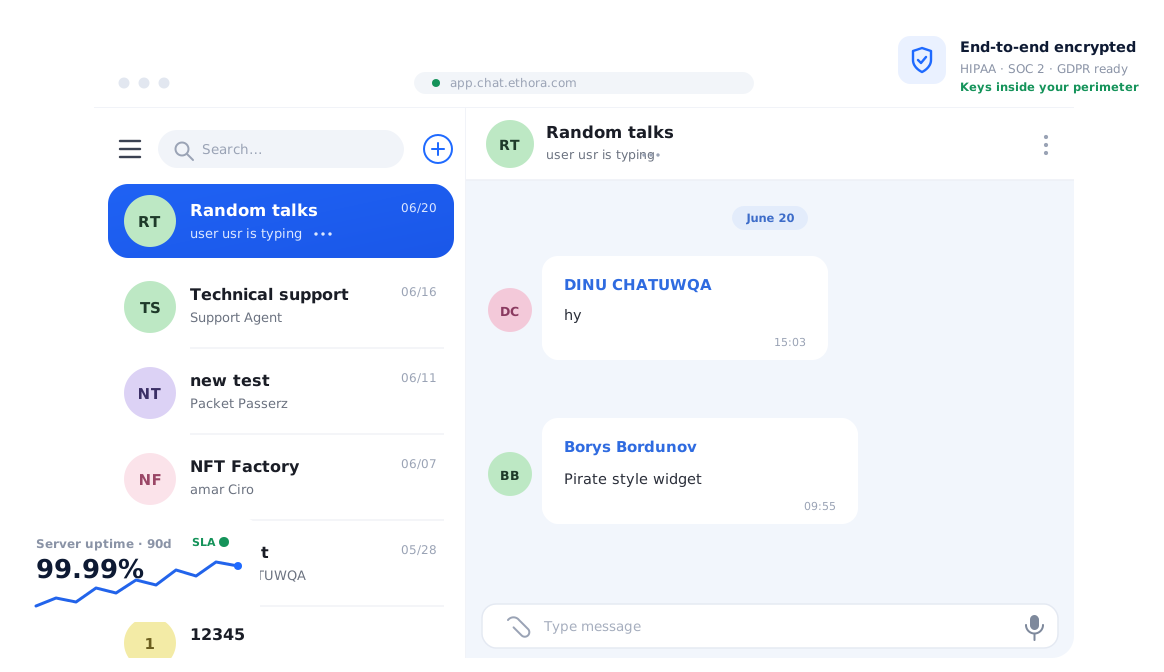
Ethora sits in a different category from the others on this list – it’s less a standalone team chat tool and more a chat and AI SDK you embed into a product you’re building. Where Mattermost gives you a finished Slack alternative, and Rocket.Chat gives you a finished omnichannel support platform, Ethora gives you the underlying engine: real-time messaging, delivery receipts, offline queuing, voice and video calls, and a BYO-LLM AI layer, all wired up through SDKs for React, React Native, iOS, and Android.
Best for: teams in highly regulated industries (healthcare, finance, government) that want to have messaging and utilize AI, while preserving full control over their data. Watch out: this is a developer SDK, not a plug-and-play team chat.
Chatwoot
Community Edition: free forever
Unlimited agents; Unlimited conversations; Docker setup ~15 min
Chatwoot is the open-source customer engagement suite closest in feel to a hosted support tool. Shared inbox, live chat widget, email, social integrations, canned responses, team assignment, conversation routing – all on the Community Edition with no limits. Managed Cloud starts at ~$19/month if you’d rather not run the infrastructure.
Setup is Docker Compose. It runs comfortably on a $10/month VPS for a team of 50. That’s the whole cost. Compare that to Tidio at $29-59/month or Crisp at $45–95/month, and you understand why support teams with any DevOps capacity choose this route.
Best for: support-heavy SaaS teams and SMBs who want to own their data. Watch out: requires someone to own deployments and upgrades.
Rocket.Chat
Community Edition: free forever
Unlimited users; Docker / Kubernetes
Rocket.Chat is a self-hosted, Slack-like team chat plus omnichannel customer messaging. The Community Edition has no user limit. It handles internal team chats as well as WhatsApp, Facebook, Instagram, e-mail, and live chat inboxes. All data is in your controlled infrastructure and never leaves it, which often makes it a go-to choice for healthcare, defence, and regulated industries.
Best for: perfect for privacy-first businesses and regulated industries that need internal and customer chat on a single platform. Watch out: resource-heavy compared to Mattermost; requires DevOps expertise.
Mattermost
Team Edition: free forever
Unlimited users; No per-user fees
Mattermost is an open-source Slack alternative with a strong track record in engineering teams, government, and defence. The free Team Edition has no user cap and message history limit – unlike Slack’s free tier, which cuts off at 90 days. It runs leaner than Rocket.Chat, and the integrations with GitHub, Jira, PagerDuty, and CI/CD pipelines are genuinely good. But it’s purely an internal communication tool, not a customer-facing chat.
Best for: engineering teams, DevOps, government, and mission-critical ChatOps. Watch out: internal team chat only – no customer-facing widget.
Element (Matrix protocol)
Matrix homeserver: free self-hosted
Decentralised and federated
Element is the main client for the Matrix protocol – decentralised, federated, end-to-end encrypted by default. Self-host a Synapse server, and you can communicate with anyone on any other Matrix server. The German Bundeswehr, the French government, NATO, and over 16 national governments run Matrix-based deployments for exactly these reasons. Steeper setup than Mattermost. Synapse is RAM-hungry, and federation adds operational complexity. Right for privacy-first or sovereignty-driven teams; overkill for most startups.
Best for: privacy-first, federated, or government use cases. Watch out: setup and admin complexity are meaningfully higher than other options here.
Zulip
Self-hosted: free forever
Cloud free for open-source projects; Unique topic-threaded model
Zulip does team chat differently: every message belongs to a channel AND a topic. The result is closer to a forum than a Slack channel – conversations don’t get buried, and async teams can catch up without scrolling through hours of channel noise. If your team is drowning in Slack noise, this is the real alternative. Free to self-host, free on managed cloud for small teams.
Best for: async-first or distributed teams frustrated by Slack’s stream model. Watch out: topic threading is the whole product – if your team doesn’t want to use topics consistently, it breaks down.
The self-hosted cost reality
A $10/month VPS runs Chatwoot or Mattermost for a team of 50 with no licensing fee. Slack Pro at $7.25/user/month for that same team is $362/month. The self-hosted payback happens in week one.
Team Chat Free Tiers
For internal communication, these are the hosted options that actually have meaningful free plans – not just trials.
Slack (Free)
Slack Free offers unlimited users and unlimited chat. The thing that kills it for most growing teams: message history cuts off at 90 days. Your older messages aren’t deleted – they just become invisible. You can be mid-project and suddenly can’t find a decision made four months ago. Ten app integrations total. No screen sharing in group calls. Pro is $7.25/user/month to unlock everything. If your team is small and nothing you discuss needs to be findable in six months, the free tier is genuinely usable. The moment you need compliance records, historical search, or more than ten integrations, you’re paying.
Microsoft Teams (Free)
Microsoft Teams free caps group calls at 60 minutes and 100 participants, gives unlimited chat, and comes with 5GB of cloud storage. The 60-minute call limit is the friction point – it’s fine for standups, annoying for anything longer. If your team already uses Microsoft 365, the calendar and file integrations are already there – this is an obvious choice. If you’re not in Microsoft’s ecosystem, it’s a bit of a detour just to get a chat app.
Discord
Discord gives you unlimited users, unlimited voice and video calls, screen sharing, and file uploads up to 25MB – all free. It was built for gaming, and the persistent voice channel model (you can just sit in a room and people drift in and out) is something Slack and Teams have never replicated. A lot of startups, developer communities, and even some companies run on it. Nitro at $9.99/month raises the file size limit and a few other things, but the free tier isn’t crippled in any meaningful way for normal team use.
Google Chat
Google Chat is free if you already have a Google account, and it fits perfectly into whatever you are doing in your Workspace. It works well with links in Drive, opens Meetings directly from the chat, and integrates Calendar events seamlessly.
It doesn’t have as many features as Slack, and has fewer integrations, but if you’re already using Gmail and Google Docs, then it’s completely free for you.
Messaging-Channel Based (WhatsApp, Telegram, Messenger)
These aren’t chat tools you install – they’re channels your customers already have on their phone. You’re not choosing between these and Tidio; you’re deciding whether to meet your customers where they are rather than asking them to come to you.
WhatsApp Business
The WhatsApp Business app is free – you get a business profile, catalog, quick replies, and away messages. For small businesses handling a manageable volume of conversations manually, that’s enough. The WhatsApp Business API – for higher volume, automation, and third-party tools – runs on Meta’s conversation-based pricing, so costs scale with usage. In markets where WhatsApp is the default way people communicate (most of Europe, Latin America, Southeast Asia, Africa), this isn’t really optional if you want to do customer service at all.
Telegram Business
Telegram bots are free to build and run. The full Business profile features sit behind Telegram Premium at ~$4.99/month. For communities and brands that have a Telegram audience, the bot API is surprisingly capable – you can handle customer inquiries, send broadcasts, build menu-driven flows, all without paying anything beyond a small VPS to host the bot. Ceiling lower than that of WhatsApp regarding customer service. However, when we speak about technical teams, the ability to use it is quite flexible.
Facebook Messenger and Instagram DM
Meta Business Suite is free for managing Messenger and Instagram DM conversations. Automation at scale requires the paid API. Works best for brands with a large audience on social media. But if your customers aren’t primarily on Facebook or Instagram, it’s less relevant for you.
Apple Messages for Business (Apple Business Chat)
Apple Messages for Business lets customers contact you directly through the native iPhone Messages app – from a button on your website, from Apple Maps, from Safari, or by tapping your phone number on an Apple device. The channel itself is free, but there’s a catch that makes it more complicated than WhatsApp or Telegram: you’re required to work through an Apple-approved Messaging Service Provider (MSP) – think Zendesk, Freshdesk, Salesforce, or LivePerson. Apple won’t connect you directly. You register, get reviewed by Apple twice, and only then go live.
On top of that, only customers can start conversations – you can’t reach out first. Moreover, if they delete the chat, you can’t reach them either until they send another message. This is especially true for consumer companies targeting iOS users: The iMessage app is secure and native to all iPhones. Apple Pay works inside the chat, which matters for checkout flows. But the MSP dependency and the approval process mean this isn’t something you set up over a weekend.
The channel dependency risk
With any of these platforms, you’re building a customer relationship on infrastructure you don’t control. Meta or Telegram can change pricing, rules, or availability at any time – and your customer communication channel goes with it.
When “Free” Stops Being Free
Almost every tool in this article converts to paid within 3–12 months of real use. These are the triggers to look out for before you commit:
- Per-agent fees. Tools like LiveChat and Intercom charge per seat – add three support agents and the monthly bill is $60-120 immediately.
- Conversation caps. Tidio free hits its 50-conversation limit in days for active stores. Zoho SalesIQ’s 100/month isn’t much either.
- Branding removal. Tawk.to charges $19/month to remove their branding. Crisp and Tidio include their branding on free tiers. Most enterprise buyers won’t accept third-party branding on customer-facing chat.
- Integration paywall. Crisp’s free tier has no integrations. Tidio’s free tier has basic integrations but nothing meaningful for workflow automation.
- Message history limits. Slack’s free 90-day limit is the most famous example. It’s not just inconvenient – on teams doing compliance or knowledge management, it’s a blocker.
- AI conversation caps. Tidio’s Lyro free tier gives 50 AI conversations as a lifetime quota, not per month. Once those are gone, the AI stops.
- Contact/CRM growth. HubSpot and Zoho both ramp pricing as your contact database grows. The “free live chat” was the hook; the CRM is where the cost lands.
The honest rule: every hosted free tool is built to convert you to paid. Pick one where the paid tier is something you could actually live with if the product turns out to be useful – or choose self-hosted from the start and skip the conversion path entirely.
Decision framework: which tool for which situation
Solo founder, marketing site, budget $0 → Tawk.to (unlimited, accept the branding)
E-commerce store, Shopify or WooCommerce → Tidio (accept you’ll hit the free cap fast)
Team already in HubSpot CRM → HubSpot Live Chat (it’s already there)
Small internal team, no history needed → Slack free or Discord
Internal team, need full history → Mattermost self-hosted (free, no 90-day cap)
Privacy-first or regulated industry → Mattermost or Rocket.Chat self-hosted
Support-heavy SaaS, want to own data → Chatwoot Community Edition self-hosted
B2C, customers already on WhatsApp → WhatsApp Business (free app, pay for API at scale)
Building a product where users chat inside it → SDK route (Ethora)
Need cross-vertical: chat + AI bots + moderation + audit logs out of the box → SDK route (Ethora)
When You Need to Own the Chat Layer – Ethora
All the tools above are products you install or subscribe to. They run on someone else’s servers, expose their branding until you pay to remove it, charge per agent or per conversation as you scale, and can’t be embedded inside a mobile or web app you’re building.
If you’re building a product — a marketplace, a healthcare portal, a SaaS platform, an enterprise tool – and chat needs to live inside your app under your brand, you need a different category: an SDK. Ethora’s embeddable chat widget drops in with a single script tag, and the embeddable chat system for legacy web portals works even with older stacks. The full chat SDK integrates with React, React Native, iOS, Android, Node.js, and Python for native embedding.
The difference from a hosted widget: you own the data (self-host on your own servers), you own the UX (white-label, fully customizable components), you own the AI (AI Bots SDK works with OpenAI, Anthropic, or any custom LLM), and you own the cost structure (flat tier, not per-agent). On a team of 50, that’s the difference between $0-149/month flat versus $362+/month on a per-seat model that only goes up.
For healthcare or fintech specifically, where hosted live chat tools often can’t pass a security review, Ethora deploys entirely on your infrastructure – the same self-hosting story as Chatwoot or Mattermost, but with AI bots and a proper mobile SDK built in.
Free tier includes the full SDK, self-hosted deployment option, and no per-agent fees. Script tag install takes five minutes. Full SDK integration for a production mobile or web app typically takes one to three days.

Share with your community


More Articles
Development
Oct 5, 2026
Cross-Platform App Development Frameworks in 2026: 10 Options Compared, Real Trade-offs, and Chat + AI SDK Fit
In 2026, evaluating cross-platform frameworks is a complex matter. There are many practical questions: Which ones have solid chat and AI SDK support today? Which ones won’t force a painful migration when the next major OS version drops? And what are the real engineering trade-offs once you move past the marketing claims? We’ll look at […]

Healthcare
Oct 1, 2026
HIPAA-Compliant Video API in 2026: What Actually Makes One, Vendor Comparison, and Twilio Video Migration
Consultations, psychiatry meetings, medication management, triage, and other medical encounters often do not require physical presence. Adding video to your healthcare app or platform can be a great idea, as it allows you to hold sessions online without losing the human touch. Using a messaging API to incorporate video into your application makes the whole […]

Try Out Ethora in Action
Experience Ethora's messaging with a dedicated demo from our CEO or start building your App right now!