Blog
Development
Blog
Development
Development
Cross-Platform App Development Frameworks in 2026: 10 Options Compared, Real Trade-offs, and Chat + AI SDK Fit
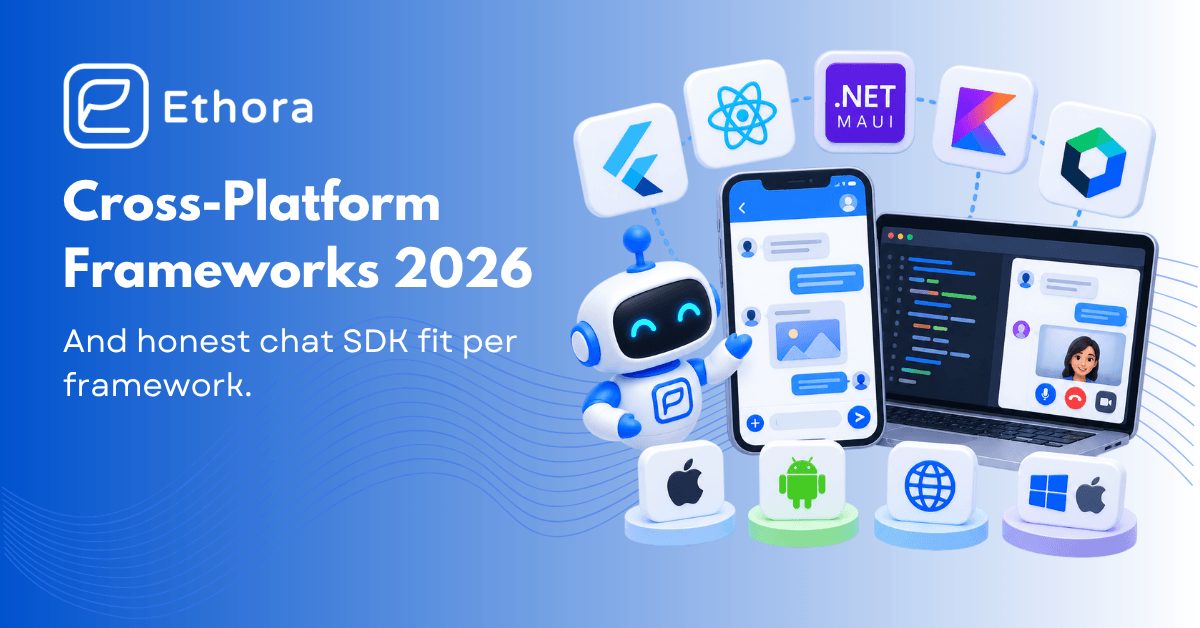
In 2026, evaluating cross-platform frameworks is a complex matter. There are many practical questions: Which ones have solid chat and AI SDK support today? Which ones won’t force a painful migration when the next major OS version drops? And what are the real engineering trade-offs once you move past the marketing claims?
We’ll look at ten frameworks with those criteria in mind, comparing their strengths and weaknesses.
In this article
- What cross-platform actually means
- The 10 frameworks
- 2024-2026 updates that reshaped the market
- Pick your framework
- Ethora SDK coverage and honest gaps
What Cross-Platform Actually Means in 2026
There are three different approaches called “cross-platform”, and each has its advantages and disadvantages. Once you know which category a framework sits in, you’ll know most of what matters about its performance and how native it will feel.
Native UI, shared logic – React Native, NativeScript, Kotlin Multiplatform
These use the platform’s actual components, so a button looks and behaves like a real iOS or Android button. Logic is shared; the UI layer is either platform-specific or abstracted (as React Native does). Performance can match pure native, and accessibility is usually stronger.
Custom-rendered UI – Flutter, Qt, Compose Multiplatform
The framework draws its own widgets to a canvas and ignores the platform’s UI components. You get pixel-perfect consistency across platforms – a win for brand consistency, but it can feel slightly off if users expect true native conventions. Flutter’s Impeller renderer (stable on iOS and Android since 2024) delivers solid 60/120 fps here.
Web in a wrapper – Ionic, Electron, Tauri
A web app runs inside a native container with access to OS APIs. Best developer productivity for web teams; the performance ceiling is the platform WebView’s ceiling. Electron bundles Chromium (heavy but consistent); Tauri uses the OS WebView (lightweight but has CSS quirks between macOS/WebKit and Linux/Chromium); Ionic/Capacitor wraps the system WebView with a rich plugin ecosystem.
The 10 Frameworks
Cross-platform genuinely saves 30-50% engineering cost compared to maintaining fully separate native codebases. Let’s consider 10 frameworks you can use.
React Native
Meta’s JavaScript/TypeScript framework that uses real native UI components. It still has the biggest ecosystem of any cross-platform option and runs production apps at Facebook, Instagram, Discord, Shopify, and Coinbase.
The big change came in October 2024 with the New Architecture – Fabric, TurboModules, and JSI. It finally killed off the old asynchronous bridge and brought solid gains: 30-60% faster startup, 120 fps animations, and lower memory use. The downside is that anything still stuck on 0.72 or earlier needs a real migration, and some native modules still haven’t shipped TurboModule support, which can leave you blocked on dependencies.
Expo is now the official recommended starting point. With SDK 52-53, development builds, EAS, and Expo Router, the old managed-vs-bare debate is largely over. Bare workflow remains available for deep native customization, but it’s no longer the default.
The hiring market is the strongest of any cross-platform framework – React Native experience maps directly from React web, and the npm ecosystem is fully available. The weakness most teams discover in production: some native module authors still lag on TurboModule compatibility, which can block specific library choices.
Chat + AI SDK fit
First-tier support across all major vendors. Best ecosystem for in-app chat and AI feature integration. See the React Native chat SDK options.
Flutter
Google’s Dart framework that draws its own widget tree to a canvas using the Impeller engine (which replaced Skia for production on both iOS and Android in 2024). Flutter 3.24 made Impeller stable on Android. Used at scale by Google Pay, ByteDance, Alibaba, and eBay Motors.
Flutter’s strongest argument is UI consistency. Because it bypasses platform UI components entirely, a design looks identical on iOS, Android, web, and desktop — which is genuinely valuable for design-forward products where the platform-native experience would be a liability rather than an asset. The 120fps animation story on ProMotion and high-refresh Android displays is the best of any cross-platform framework.
As for the limitations, there are two. Dart is a relatively niche language – the hiring pool is smaller than JavaScript or Kotlin, and senior Flutter engineers cost more or take longer to find. And Flutter’s web target, while improved, is not the strongest choice for SEO-important content or for apps where you want progressive enhancement – Flutter web apps compile to a canvas or DOM element, which search engines and accessibility tools treat differently from standard HTML.
Chat + AI SDK fit
Ethora does not currently ship a native Flutter SDK – Flutter-primary teams should consider another vendor or bridge via WebView with Ethora’s Chat Widget (not the same as a native SDK).
.NET MAUI
Microsoft’s successor to Xamarin.Forms. C# and XAML, compiling to native binaries per platform. .NET 9 (November 2024) improved MAUI performance significantly and deepened Blazor Hybrid integration, which lets Blazor web components run inside a native app shell – useful for teams that already have Blazor web surfaces.
MAUI’s case is clearest for organisations already deep in the .NET ecosystem. If your backend is C#, your team knows C#, and you have existing Xamarin investment, MAUI is the obvious path. The commercial appeal is real: Fidelity and NBC Sports Next ship on it. The community is smaller than React Native or Flutter, and iOS builds still require a Mac or a remote Mac build agent. Teams outside the Microsoft ecosystem generally find better cross-platform options.
Chat + AI SDK fit
No mainstream chat SDK ships a native .NET MAUI package. The practical path is WebView + a JavaScript chat SDK, or custom over SignalR (Microsoft’s WebSocket wrapper). If you need in-app chat on MAUI, expect to build a wrapper layer.
Kotlin Multiplatform (KMP + Compose Multiplatform)
JetBrains + Google’s approach: share business logic across Android, iOS, web, and desktop using Kotlin. Compose Multiplatform reached GA for iOS in 2025, meaning you can now share the UI layer too, not just the business logic. Cash App, Netflix, Memrise, and 9GAG run it in production.
KMP is the least-friction extension path for Android-first teams. If you write Android apps in Kotlin and now need iOS support, you can use KMP to share the logic layer. Thus, you won’t have to rewrite code in Dart or JavaScript. Kotlin offers nullability by default, coroutines, data classes, and extension functions, which makes it perhaps the best mobile language. JetBrains tooling in IntelliJ/Android Studio is genuinely excellent.
Still, some friction remains. Kotlin’s abstractions don’t yet cover some of iOS platform APIs – this makes Xcode and occasional Swift/Objective-C interop required for iOS builds. Finding engineers who know KMP specifically (not just Kotlin for Android) is harder than finding React Native or Flutter developers. Compose Multiplatform iOS is GA but still has edge cases in the UI layer that teams are working around.
Chat + AI SDK fit
There isn’t an “official chat SDK for Kotlin Multiplatform” from any major vendor yet. Usually, teams use the vendor’s Android SDK (for Android devices) and the same vendor’s iOS SDK (for iOS devices), separate implementations tied together via the KMP shared logic.
Ionic + Capacitor
Web technologies such as Angular, React, Vue, and Svelte running in a native container via Capacitor 6, with access to native device APIs through Capacitor plugins. Ionic 8 (2024) improved performance and the Capacitor plugin ecosystem. Backed by OutSystems since 2022. Untappd, Instant Pot, and Sanvello run on it.
Ionic’s strongest case: web teams shipping mobile without hiring native developers. If your team already builds in React or Angular, Ionic is genuinely fast to add iOS/Android from the same codebase. The plugin ecosystem covers most common native capabilities. The performance ceiling is the WebView’s ceiling – not a problem for most content, form, and workflow apps; a real problem for graphics-intensive features or very long scrolling lists where native scroll physics matter.
Chat + AI SDK fit
Any web-based chat SDK or JavaScript chat API works out of the box – this is Ionic’s biggest advantage in this dimension. Ethora’s Chat Widget runs natively in the browser context without any bridging. The full JS ecosystem is available.
Unity
Unity is a C# framework for gaming and AR/VR, and real-time 3D. Many famous games, including Pokémon GO, Beat Saber, and Among Us, were built using it. For enterprise AR/VR – Vision Pro, Meta Quest, enterprise training simulations – Unity is still the standard tool.
Chat + AI SDK fit
Most other vendors don’t ship Unity packages; game teams typically build custom WebSocket connections.
Electron
Chromium + Node.js for desktop apps. The framework powering Slack, Discord, Figma, Postman, and VS Code. Electron 32+ (2024) improved default performance profiles. The bundle size problem (100-300 MB) is well-documented and hasn’t gone away – Electron bundles an entire Chromium instance, which is why every Electron app uses significant RAM.
Electron’s case is straightforward: if you have a web app and need a desktop app that feels like software rather than a browser tab, Electron gets you there with minimal additional engineering. The web development skills transfer directly. Cross-platform consistency is excellent because everyone gets the same Chromium. The trade-offs – memory, bundle size, not feeling quite native on any platform – are real and well-understood. Teams that reach for Electron knowing those trade-offs usually make the right call.
Chat + AI SDK fit
Any web-based chat SDK or JavaScript chat API works. The full browser JS environment is available inside Electron’s renderer process.
Tauri
Rust on the backend, regular web tech on the frontend, and it uses the OS’s own WebView instead of shipping Chromium. Tauri 2.0 finally made iOS and Android solid targets alongside desktop. Bundle size is the obvious win – a lot of Tauri apps land under 1 MB, while Electron is still hauling around 100+ MB.
The catch is those WebViews aren’t the same. macOS and iOS run WebKit, Windows uses WebView2, Linux is either WebKitGTK or Chromium. So CSS that looks fine on your Mac can look broken somewhere else, and you end up testing across platforms again. Rust itself is fast and secure, but if your team is coming from JavaScript or Python, the learning curve is real.
Chat + AI SDK fit
Web-based chat SDKs work via the JS frontend. The Rust backend can host a self-hosted chat server (like Ethora) for teams that want to keep the messaging layer local – an emerging pattern in privacy-conscious enterprise apps.
NativeScript
JavaScript/TypeScript rendering truly native UI – actual native components called from JavaScript. Supports Angular, Vue, Svelte, and SolidJS. Qt
NativeScript’s pitch is genuinely compelling in theory: native UI feel with web developer skills, no WebView ceiling, direct native API access without bridging. The practical problem is momentum. The community is materially smaller than React Native, documentation gaps exist in edge cases, and finding engineers with NativeScript experience is harder than finding React Native engineers. Teams that need truly native UI from a JavaScript stack should benchmark React Native’s New Architecture first – the performance gap between them has narrowed considerably.
Chat + AI SDK fit
Limited first-party chat SDK support. Teams integrate via JavaScript wrapper clients rather than native packages. Not the strongest target for in-app chat.
Qt
C++ framework with QML for UI, Python bindings (PySide6/PyQt), and a commercial license (required for closed-source projects, which adds meaningful cost at scale). Qt 6.8 improved WebAssembly output and the Vulkan-based rendering path. 80% of Fortune 500 companies use Qt.
Qt’s platform breadth is unmatched: desktop (Windows, macOS, Linux), mobile (iOS, Android), web (via WebAssembly), and embedded systems (none of the above frameworks cover embedded). The cost is C++ – excellent for performance-critical code, expensive to hire for, and with a steeper learning curve than any other framework here.
Chat + AI SDK fit
No mainstream commercial chat SDK ships native Qt bindings. Telegram built their own. Teams either build custom WebSocket clients or embed a WebView with a JavaScript chat SDK. This is a real gap if in-app chat is a significant feature.
2024-2026 Updates That Reshaped the Market
There are changes that you should know about, which happened in 2024 and later.
React Native New Architecture mandatory (Oct 2024, RN 0.76+)
This wasn’t a soft recommendation – the legacy bridge is hard-deprecated. Apps still on 0.72 or older are on borrowed time and won’t get future security updates. Migration cost depends almost entirely on whether your third-party native modules have TurboModule support yet. Many do. Some don’t.
Expo became the Meta-recommended default
Bigger than it sounds. Expo SDK 52-53 with EAS Build and Expo Router now handles most of what used to require the bare workflow. New projects finally have a clear, batteries-included starting point.
Compose Multiplatform iOS GA (2025)
Kotlin Multiplatform moved from promising experiment to real three-platform option. Cash App, Netflix, and 9GAG in production give it solid social proof. For Android-first teams that don’t want to learn a second language, it’s now the lowest-friction path to iOS.
Tauri 2.0 mobile GA (Oct 2024)
Small bundles and Rust’s security already made Tauri strong on desktop. Mobile support now lets teams use one stack instead of bolting on React Native. WebView differences across platforms are real but manageable for most apps.
iOS 18/19 and Android 15 enforcement
Apple and Google both tightened background and foreground service rules in 2024-2025. Older Cordova-style WebView apps needed emergency patches. Native-UI frameworks (React Native, NativeScript, KMP) handled it better because they talk directly to platform APIs – a strong argument against pure WebView wrappers when reliable background behavior matters.
Pick Your Framework
| Consumer app, rich chat + AI features, largest SDK optionality | React Native + Expo |
| Design-forward app, custom UI, pixel-perfect consistency across platforms | Flutter |
| Android-first team extending to iOS, Kotlin already in use | Kotlin Multiplatform + Compose Multiplatform |
| Enterprise .NET shop, existing Xamarin or C# investment | .NET MAUI |
| Web team shipping mobile from same codebase, JS ecosystem required | Ionic + Capacitor |
| Desktop app, web tech, Electron weight is a concern | Tauri (if team can handle Rust + WebView quirks) |
| Desktop app, large existing web team, consistency over bundle size | Electron |
| Game, AR/VR, real-time 3D | Unity |
| All platforms, including embedded; C++ team in place | Qt |
| No strong constraint pulling you to another option | React Native. It has the largest ecosystem, the most active investment, and the widest chat + AI SDK optionality |
Ethora SDK Coverage (and Honest Gaps)
Ethora’s chat SDK ships first-party packages for React, React Native, iOS (Swift), Android (Kotlin), Node.js, and Python. For teams on those platforms, the integration is straightforward – one API surface whether you’re building a React web app, a React Native mobile app, or an iOS and Android pair.
The AI Bots SDK connects to whichever LLM endpoint you configure – OpenAI, Anthropic, or a self-hosted LLM running Llama 3.3 or Mistral – without changing application code when you switch.
The gaps are real and worth stating plainly. There is no Flutter SDK, but if Ethora-specific features (BYO LLM, self-hosting, flat pricing) are important for you, you can bridge via WebView
There is no native .NET MAUI SDK, no Unity SDK, and no Qt SDK. MAUI and Qt teams bridge via WebView and the Chat Widget. KMP teams use the separate Android and iOS SDKs rather than a unified KMP module.
On the self-hosting side: the self-hosted chat server runs on any Kubernetes cluster regardless of which client framework connects to it. Framework choice affects the client SDK; it doesn’t affect the server deployment. A Tauri desktop app with a Rust backend can run a self-hosted Ethora server locally – the client-side uses the JavaScript SDK in the Tauri WebView frontend.
If you have any questions left, feel free to reach out. We’ll gladly answer all of them.

Share with your community


More Articles
Healthcare
Oct 1, 2026
HIPAA-Compliant Video API in 2026: What Actually Makes One, Vendor Comparison, and Twilio Video Migration
Consultations, psychiatry meetings, medication management, triage, and other medical encounters often do not require physical presence. Adding video to your healthcare app or platform can be a great idea, as it allows you to hold sessions online without losing the human touch. Using a messaging API to incorporate video into your application makes the whole […]

Healthcare
Sep 28, 2026
Telemedicine App Development in 2026: Architecture, HIPAA, AI, and the Build-vs-Buy Decisions That Matter
Telemedicine app development in 2026: HIPAA + EU AI Act, architecture, AI-native patterns, video/chat SDK decisions, and real cost math.

Try Out Ethora in Action
Experience Ethora's messaging with a dedicated demo from our CEO or start building your App right now!