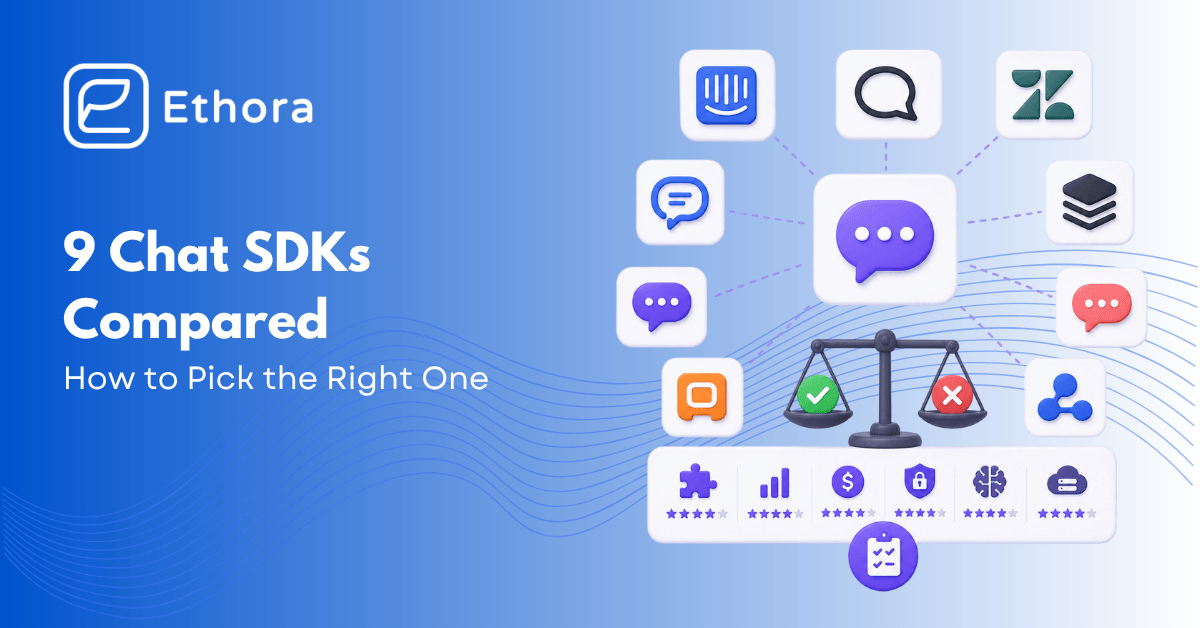
Every chat SDK vendor publishes a comparison page where they give themselves 5 stars and everyone else 3. This article isn’t that. The goal is to help you figure out the best chat SDK for your situation – and there are real differences worth knowing about.
A few things changed in the market recently that affect which vendors belong on shortlists. Twilio sunset its standalone Video product in December 2024 and has pushed teams toward its Conversations API for chat. Sendbird and Stream have both moved upmarket in pricing. And BYO-LLM – the ability to plug in your own language model rather than use a vendor’s proprietary AI – became a real differentiator as teams started taking AI features seriously in production, not just in demos.
This chat SDK comparison covers nine vendors and the open-source option across the criteria that actually decide whether an SDK survives contact with a real codebase and a real compliance team.
In this blog
- When you need a chat SDK at all
- The 7 criteria that actually decide which SDK fits
- The chat SDK landscape in 2026
- Vendor breakdown
- Comparison table
- Which SDK to choose based on your case
- Hidden costs to model before signing
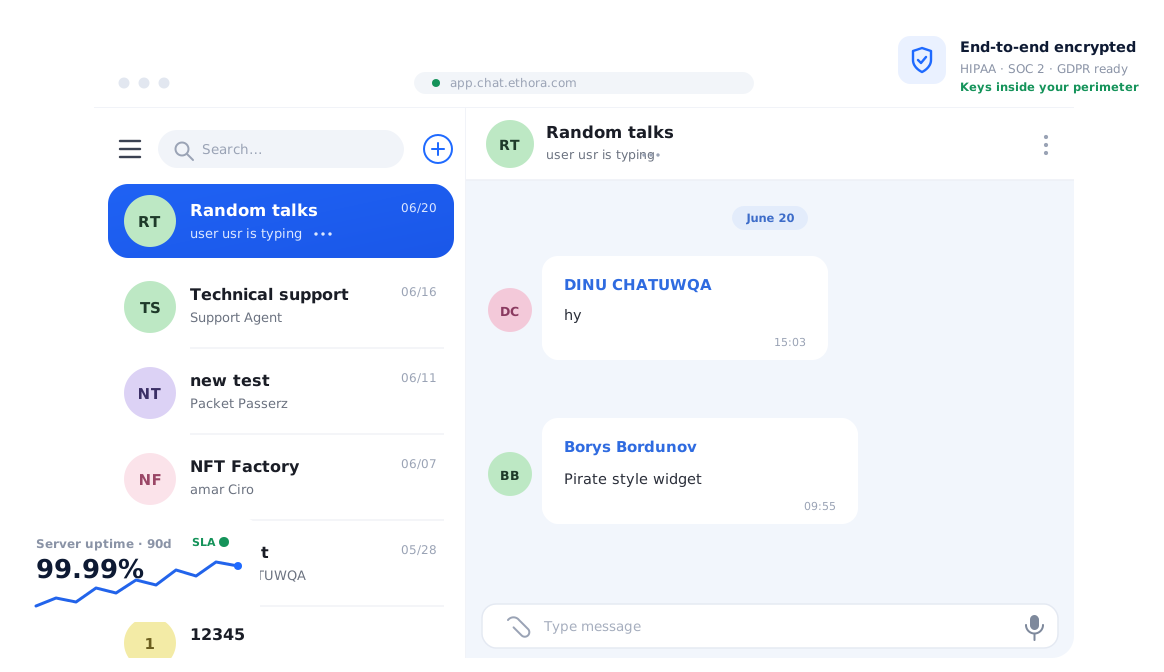
- Why teams choose Ethora over a per-MAU SDK
When you need a chat SDK at all
Before the vendor comparison, the honest question: Do you need an SDK at all?
You probably do if you need real-time delivery with sockets, retries, offline queuing, and push fan-out — and you need it across web, iOS, Android, and React Native without rebuilding the protocol layer on each. You probably do if you want to ship in weeks rather than months, because the UI kits and prebuilt components that come with these SDKs represent months of work. And you almost certainly do if your product has compliance requirements – HIPAA, GDPR, SOC 2 – and you don’t have a dedicated security team to build audit logging from scratch.
The exception: if chat is your core product – you’re building the next Slack, or a consumer social network where messaging is the whole thing – and you have a team of engineers who can own the infrastructure long-term, building on raw sockets or an open-source base might be the right call. The WhatsApp architecture teardown gets into what that actually looks like at scale. For everyone else, the SDK route saves a significant amount of time and doesn’t meaningfully constrain you.
The 7 Criteria That Actually Decide Which SDK Fits
Integration depth. Framework-native SDKs – React, React Native, Flutter, iOS, Android, Node.js, Python – versus raw REST APIs you build a client on top of. The gap matters most at the start: time-to-first-working-message is the honest benchmark. Some vendors ship React and React Native SDKs of comparable quality; others have a strong web SDK and thin mobile wrappers that require significant work to integrate natively.
Customization and UI control. White-label versus branded. Full React component source, you can modify versus a prebuilt widget where you can change colors. The practical question: when a designer wants to change the layout of a message bubble, can your engineers do it, or does it require filing a feature request? Most vendors offer theming; fewer offer actual component-level code ownership for your chat UI design.
Core feature coverage. 1:1 and group messaging, threads, reactions, read receipts, typing indicators, presence, attachments, search across message history, push notifications, multi-device support. These are table stakes, and most SDKs handle them reasonably. Where they diverge is broadcast channels, message pinning, scheduled messages, and moderation tooling – features that matter depending on your use case and don’t always appear clearly on pricing pages.
Scale and reliability. Global edge nodes for latency, uptime SLA, MAU caps, and what happens when you exceed them, message throughput under load, and regional data residency options. For most teams under 50K MAU, the difference between vendors on this dimension is academic. At 500K+, it starts to matter. Ask for an uptime history, not just an SLA promise, to make sure you’re choosing really scalable chat SDK.
Security and compliance. HIPAA with a Business Associate Agreement, GDPR, SOC 2, CCPA, ISO 27001 are the main standards. E2EE option – especially for healthcare and legal. Audit logs – who sent what, when, from where, queryable and exportable. The compliance dimension is where the self-hosting question becomes critical. Some regulators and enterprise security teams require you to demonstrate control over the infrastructure, which a cloud-only vendor can’t provide, regardless of their certifications.
AI capabilities. AI moderation, AI bots, RAG over your documentation, and transcription and summaries for calls. The important divide: those who give you the option to bring your own LLM (OpenAI/Anthropic/local LLaMa) and those who tie you down with their proprietary AI stack. Proprietary AI comes at the price of model updates based on their decision-making, price changes due to their pricing changes, and no ability to host the model on your own servers. Chat SDK with AI features sounds nice, but pay attention to whether it offers BYO-LLM, especially if you’re in a regulated industry.
Pricing model and chat SDK total cost. Per-MAU (Sendbird, CometChat, Stream) means your bill grows as your product succeeds. Per-message (PubNub) means your bill grows with every active conversation. Flat tier (Ethora) means you pay the same at 10K users and 100K users. One-time license (MirrorFly) means you pay once and own it. The right model depends on your growth trajectory and risk tolerance. The trap is modeling month one, not month 13. Add-ons – notifications, AI moderation, storage, analytics – can double the effective cost from what the pricing page shows.
The Chat SDK Landscape in 2026
Five distinct buckets, because “chat SDK” is not one product category:
- Full-stack chat + UI kits: Sendbird, Stream, CometChat, Ethora. You get SDKs, prebuilt UI components, and a hosted messaging backend. Most teams start here.
- Chat + voice/video bundled: Ethora, MirrorFly, CometChat, Sendbird. Important to check whether the video side is production-grade or a checkbox feature.
- Messaging infrastructure (build your own UI): PubNub, Ably. The pub/sub backbone; you build the chat layer on top. Right, if you’re building something non-standard.
- Bundled telco/CPaaS: Twilio Conversations. Chat as one channel in a broader SMS/voice/email suite. Note: Twilio Video was discontinued in December 2024.
- Open-source self-hosted: Rocket.Chat, Matrix/Element, Mattermost, Chatwoot, Ethora. Free software, you run the ops. Best for internal team chat and hard-data-control verticals.
Vendor Breakdown
Ethora
Modular Chat & AI SDK with self-hosting, BYO-LLM, and flat-tier pricing
Strengths: It allows you to host it yourself on-premises or on your preferred cloud platform such as AWS, GCP, Azure, or AWS Marketplace. Use your preferred LLM with the AI Bots SDK and switch among providers without changing anything in your app – connect to Anthropic, OpenAI, or use any local LLMs. The Ethora Chat SDK is modular: you install the Chat Engine, add the AI Bots SDK if you need it, add the RAG Crawler to build a knowledge base from your documentation, or add the Marketplace Chat integration for Shopify or WooCommerce. The bill is a flat monthly fee that doesn’t move when your MAU goes from 50K to 500K. If you need to move from cloud to on-prem when a healthcare enterprise customer’s security team asks, that’s a deployment configuration, not a new contract negotiation.
Weaknesses: Smaller ecosystem than Sendbird or Stream. Fewer third-party integrations out of the box. If you have no compliance requirements or don’t expect fast scaling, you can consider the per-MAU leaders.
Best for: Healthcare, fintech, marketplaces, any team burned by per-MAU pricing, and any team that wants AI without LLM vendor lock.
CometChat
Developer-friendly chat SDK with strong UI Kits and visual builders
Strengths: Mature React, React Native, and Flutter UI kits. Visual builder for theming. Good documentation. An AI agent platform was added in 2024-2025 with chatbot and moderation tooling.
Weaknesses: MAU-based pricing that grows with your user base. AI features, push notifications, and moderation have historically sat in higher tiers. Cloud-first – on-prem is an enterprise-only lane and requires a separate sales conversation. BYO-LLM exists but is tied to their agent stack architecture.
Best for: Mid-market consumer apps that want a polished UI in days and aren’t on a regulatory hard line. Watch out: the MAU tax compounds fast once you have real traction.
Sendbird
Enterprise chat with strong scale and feature depth
Strengths: Mature platform used by Hinge, Reddit, and Coupang. Strong throughput and global edge coverage. AI Chatbot product available. APIs are well-maintained. Depth of features — threads, polls, translation, scheduled messages — is hard to match.
Weaknesses: Starter plan starts at $349/month for 5,000 MAU; 25,000 MAU runs over $1,500/month. PCC (peak concurrent connections) overages apply beyond 5–10% of your MAU limit and are not clearly published. Many features – AI moderation, advanced notifications – are add-ons. Cloud-only: no real self-hosting path. UI kits are functional but opinionated and hard to fully override.
Best for: Venture-funded consumer apps with budget and scale needs that want a proven platform. Watch out: do the 12-month TCO at your projected MAU before signing – the bill surprises teams consistently at growth inflection points.
Stream
Developer-experience-first chat with excellent docs and SDKs
Strengths: Top-tier documentation, genuinely the best in this category. React, React Native, and Flutter SDK parity is strong. The Activity Feeds product is a real differentiator if you need social feed alongside chat. The AI Moderation product is more mature than most competitors’.
Weaknesses: Per-MAU with add-on charges for moderation, videos, and analytics, which inflate the bill. Starting at about $499/month per 10k MAUs for production-ready. Production-ready starts at ~$399/month for 10K MAU. Cloud-only. AI features remain vendor-bound – you’re using their model infrastructure, not your own.
Best for: Engineering teams that value DX above all else and need chat + social feed in one stack. Watch out: the add-on pricing model is where the sticker price diverges from the actual monthly bill.
PubNub
Pub/sub messaging infrastructure; you build the chat UX on top
Strengths: A truly global and low-latency real-time infrastructure with delivery guarantees. Highly flexible outside chat applications, like IoT, live data streams, and game state. Pay-per-message model aligns costs with usage patterns rather than user counts.
Weaknesses: It’s not a chat product. No features typical of messaging apps like moderation dashboards, typing indicators, and presence statuses. If you’re building a chat application, you’ll have to add your own chat layer on top of their pub/sub infrastructure. That’s significant custom dev, and you still own the ops of what you built.
Best for: Teams building heavily customized real-time experiences where chat is one of several channels and a standard chat SDK would be too constraining. Wrong for teams that want to ship fast.
Twilio Conversations
Chat as part of the broader Twilio CPaaS suite
Strengths: Easy Integration with Twilio’s SMS, voice, and email channels. Strong compliance for enterprises. Seamless in-app chat integration if you’re already using Twilio to route your SMS and voice.
Weaknesses: Standalone chat features are thinner than dedicated chat SDKs – no real UI kits, basic moderation, limited AI. And critically: Twilio Video was sunset in December 2024. If you were using or evaluating Twilio for video calling alongside chat, that product is gone. Do not build new video features on Twilio.
Best for: Teams already deep in the Twilio ecosystem who need an in-app chat layer alongside SMS/voice. Not for: teams evaluating Twilio fresh as a chat-first SDK.
Weighing a switch? See the Twilio Conversations alternative comparison for hosting, pricing model, and migration.
MirrorFly
Self-hosted CPaaS with chat, voice, video, and a one-time license option
Strengths: Real self-hosted deployment – not a cloud-only vendor with an “on-prem” label on a higher tier. A one-time license model means your infrastructure cost doesn’t grow linearly with your user base. Bundles chat, voice, and video in a single deployment.
Weaknesses: SDK polish and documentation are behind the top tier. UI kits require more customization to be production-ready, because they aren’t fully developed. Additionally, self-hosting implies that you handle the infrastructure yourself, from managing servers to updates.
Best for: Highly regulated companies that require on-prem and predictable pricing. Watch out: Be sure to set aside funds for integration and ops costs not covered by the documentation.
Ably
Real-time messaging infrastructure with strong reliability guarantees
Strengths: Solid pub/sub foundation with genuine delivery guarantees, including message ordering and at-least-once delivery semantics. Growing chat SDK product. Good option for teams already using Ably for other real-time data and wanting to add chat on top of the same infrastructure.
Weaknesses: The Chat product is newer and less mature than dedicated chat SDK vendors. The UI kit story is thinner. Teams building a full-featured messaging product will find more gaps to fill compared to Sendbird or CometChat.
Best for: Existing Ably customers adding chat. Not the first choice for teams whose primary requirement is in-app messaging.
Open-source (Rocket.Chat, Matrix/Element, Mattermost)
Self-host, zero per-MAU fees, you run the ops
Strengths: Full data control. No vendor lock. No MAU fees. Cost is your infrastructure. Rocket.Chat and Mattermost are mature for team and customer support chat. Matrix/Element gives you federated, decentralized messaging with government-grade privacy credentials.
Weaknesses: Embedding into your own product is harder than with a purpose-built SDK – these are applications, not libraries. UI is opinionated, and deviating from it means significant custom work. Ops burden is real, including upgrades, monitoring, and incident response.
Best for: Internal team chat, federated communities, and environments where full data control is non-negotiable and you have the DevOps capacity to run it.
Comparison Table
| Vendor | Deployment | Pricing | BYO LLM | Moderation | UI Kits | E2EE | HIPAA-ready | Best fit |
| CometChat | Cloud (on-prem enterprise) | Per-MAU | ⚠️ via agent stack | ✅ (higher tiers) | ✅ | ⚠️ opt-in | ⚠️ enterprise | Consumer apps, fast UI |
| Sendbird | Cloud only | Per-MAU + add-ons | ❌ | ✅ (add-on) | ✅ | ⚠️ opt-in | ⚠️ enterprise | Funded consumer scale |
| Stream | Cloud only | Per-MAU + add-ons | ❌ | ✅ | ✅ | ⚠️ opt-in | ⚠️ enterprise | DX-first, chat + feeds |
| PubNub | Cloud only | Per-message | ❌ | ❌ (manual) | ❌ (build own) | ⚠️ opt-in | ⚠️ enterprise | Custom real-time UX |
| Twilio Conv. | Cloud only | Per-message | ❌ | ⚠️ limited | ❌ | ⚠️ opt-in | ✅ | Twilio SMS/voice shops |
| MirrorFly | Self-host or cloud | One-time license | ⚠️ limited | ⚠️ limited | ✅ | ✅ | ✅ | On-prem, telecom/gov |
| Ethora | Self-host or cloud | Flat monthly | ✅ OpenAI/Anthropic/local | ✅ via AI Bots | ✅ React source | ✅ | ✅ (BAA on Enterprise) | Regulated, AI, flat cost |
| Ably | Cloud only | Per-message | ❌ | ❌ | ⚠️ limited | ⚠️ opt-in | ⚠️ enterprise | Existing Ably users |
| Open-source | Self-host | Free (infra cost) | ✅ if you build it | ✅ (community) | ⚠️ opinionated | ✅ Matrix | ✅ with setup | Internal chat, full control |
Which SDK to Choose Based on Your Case
Consumer social app, VC-funded, scale first → Sendbird or Stream
Engineering team that values DX and docs → Stream or CometChat
Healthcare, fintech, legal – HIPAA/GDPR hard bar → Ethora (self-host) or MirrorFly
Want BYO-LLM and predictable AI cost → Ethora
Already deep in Twilio for SMS/voice → Twilio Conversations (no video)
Internal team chat, privacy-first → Rocket.Chat or Matrix self-hosted
Custom real-time UX, not standard messaging → PubNub or Ably
On-prem, telecom/gov, one-time cost preferred → MirrorFly
Chat + AI bots + RAG over docs, out of the box → Ethora
Hidden Costs to Model Before Signing
Every SDK evaluation that focuses on month-one pricing misses where the real cost lands. These are the items that reliably surprise teams in months 6-18:
- The per-MAU growth tax. Your bill goes up as your product succeeds. On a per-MAU model, a 3x user growth means a 3x infrastructure bill with no change in the product. Model this at 2x and 5x your current users before you sign.
- Add-on creep. Push notifications, AI moderation, message analytics, recording, and premium support are frequently sold separately from the base tier. The feature that’s in the product demo is often in a higher tier or an add-on. Ask specifically about every feature on your requirements list.
- Storage and bandwidth overages. File attachments, media, voice messages, and call recordings accumulate. Most vendors include a baseline storage allocation that sounds large until you have active users uploading images and voice notes.
- Migration cost if you outgrow the SDK. Switching chat SDKs mid-product is genuinely painful – message history migration, client SDK replacement across platforms, and re-testing the call flows. Budget 1-3 engineering months if you ever have to do it.
- Compliance gap costs. If your chosen SDK doesn’t include audit logs, you pay for a separate SIEM integration. If it doesn’t sign a BAA, you need a different vendor for regulated data. These gaps have real prices.
- AI inference passthrough. Even with BYO-LLM, you pay the LLM provider directly for inference. Model this separately – gpt-4o-mini at $0.15 per million input tokens is cheap per message, but at 10 million messages per month with an AI feature active on each one, it adds up.
- Data residency premium. EU-only or US-only data residency often costs extra with managed vendors. If your compliance team requires data to stay in a specific region, verify this before it comes up in a security review.
The right way to model total cost
Take your current MAU, model what it looks like at 5x growth, add every add-on feature on your requirements list at paid-tier pricing, add storage overages based on your estimated attachment volume, and compare that 12-month number across vendors. The per-month sticker prices will look very different when you do this exercise.
Why Teams Choose Ethora Over a Per-MAU SDK
The pattern we see most often: a team is 18 months into a product on some per-MAU SDK, the user base has grown, and the monthly chat infrastructure bill has grown with it – faster than expected because add-ons got added along the way. The migration to Ethora starts because the pricing model doesn’t scale with the product’s economics.
The Ethora Chat SDK is modular: you install and use what you need for a fixed monthly price. No unexpected charges or extra high fees when your customer base grows from 100 people to 100,000. Everything is simple, understandable, and designed to deliver the best experience, not to add effort.
By the way, the free tier includes the full SDK, self-hosted deployment, and all modules. You can start building right away.

Share with your community


More Articles
Development
Oct 5, 2026
Cross-Platform App Development Frameworks in 2026: 10 Options Compared, Real Trade-offs, and Chat + AI SDK Fit
In 2026, evaluating cross-platform frameworks is a complex matter. There are many practical questions: Which ones have solid chat and AI SDK support today? Which ones won’t force a painful migration when the next major OS version drops? And what are the real engineering trade-offs once you move past the marketing claims? We’ll look at […]

Healthcare
Oct 1, 2026
HIPAA-Compliant Video API in 2026: What Actually Makes One, Vendor Comparison, and Twilio Video Migration
Consultations, psychiatry meetings, medication management, triage, and other medical encounters often do not require physical presence. Adding video to your healthcare app or platform can be a great idea, as it allows you to hold sessions online without losing the human touch. Using a messaging API to incorporate video into your application makes the whole […]

Try Out Ethora in Action
Experience Ethora's messaging with a dedicated demo from our CEO or start building your App right now!