Smartphones have become an integral part of our lives, we use them for almost everything, from entertainment to managing insurance and finance. For businesses, this makes a smartphone a convenient tool to reach their customers.
What is an SMS notification, and how does it differ from a push notification?
An SMS notification is a short text message delivered through the cellular network using the SMS protocol — it works on any mobile phone with a SIM, no app required, and the carrier charges per message. A push notification is a real-time alert delivered through Apple Push Notification Service (APNs) or Firebase Cloud Messaging (FCM) directly to an installed app on an internet-connected device. Push is free at scale, supports rich media and deep links, but only works for users who have your app installed and notifications enabled.
There are two main ways to connect with your audience via smartphones: SMS and push notifications. These two methods have their differences, as well as pros and cons, and knowing them will help you craft better communication strategies, drive engagement, and enhance customer experience.
What Is an SMS Notification?
SMS notification meaning: An SMS notification is a short text message (up to 160 characters) sent from a business to a customer’s mobile phone number via a cellular carrier network. Unlike push notifications, SMS doesn’t require an app, internet connection, or any installation — any mobile phone can receive one, which is why open rates reach around 98%.
SMS is a short text message sent to your mobile device. They are sent via Short Message Service (SMS), hence the name.
Businesses use SMS to deliver important information to their customers. Such messages are called SMS notifications. For example, banks send notifications about transactions and security verifications, e-commerce stores send order confirmations and shipping updates, healthcare providers remind about appointments, and so on.
What Is a Push Message (or Push Notification)?
Push message meaning: A push message — also called a push notification — is a short, actionable message that an app “pushes” to a user’s device over the internet. It appears on the lock screen or notification bar and can contain text, images, or interactive buttons. The terms “push message” and “push notification” are used interchangeably.
Push notifications are messages that applications send to users’ devices. They are displayed on the lock screen or notification bar of a device, featuring short text, images, or interactive buttons. They are used for promotions, reminders, or real-time updates, such as “Your ride has arrived” or “You’ve got a message.”
Push Notifications vs SMS: Key Differences
Both SMS and push notifications are an essential part of today’s mobile marketing. They serve similar purposes, yet they differ in some aspects. Here’s the breakdown of key differences between pushes and SMS.
| Feature | SMS Notification | Push Notification |
|---|---|---|
| Delivery channel | Cellular carrier | Internet (app or browser) |
| Requires app | No | Yes |
| Requires internet | No | Yes |
| Typical open rate | ~98% | 4–20% |
| Character limit | 160 | ~178 (iOS typical) |
| Cost per message | $0.01–$0.10+ | Free |
| Rich media | Text only (MMS for media) | Images, buttons, deep links |
| Best for | Urgent alerts, 2FA codes | Engagement, re-activation |
Delivery Method
- SMS notifications are delivered via telecom carriers and appear in the native messaging app
- Push notifications are delivered over the internet through an app or browser
Opt-In Requirements
- For SMS, users need to provide their number to opt in and receive your newsletter
- For push notifications, consent is given when users install an app and enable notifications
Reach and Accessibility
- SMS can reach any mobile phone – smart or not – making it universal
- Push notifications only reach users who have the relevant app installed and notifications enabled
Customization
- SMS is text-only with minimal formatting
- Push notifications can include images, buttons, and dynamic content
Visibility
- SMS notifications are separate from others. Also, users can click on the links in the messages and respond with text
- Push notifications pop up as banners and stack over many others. Clicking on them, users open the app
User control
- For SMS, users can’t set their preferences, having only the options to subscribe or unsubscribe
- Users have greater control over what notifications they want to receive
Engagement and Open Rates
- SMS messages have a staggering open rate of about 98%, with most read within minutes
- Push notifications generally have lower open rates (4-20%), but are highly effective for app engagement
Cost and Regulation
- SMS delivery usually incurs a cost per message and is strictly regulated
- Push notifications are free to send, but they are limited to app users
Advantages and Limitations of SMS and Push Notifications
SMS and push notifications have their advantages and disadvantages. Knowing them will help you choose the best communication option for various scenarios. Let’s start with the SMS.
Advantages of the SMS notifications:
- Universal reach. You can contact users without a data or application; all you need is their phone number
- Universal support. All mobile networks and devices can receive SMS, which makes them one of the most reliable and powerful communication methods
- High open rate. SMS messages have an extremely high (98%) open and response rate
But they have some imperfections too. This includes:
- Limited formatting. Your message can be up to 160 characters, without the possibility of adding emojis or images
- Cost per message. For each message you send, you pay a fee to the mobile network carrier
- Strict compliance. SMS is heavily regulated to protect consumer privacy and prevent spam. If you fail to comply with requirements, this can result in fines, lawsuits, or even blacklisting your number by carriers.
Now, let’s look at what benefits push notifications offer:
- Cost effectiveness. Sending push notifications from your app doesn’t incur any costs
- Instant delivery. Pushes are delivered to customers in real time
- Interactiveness. You can include images, buttons, deep links, and custom actions, which makes your communication more engaging
- Effective for engagement and retention. Timely, personalized push messages can re-engage dormant users, drive daily app usage, and improve customer lifetime value
But just like SMS, push notifications have some disadvantages too:
- No app, no push. You can’t reach users who didn’t download your app or deleted it. This limits your customer reach compared to SMS
- Requires an internet connection. If a user doesn’t have an internet connection, it’s impossible to reach them
- Disabled notifications. Users can set preferences for notifications, and they may disable them for your app completely
- Lower engagement. Push notifications generally see lower open and response rates than SMS, especially for urgent or time-sensitive messages
As we see, none of these methods is perfect. That’s why businesses often use a hybrid strategy, combining them. Using push for in-app engagement and SMS for essential alerts and confirmations helps businesses get the most out of both.
When to Use SMS Notifications vs Push Notifications
Now that you know the strengths and weaknesses of SMS and pushes, you can better understand the best use case scenarios for both. It will help you reach users when you need to, without wasting costs, improve user experience, and achieve better campaign results.
Here is the list of use cases when it’s preferable to use SMS.
- Time-sensitive alerts (e.g., security codes, flight or booking changes, etc.)
- Your audience may not have internet access or your app installed
- You want a guaranteed delivery and immediate visibility
In short, send SMS when it’s a matter of urgency.
Use notifications when:
- You have an app and want to boost engagement or reactivation
- You’re sending personalized offers, reminders, or in-app activity updates
- You want to use multimedia, interactive elements, or deep links to specific app pages
Many businesses combine both SMS and push to create an omnichannel unified experience and ensure their messages are noticed.
Push Notifications for Offline Users: How Modern Chat Platforms Handle This
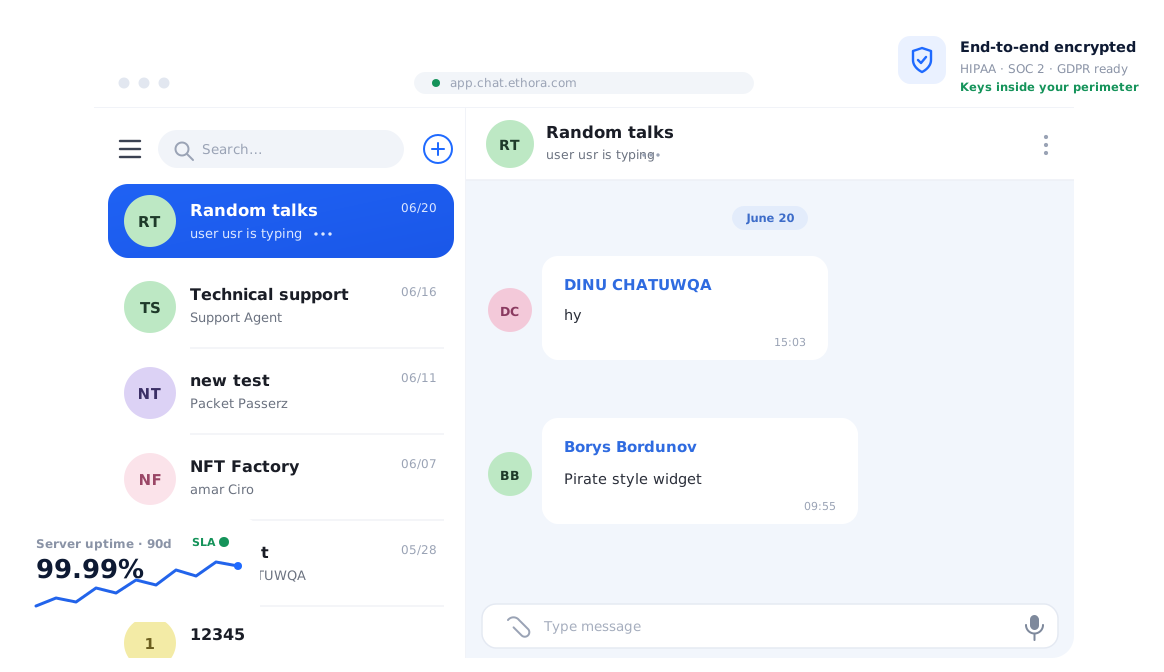
In a real-time chat or messaging app, push notifications serve a specific and critical role: they’re how the system reaches a user whose app isn’t currently open. When someone sends a message — whether from another user or an AI agent — and the recipient’s app is in the background or closed, the messaging platform needs to deliver a push notification that deep-links them straight back to the exact chat room or thread where the new activity happened. Without this, users miss time-sensitive updates and the chat experience breaks down.
Building this offline-delivery pipeline from scratch is surprisingly involved. It requires presence tracking (is the user online or offline right now?), per-device push token management across iOS and Android, APNs and FCM integration, payload shaping to carry the right deep-link metadata, routing logic that opens the correct conversation when a user taps a notification, and fallback handling when the push service is degraded.
Ethora bundles all of this automatically across every SDK — iOS, Android, React Native, Web, and the backend. When a user is offline, Ethora detects the presence state, sends a push notification with the chat room deep link, and routes the user straight into the relevant conversation on tap. Developers integrating Ethora don’t spend weeks implementing this for each platform — it’s built into the SDK and works out of the box, whether the message comes from another user, an AI bot, or a system event.
Frequently Asked Questions
What is a push message?
A push message (or push notification) is a short, actionable message that an app sends to a user’s device via the internet. It appears on the lock screen or notification bar and can include text, images, and interactive buttons. Push messages are free to send but require the user to have your app installed with notifications enabled.
What does SMS notification mean?
An SMS notification is a text message sent from a business to a customer’s mobile phone over a cellular network. It delivers important information such as security codes, order confirmations, or appointment reminders. SMS notifications work on any mobile phone without requiring an app or internet connection, which is why they reach nearly every device.
Are SMS notifications free to send?
No. SMS notifications typically cost $0.01–$0.10+ per message depending on the carrier, destination country, and monthly volume. Push notifications, in contrast, are free to send once a user has your app installed — you only pay for the infrastructure (FCM, APNs, or your messaging platform).
What is the difference between SMS and push notifications?
The main differences are channel (SMS uses cellular networks; push uses the internet), reach (SMS works on any phone; push requires an app), open rate (SMS ~98%; push 4-20%), cost (SMS is paid per message; push is free), and rich-media support (push supports images, buttons, and deep links; SMS is text-only except via MMS).
Which is better for time-sensitive alerts: SMS or push?
SMS is generally better for time-sensitive alerts because of its near-universal reach, near-instant delivery, and ~98% open rate. Push notifications depend on the user having your app installed, notifications enabled, and an active internet connection. For chat messaging, however, push notifications with proper deep linking are the correct choice — they route users back into the specific conversation that needs attention.
Conclusion and Recommendations
Understanding the difference between SMS notifications and push alerts is central to creating smart, successful customer communications strategies. SMS is unique in its capability to send urgent, reliable messages, and push notifications are particularly good at in-app engagement, reactivation, and long-term user retention.
If your business has a mobile app or website, the most powerful strategy is to use both channels – push notifications to build loyalty and daily engagement, and SMS to make sure important updates are received instantly, even when customers are not online.
With Ethora’s engine, you can simply integrate SMS and push notifications into your app with flexible, scalable tools. Whether you’re building a support chat, community forum, or feature-rich super-app, Ethora supplies the communications infrastructure to keep users informed, engaged, and connected anywhere, anytime. If you’d like to learn more about how Ethora can improve communication for your business, contact us.
Adding push and SMS notifications to your app? Ethora’s chat SDK ships APNs and FCM push out of the box and integrates with any SMS provider.
Frequently asked questions
Are SMS notifications free?
No. SMS notifications go through the cellular network and the carrier charges per message — typically $0.005-$0.075 per SMS in the US depending on volume and provider (Twilio, Sinch, etc.). Push notifications via APNs and FCM are free regardless of volume.
When should you use SMS instead of push?
Use SMS when you need to reach users who don’t have your app installed (e.g. one-time passwords, appointment reminders, transactional alerts to phone numbers), when delivery confirmation matters (SMS has higher open rates), or when reaching feature phones. Use push for engagement, in-app events, and rich notifications to your active users.
Can a chat SDK send both SMS and push notifications?
Yes. Ethora’s chat SDK ships push notifications via APNs and FCM out of the box, and you can wire SMS via Twilio, Sinch, or your existing SMS provider for fallback when push fails or for users without the app.
Are SMS notifications secure?
SMS is sent in cleartext through the carrier network and is generally considered less secure than encrypted push notifications. For sensitive content (auth codes, healthcare info), prefer push to an encrypted app, or use SMS only for non-sensitive alerts and never include the actual data.

Share with your community


More Articles
Development
Oct 5, 2026
Cross-Platform App Development Frameworks in 2026: 10 Options Compared, Real Trade-offs, and Chat + AI SDK Fit
In 2026, evaluating cross-platform frameworks is a complex matter. There are many practical questions: Which ones have solid chat and AI SDK support today? Which ones won’t force a painful migration when the next major OS version drops? And what are the real engineering trade-offs once you move past the marketing claims? We’ll look at […]

Healthcare
Oct 1, 2026
HIPAA-Compliant Video API in 2026: What Actually Makes One, Vendor Comparison, and Twilio Video Migration
Consultations, psychiatry meetings, medication management, triage, and other medical encounters often do not require physical presence. Adding video to your healthcare app or platform can be a great idea, as it allows you to hold sessions online without losing the human touch. Using a messaging API to incorporate video into your application makes the whole […]

Try Out Ethora in Action
Experience Ethora's messaging with a dedicated demo from our CEO or start building your App right now!