Blog
Development
Blog
Development
Development
Digital Transformation for Midstream Oil & Gas: Field Communications, AI Knowledge Bases, and Compliance-Grade Data
Midstream operators move product across thousands of miles of pipeline, store it in tank farms and caverns, process it at compressor stations and gas plants, and do all of this under continuous oversight from PHMSA, FERC, the EPA, and state public utility commissions. The assets are instrumented, increasingly, with sensors and SCADA. The incident records, inspection logs, and work orders are still, at many operators, managed on clipboards, shared drives, and text messages.
The gap between the physical instrumentation layer and the information layer is where most midstream digital-transformation programs are playing in 2025-2026. Not “add a mobile app” – that’s a decade old. The real work is closing three specific gaps: connecting field-workforce communications to a tamper-evident audit trail, making regulatory content searchable by the people who need it, and getting predictive maintenance models into the hands of operators before failures become incidents.
This article covers the four layers of midstream digital transformation, the six software categories that actually move the needle, and two overlays – secure field chat and AI regulatory knowledge bases – that are underappreciated relative to their ROI.
In this article
- The 4 layers of midstream digital transformation
- 6 software categories that move KPIs
- Overlay 1: Secure field-workforce communications
- Overlay 2: AI knowledge bases for regulated operations
- Real KPI benchmarks
- Mistakes that slow transformation programs
- Where Ethora fits
The 4 Layers of Pipeline Digital Transformation for Midstream Operators
Midstream energy industry digital transformation is not just about introducing new technology but a strategic process through which organizations must transform their operations and connect data in order to make more intelligent and quicker decisions. When organizations have an insight into different layers of digital transformation, they will be able to allocate resources properly, minimize the complexity of processes, and establish a scalable digital environment. Four layers of midstream digital transformation can serve as a roadmap for that purpose.
1. Physical instrumentation
SCADA modernization, IoT sensors on compressor stations, flow meters, corrosion monitoring, leak detection via satellite imagery, acoustic sensing, and distributed fiber. Most operators have been investing in this layer for a decade. What’s newer is the OT/IT convergence problem – as operational technology connects to enterprise networks, the cybersecurity attack surface expands dramatically. The Colonial Pipeline incident in 2021 is the canonical example of what happens when that boundary isn’t managed.
2. Operational systems
Pipeline integrity management (PIM), gas measurement and allocation, scheduling, nomination systems, transportation management systems. This is the deepest and most specialized technical stack in midstream – these systems handle the actual commercial and regulatory reporting that operators live and die by. Replacing or upgrading them is a multi-year program, not a sprint.
3. Workforce enablement
Mobile field apps for inspectors and pipeline crews, digital work orders, electronic permits-to-work (e-PTWs), mobile form capture, and dispatch communications. This is the layer with the highest labor-productivity ROI relative to implementation complexity – the tools exist, the integration patterns are established, and the payback is measurable in months rather than years.
4. Data and AI
Operational data lakes for time series, ML models for predictive maintenance, AI knowledge bases on top of regulations and SOPs, LLM-driven internal support. This is the new, fast-growing layer in 2026.
6 Software Categories That Actually Move Midstream KPIs
| Category | Primary KPI | Typical vendors | Implementation horizon |
| SCADA + IIoT | 10-20% reduction in unplanned downtime | Inductive Automation Ignition, AVEVA, GE iFIX | 12-36 months |
| Pipeline Integrity Management | Integrity reporting cycle: weeks → days | Enablon, ROSEN, Emerson, ILI vendors | 18-36 months |
| Field workforce apps | 20-35% productivity lift; 40-60% fewer paper-form errors | IBM Maximo, ServiceNow FSM, eMaint, Salesforce FS | 6-18 months |
| Predictive maintenance / APM | 15-30% reduction in reactive maintenance spend | OSIsoft PI, AVEVA APM, C3 AI, GE Digital | 12-24 months |
| Secure field communications | 20-35% faster incident-response coordination; audit trail | Purpose-built SDK, Teams/Slack with retention add-ons | 3-9 months |
| AI knowledge bases (RAG) | 30-50% faster time-to-answer on regulatory content | Custom RAG stack, Microsoft Copilot, Glean | 3-6 months for pilot |
KPI benchmarks are directional, based on operator case studies published by McKinsey Energy Insights, Deloitte Energy, and PHMSA technical assistance resources. Results vary by operator size and implementation quality.
Overlay 1 – Secure Field-Workforce Communications
Here’s the gap that doesn’t appear in vendor brochures: most midstream operators coordinate field crews on SMS, personal WhatsApp, and radio. SMS has no audit trail. WhatsApp is legally and regulatorily problematic for any conversation that could be relevant to a PHMSA integrity investigation – and under 49 CFR Part 195, the agency can and does subpoena communications related to reportable incidents. Radio is searchable only as far back as whatever was recorded, which in most operations means not at all.
The practical consequence: when an incident triggers an investigation, reconstruction of field communications is a legal-discovery nightmare. Operations lawyers are consistently among the earliest advocates for secure, logged field-chat platforms – not because of digital-transformation enthusiasm, but because of what they’ve seen happen when investigators ask for the messages between a crew and dispatch in the 48 hours before an incident.
What secure field-workforce chat actually means for midstream
A purpose-built platform for this use case needs mobile-first apps that work for pipeline crews (meaning offline messaging – fiber-coupled ROW is a dead zone), a tamper-evident audit log with legal-hold capability, role-based channels (dispatch, crew, inspector, emergency response), file and photo attachment with EXIF metadata preservation for evidentiary use, and integration with dispatch ticketing.
That’s different from Slack. Slack is excellent for office-based team communication. It was not designed for crews working in Class 3 locations with intermittent LTE, for legal-hold scenarios, or for workflows where the attachment needs provenance metadata that survives into a courtroom. The difference between “send a message” and “send a legally recoverable, geo-tagged, timestamped message” is material in this context.
Build vs buy
Most midstream operators don’t build communications infrastructure. The options are: enterprise messaging (Teams or Slack with compliance add-ons) – cheap, reasonably accessible, but not designed for field-crew workflows or offline operation; field-service platforms with built-in chat (ServiceNow FSM, Salesforce Field Service) – integrated with work-order workflows but often heavy and expensive; or a chat SDK embedded in the operator’s custom field app, deployed on a self-hosted chat server for operators who need on-prem control over where communications data lives.
Compliance note
SOC 2 compliant chat and data-residency controls are increasingly requirements in midstream JV agreements and enterprise customer contracts, not just nice-to-haves. Check what your largest shipper contracts require before picking a platform.
Overlay 2 – AI Knowledge Bases for Regulated Operations
A midstream engineer trying to answer “what is the maximum allowable operating pressure for a 16-inch Class 2 pipeline with 0.312-inch wall thickness, Grade X52?” has a right answer – it’s in 49 CFR §192.619, combined with ASME B31.8 design factors. Finding that answer, cross-referencing it against the company’s SOP, and verifying it against the specific pipe’s vintage specs takes a competent engineer 15-30 minutes. Multiply that by 500 field workers asking similar questions across a 12,000-mile system.
A retrieval-augmented generation (RAG) system over that content library doesn’t replace the engineer’s judgment – it eliminates the 15-30 minutes of document hunting. Point an AI knowledge base at your PHMSA regulatory library (49 CFR Parts 192 and 195), company SOPs, ASME B31.4/B31.8 codes, MSDS sheets, environmental permits, and past inspection reports. Field workers ask in natural language and get a grounded answer with citations to the specific paragraph, so they can verify it rather than just trusting it. That last point matters: the system isn’t replacing regulatory expertise, it’s making it faster to reach the primary source.
Why on-premise LLM matters for midstream specifically
Operational data in midstream is a different category of sensitive from most enterprise contexts. SOPs for a specific pipeline segment, incident reports with root-cause analysis, and internal design calculations are IP that competitors and regulators would both find interesting. Sending that content to a public LLM API – even with a data processing agreement – puts it on third-party infrastructure in ways that midstream operators’ legal and security teams are rarely comfortable with.
The alternative is self-host LLM on the operator’s private cloud or on-premises infrastructure. Llama 3.3 70B from Meta (available on Hugging Face) and Qwen 2.5 72B run competitively with commercial models on most instruction-following and question-answering tasks. On 4-8 A100-class GPUs – the kind already present in some operators’ data centers for SCADA analytics – either model handles 100-500 concurrent queries at acceptable latency. The on premise LLM route keeps operational data inside the operator’s security perimeter entirely.
Reference architecture
Document ingestion from SharePoint, your SOP repository, and PHMSA regulatory downloads. Chunking and embedding – either via OpenAI’s text-embedding-3-small (if cloud API is acceptable for the embedding layer) or a self-hosted model like BAAI/bge-large. A vector database (pgvector on Postgres, Qdrant, or Weaviate). The LLM – self-hosted Llama or Qwen for maximum data control, or a commercial model via a signed DPA for operators comfortable with cloud. A chat interface embedded in the existing field-worker mobile app, so crews don’t need to learn a new tool. See the conversational AI agents architecture article for the full 6-primitive stack detail, and local LLM tools for the self-hosting setup options
Consolidated KPI Benchmarks
| Transformation area | Typical KPI outcome | Source basis |
| SCADA modernization + IIoT | 10-20% reduction in unplanned downtime | Directional, industry benchmarks |
| Field workforce apps (digital work orders, e-PTW) | 20-35% productivity improvement; 40-60% reduction in paper errors | Directional, operator case studies |
| Predictive maintenance / APM | 15-30% reduction in reactive maintenance spend | Directional, McKinsey Energy; GE Digital APM data |
| Secure field chat (vs SMS/radio) | 20-35% faster incident-response coordination; full audit trail | Directional, field-service platform benchmarks |
| AI knowledge base (RAG over regs/SOPs) | 30-50% faster time-to-answer on regulatory content | Directional, industrial AI early-adopter reports |
| PIM integrity reporting | Cycle time: weeks → days | Directional, PHMSA TA program case reports |
| Program payback (well-scoped) | 18-36 months | Directional, Deloitte Energy transformation benchmarks |
Mistakes That Slow Midstream Transformation Programs
Digital transformation takes time, effort, and money. Mistakes can be costly and slow down the process. Knowing the most common ones will help you decrease these risks.
Buying software before diagnosing the workflow. Field inspection apps get deployed and then go unused because they added steps rather than removed them. The diagnosis conversation should happen before the vendor conversation.
Underestimating OT/IT cybersecurity. Connecting operational technology to enterprise networks – which SCADA modernization requires – without a corresponding OT security program creates real exposure. CISA’s ICS security framework is the reference; most midstream operators are still catching up to it.
Attempting a single-vendor stack for all six categories. Midstream operations software is genuinely specialized – PHMSA reporting workflows are not the same as enterprise asset management workflows. Best-of-breed with integration wins over all-on-one almost every time in this space.
Skipping field-crew buy-in. Inspectors and pipeline crews who weren’t involved in tool selection will find workarounds to avoid using them. A tool that adds friction without removing friction doesn’t get adopted regardless of executive mandate.
Sending operational data to public LLM APIs without data-residency review. Legal and security review of where SOP content and incident data goes should happen before the AI pilot, not after the first inquiry from in-house counsel.
Using SMS or personal WhatsApp for regulated communications. No audit trail. Discoverable in litigation whether or not there’s a policy against it. The problem compounds over time as message history accumulates in places nobody controls.
Treating change management as a soft cost. The people and process side of a transformation program typically accounts for 40-60% or even 80% of total implementation cost and most of the failure risk. Scope it explicitly.
Where Ethora Fits – and Where It Doesn’t
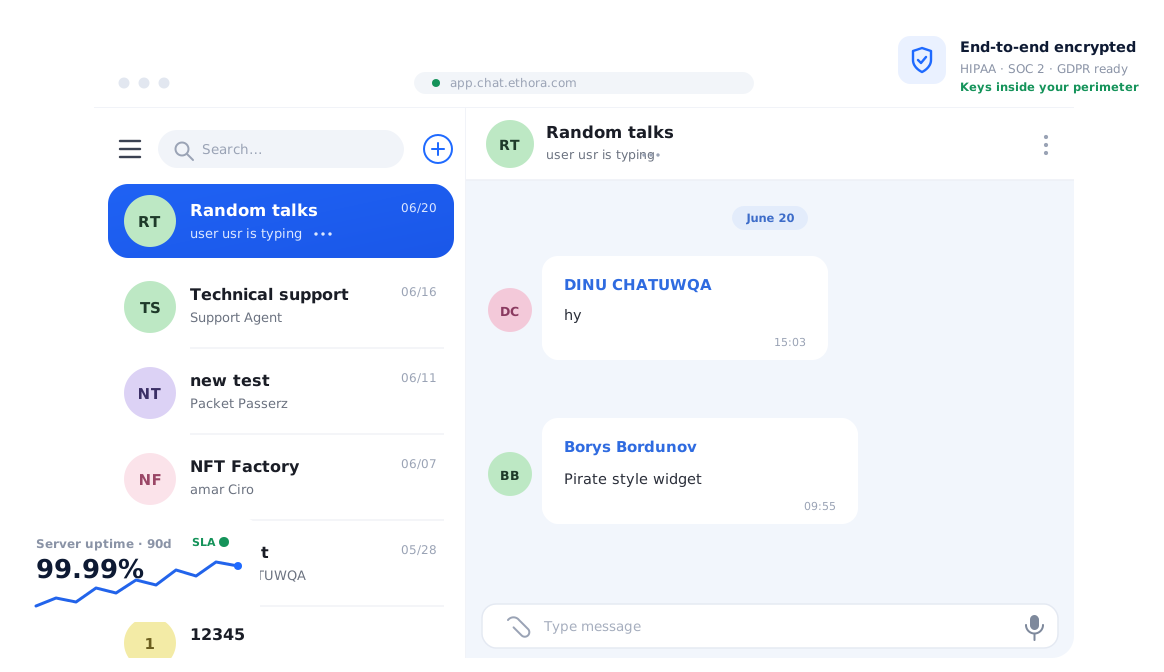
The two overlays in this article – secure field-workforce chat and AI knowledge bases over regulatory content – are where Ethora is credible. The secure chat SDK for field workforce embeds in your existing field-worker mobile app (React Native for iOS and Android, React for the dispatch web interface) with audit-logging, role-based channels, file attachment with metadata preservation, and offline message queuing for crews in dead zones. The self-hosted chat server on AWS or on your own data center keeps the message data inside your infrastructure.
For the AI knowledge base layer, the AI Bots SDK connects to a RAG Crawler pointed at your SharePoint SOP repository and PHMSA document library. The LLM endpoint is configurable — OpenAI or Anthropic via a signed DPA for operators comfortable with cloud, or a self-hosted LLM AI agent running Llama 3.3 70B on your own infrastructure for operators who need complete data-residency control. Swapping the model is a config change, not a reintegration. See the open-source messaging platforms guide for the self-hosted communications options at different ops-burden levels.
Ethora is the right fit specifically when you’re embedding chat into a custom-built field app and need the LLM layer to stay inside your infrastructure – not when you need a prebuilt enterprise communications product with existing midstream integrations.
If you’d like to learn more about how Ethora can facilitate your digital transformation, drop us a line.

Share with your community


More Articles
Development
Oct 5, 2026
Cross-Platform App Development Frameworks in 2026: 10 Options Compared, Real Trade-offs, and Chat + AI SDK Fit
In 2026, evaluating cross-platform frameworks is a complex matter. There are many practical questions: Which ones have solid chat and AI SDK support today? Which ones won’t force a painful migration when the next major OS version drops? And what are the real engineering trade-offs once you move past the marketing claims? We’ll look at […]

Healthcare
Oct 1, 2026
HIPAA-Compliant Video API in 2026: What Actually Makes One, Vendor Comparison, and Twilio Video Migration
Consultations, psychiatry meetings, medication management, triage, and other medical encounters often do not require physical presence. Adding video to your healthcare app or platform can be a great idea, as it allows you to hold sessions online without losing the human touch. Using a messaging API to incorporate video into your application makes the whole […]

Try Out Ethora in Action
Experience Ethora's messaging with a dedicated demo from our CEO or start building your App right now!