Blog
Healthcare
Blog
Healthcare
Healthcare
Telemedicine App Development in 2026: Architecture, HIPAA, AI, and the Build-vs-Buy Decisions That Matter
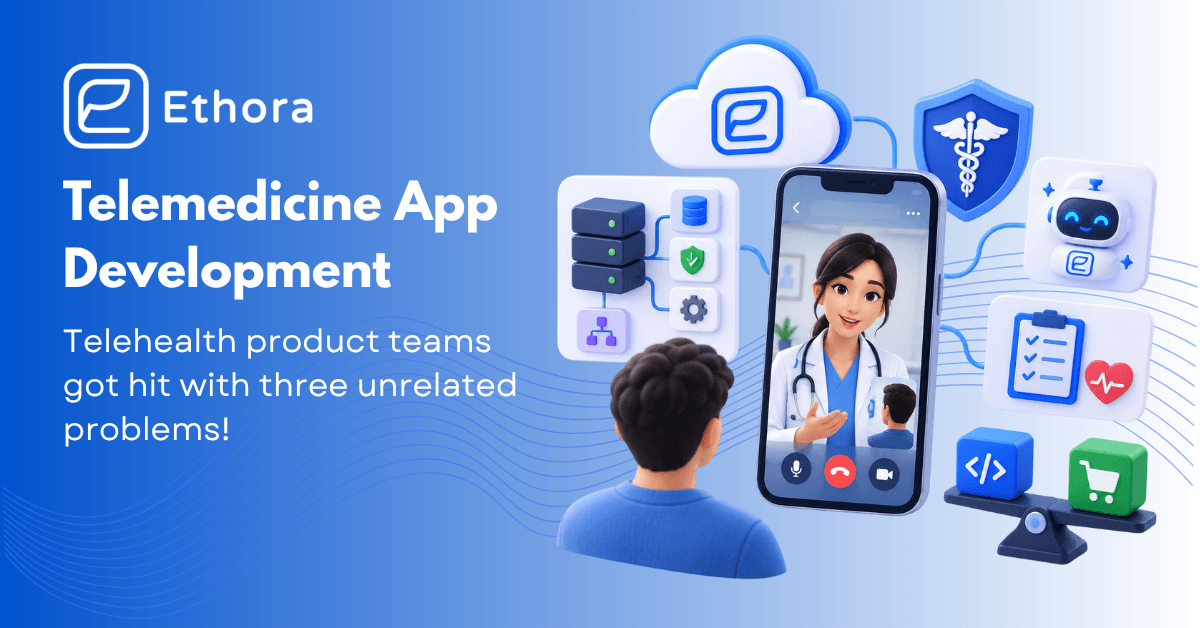
Telehealth product teams got hit with three unrelated problems in quick succession, and none of them were optional to deal with.
The first was operational: Twilio sunset Programmable Video on December 5, 2024. Not a deprecation notice with a year of runway – an actual hard shutdown. Hundreds of teams were forced to migrate a production feature their patients were using.
The second was regulatory: HHS published the first major proposed update to the HIPAA Security Rule in roughly 20 years. The December 2024 NPRM would make encryption at rest, MFA, annual penetration testing, and a 72-hour breach response window mandatory. This rule is still proposed, but adhering to these standards can future-proof
The third is now in force: any AI system used for medical diagnosis or clinical decision support – anything that influences a treatment recommendation falls under Annex III of the EU AI Act’s high-risk AI obligations and requires conformity assessment, human oversight mechanisms, and Article 12 audit logging.
The practical upshot: a Business Associate Agreement can no longer be an afterthought. Neither can the audit trail, the encryption configuration, or whether your LLM vendor signs BAAs.
In this article
- What a telemedicine app actually is in 2026
- Architecture
- HIPAA compliance, rule by rule
- Feature stack: MVP through enterprise
- Twilio Video sunset migration
- AI in telemedicine: what’s real, what’s regulated
- 6-step development plan
- Ethora: HIPAA chat + AI + video SDK
What a Telemedicine App Actually Is in 2026
In 2019, “telemedicine app” meant video call plus secure messaging – you could have an MVP in just a few months. In 2026, a patient communication platform that a health system will actually sign a contract for includes async messaging, video visits, AI-assisted intake, patient education content, remote monitoring data ingestion, EHR sync, and an audit trail that can withstand a HIPAA compliance review from an outside auditor. That’s not a longer feature list for its own sake – each of those layers exists because a real clinical workflow requires it.
The HHS ONC draws a line between telemedicine and telehealth as follows: telemedicine entails remote medical services only, such as diagnostics, prescriptions, consultations, and remote patient monitoring. The telehealth concept is wider and includes all these services together with some other non-medical activities like provider education and coordination.
All things funded and developed in 2026 will be telehealth services, and telemedicine is a basic component of them. The distinction matters for regulatory purposes because EU AI Act classification and some US state telehealth laws apply only to the clinical decision-making component, not the administrative or educational layers.
Three product shapes cover most of the market, and they have genuinely different technical requirements:
- Real-time patient visits. Video conversations between the patient and provider, with latency being the main limiting factor.
- Remote patient monitoring. Wearable devices and home devices sending information asynchronously into the clinical dashboard where storage and alert rules take precedence over latency.
- Message- and prescription-based approaches. Prevalent in mental health, dermatology, and chronic disease care, and in which the interaction itself is mostly text and workflow-based.
Eventually, most telehealth startups end up needing all three of these approaches, which is why architectural choices made early on have a great impact on whether this is possible.
Architecture
The stack layers in a 2026 telemedicine product are relatively consistent across implementations, though the vendor choices at each layer vary significantly.
At the client layer, you have iOS, Android, and web – React Native for a shared codebase is the most common choice, though teams with existing native codebases often keep separate iOS and Android implementations. The provider-side portal is usually web-first. The patient-side is usually mobile-first. Both need accessibility compliance (WCAG 2.2 AA minimum), which is non-trivial on a telehealth product where many patients are elderly or have disabilities.
Below the clients: an API gateway handling authentication, rate limiting, and the first line of audit logging. Behind that, a real-time messaging layer – WebSocket for HIPAA-compliant messaging, presence, and typing indicators. A video layer running WebRTC with an SFU (Selective Forwarding Unit) for multi-party calls. An AI layer, either a BAA-covered API endpoint or a self-hosted model. A RAG layer where your clinical protocols and patient education content live indexed. A primary database, an audit database (append-only, tamper-evident), and EHR integration via FHIR or HL7 to Epic, Cerner, or OpenEMR.
Two architectural choices that have the most impact on your cost and compliance are cloud versus self-hosting and BYO LLM versus managed API services. For speed, a cloud deployment is much faster to deploy, though many hospital IT organizations need a self-hosted option without accepting a third-party BAA for the data layer. Managed LLM API services are easy to operate, but open-weights self-hosted models ensure data sovereignty and no token cost at scale.
Pro tip
Design the messaging layer with horizontal scaling from day one – WebSocket fan-out via a pub/sub broker (Redis, NATS), not a single stateful Node process. A WebSocket server that works for 50 users and falls over under production load is a production incident waiting to happen, not a technical debt item to address later.
HIPAA Compliance, Rule by Rule
There are three rules your telehealth app needs to follow to meet HIPAA requirements. Knowing them will help you build and configure your application correctly.
Privacy Rule
The Privacy Rule governs who can access ePHI (electronic protected health information) and under what circumstances. For a telemedicine app, the minimum necessary access is the standard: don’t show more data than a user’s role actually requires to do their job – providers see only their own patients, billing staff sees only billing data, admin staff sees only what their role requires.
Additionally, patients need to give documented consent to telehealth delivery of care. If your product sends any data to a third party – including an AI model processing visit summaries – that third party is a Business Associate and needs a signed BAA before the first data transfer.
Security Rule
This one specifies the technical, physical, and administrative safeguards required to protect ePHI. The technical safeguards are what engineering teams actually implement. The current rule separates requirements into “required” (must implement) and “addressable” (implement if reasonable and appropriate). The December 2024 NPRM proposes eliminating the addressable category – everything would become required, including encryption at rest, which is currently addressable and therefore sometimes skipped.
The technical checklist for a HIPAA-compliant messaging app in 2026, designed to be compliant with the current rule and future-proofed against the NPRM: encryption at rest using AES-256 for all stored messages, recordings, and backups; encryption in transit using TLS 1.3; unique user identification (no shared logins); automatic session timeout and logoff; audit controls logging every data access event with user ID, timestamp, and action; integrity controls to detect unauthorized modification of records; person or entity authentication – MFA is strongly recommended now and would be mandatory under the NPRM; and transmission security for all HIPAA-compliant secure text messaging.
If you work with thord-party vendors, they should sign BAA, whether it’s your cloud provider, or SDK vendor, video vendor, AI LLM vendor, etc. If any one of these vendors handles ePHI without a signed BAA, the entire deployment is non-compliant regardless of how well everything else is configured.
Breach Notification Rule
If a breach affects 500 or more individuals, HHS must be notified within 60 days, affected individuals must be notified, and if the breach affects a geographic area, media notification may be required. Smaller breaches are reported to HHS annually.
HIPAA fines run from $100 to $50,000 per violation, with an annual cap of $1.9 million per violation category. The average HIPAA settlement is more than $4 million.
Your audit trail needs to be detailed enough to prove, in the event of a security incident, that a breach did not actually occur – or to quickly determine exactly what data was accessed and by whom.
Feature Stack: MVP Through Enterprise
What you need for launch, what drives retention after launch, and what opens the hospital-system deals are meaningfully different lists.
MVP – required for any paying user:
- Patient portal: authenticated login with MFA, medical history intake, symptom questionnaire, insurance capture, HIPAA-compliant payment flow
- Provider portal: schedule view, patient chart, visit notes, e-prescribing or referral workflow
- WebRTC video visit: 1:1, HD video, low latency – for the trade-offs between WebRTC and alternatives see the WebRTC vs WebSockets breakdown
- WebSocket chat alongside video: survives when video drops, allows async follow-up in the same session
- Async patient communication: secure direct messaging between visits (the HIPAA-compliant messaging layer that replaces email for clinical comms)
- Calendar + scheduling with automated reminders
- Audit trail: every data access event logged with user, timestamp, action, and data type
- Secure file upload: labs, imaging, insurance cards
Async care – drives retention after MVP:
- Secure messaging for healthcare: structured threads between patient and care team, not free-form SMS
- Patient education RAG: personalized content based on diagnosis and visit history, pulled from indexed clinical library
- Appointment reminders and follow-up check-ins via push notification
- Prescription refill request flow
- Automated symptom tracking between visits (daily check-ins, wearable data ingestion)
AI-native – the 2026 differentiator:
- AI symptom triage: LLM-driven pre-visit intake that routes patients to the right specialty or urgency level
- AI note-taking: voice recording → structured SOAP note (Nuance DAX, Abridge, and Suki are the leading third-party options; self-hosted models are viable at sufficient volume)
- AI care coordinator: responds to patient messages between visits with escalation to a human clinician when needed – the HIPAA-compliant AI pattern that most teams are piloting in 2026
- AI patient education: personalized post-visit summary and next-step content from indexed clinical protocols
Every AI feature needs a HIPAA-compliant LLM – either a BAA-covered API (Azure OpenAI, Anthropic enterprise) or a self-hosted model on your infrastructure.
See the EU digital sovereignty guide for EU provider requirements.
Enterprise – required for hospital-system contracts:
- EHR integration: Epic App Orchard, Cerner CommunityWorks, OpenEMR via FHIR or HL7 pipelines – without this, the hospital won’t sign
- SSO via SAML, Okta, Azure AD
- Role-based access control with time-limited grants and per-tenant data isolation for multi-site deployments
- On-premises or private-cloud deployment option – many hospital IT teams refuse third-party cloud BAAs for primary data
- SOC 2 Type II attestation; HITRUST for the largest systems
- Remote patient monitoring: Apple HealthKit, Google Health Connect, Withings, and device-specific integrations
- Legal hold and eDiscovery capability for medical records
Twilio Video Sunset: Migration Status in 2026
The shutdown of Twilio Programmable Video forced telehealth teams to migrate a production feature handling real patient visits. Here’s the market evaluation for potential replacement.
| Vendor | HIPAA BAA | Self-host | Pricing (managed) | Best for |
| LiveKit | Enterprise plan only | ✅ open-source | ~$0.004/participant/min | React/RN teams; self-host path |
| Daily.co | Scale or Enterprise | ❌ | ~$0.004/participant/min | Fast integration, telehealth focus |
| Vonage Video | Enterprise only | ❌ | Higher than LiveKit/Daily | Enterprise with legacy OpenTok |
| Amazon Chime SDK | Under AWS BAA | ❌ (AWS only) | $0.0017/attendee/min (audio) | Teams already on AWS |
| Agora | Enterprise only | Limited | Variable; complex tiers | Cross-region US–Asia deployments |
| Ethora | ✅ Business tier | ✅ all tiers | ~$99/mo flat (not per-min) | Chat + video + AI in one SDK |
The most common migration pattern: teams migrate the video layer first, keep existing Twilio Programmable Messaging and SMS (which is not sunset – only Video was), then re-evaluate the chat vendor at the next contract renewal. Some teams use the forced migration as an opportunity to consolidate chat, video, and AI under one SDK and one BAA rather than maintaining three separate vendor relationships. That consolidation question is worth modeling explicitly – three BAAs, three vendor relationships, and three integration surfaces have a real ongoing maintenance cost. SDK API surfaces differ significantly between vendors, so expect 2-6 weeks of engineering per platform for a clean migration rather than a drop-in replacement.
AI in Telemedicine: What’s Real and What’s Regulated
Four AI use cases have genuine production deployments in 2026, and they have meaningfully different regulatory profiles.
AI Intake and Triage
Pre-appointment questionnaire driven by the language model that gathers symptoms and routes the patient to the appropriate specialty, and fills in the healthcare practitioner’s records. Regulatory considerations: Not a high-risk classification under the AI Act of the EU as it does not involve any clinical decisions but only the collection and routing of information. Needs to be HIPAA-compliant language model infrastructure.
AI Note-Taking
Recording the visit and generating a structured SOAP note for the provider to review and sign. Self-hosted options are viable with enough scale (Whisper for transcription + an LLM for structuring). Regulatory status: not decision-making in a clinical context, hence typically does not fall into the high-risk category per the EU AI Act. Reviewed and signed by provider – retains human element.
AI Patient Education and Care Coordination
This includes answering patient questions between visits from indexed clinical content, personalizing post-visit instructions, and following up on care plan adherence.
When an AI answers a patient’s question about their medication, the response needs to be grounded in verified clinical content (RAG on your clinical library) rather than the model’s general training, and there needs to be a human escalation path for anything clinical.
AI Clinical Decision Support
Real-time suggestions to the provider during a visit falls under Annex III of the EU AI Act, requiring conformity assessment, technical documentation, human oversight mechanisms, and Article 12 record-keeping. Teams building for EU providers need to assess their specific AI features against the high-risk criteria before August 2026, or risk operating a non-compliant system.
Self-hosting the LLM
For hospital deployments where data sovereignty is non-negotiable a self-hosted model is the only viable path. It gives you full audit control over every prompt and completion – which matters when your audit trail needs to prove HIPAA compliance per patient interaction.
6-Step Development Plan
Start building your app by outlining the steps. Dividing development into stages will help you identify dependencies between features, separate MVP from features that can be implemented later, catch regulatory and security requirements, and give developers a clear implementation sequence.
Planning + market validation (4-8 weeks)
User research with actual patients and providers, not just founders. Competitor landscape (LiveHealth, Teladoc, Amwell, specialty telehealth apps in your vertical). MVP feature scope. HIPAA + EU AI Act requirements mapped to your specific feature set. Vendor shortlist with BAA verification for each. Do not skip the regulatory mapping – discovering a BAA gap at launch is a show-stopper.
Design + pre-development (6-10 weeks)
Wireframes with HIPAA-conscious UX: clear consent flows, large tap targets for elderly users, accessible design at WCAG 2.2 AA. API and SDK selection for video, chat, AI, and EHR. All BAAs signed before any patient data flows through any vendor. This last point is non-negotiable – BAA must precede data, not follow it.
Development (12-24 weeks)
Client apps (iOS, Android, web), backend (auth, database, EHR integration via FHIR/HL7), integration of video, chat, and AI SDKs, audit logging for every data access event, payment flow with a HIPAA-covered payment processor (Stripe has a BAA for eligible products). The self-hosted chat server setup and the HIPAA-compliant chat SDK documentation are useful reference points for the messaging layer configuration.
Testing (4-8 weeks)
HIPAA compliance audit (internal first, then third-party), penetration testing (mandatory under the NPRM; good practice now), load testing at 10× expected launch load, usability testing with real providers and patients, EHR integration testing in the vendor’s sandbox environment before production.
Launch (2-4 weeks)
Soft launch with 1-2 partner clinics before broad availability. Real patient visits in a controlled environment expose usability issues that testing doesn’t. Monitor audit logs for unexpected access patterns in the first 30 days. Have the breach notification template pre-drafted so you’re not writing it under pressure if an incident occurs.
Maintenance
Monthly security review, quarterly HIPAA re-audit, ongoing LLM model updates (open-weights models release frequently; keep a documented update and testing process), annual EU AI Act conformity assessment for any high-risk AI features, and a recurring review of whether the build-vs-buy calculus has shifted as MAU grows.
Ethora: HIPAA Chat + AI + Video in One SDK
Most telehealth apps in 2026 have three separate vendor relationships for chat, video, and AI – three BAAs, three integration surfaces, three SDK upgrades to track, three vendor relationships to manage. Ethora’s modular SDK ships all three under one BAA-covered deployment, which matters most when you’re self-hosting on a hospital private cloud where the number of external dependencies is a compliance concern in itself.
Ethora’s HIPAA-compliant chat SDK handles patient-provider messaging with encryption at rest, customer-managed keys, and an audit trail that logs every message access event with user ID, timestamp, and action. The video module runs WebRTC with SRTP in transit, recording storage encrypted at rest, MFA-required authenticated join, and waiting-room admission control – the four conditions that make a HIPAA-compliant video chat deployment defensible under the Security Rule.
For hospital deployments that can’t accept any third-party cloud dependency, the self-hosted chat server runs on any Kubernetes cluster – AWS with BAA, OVHcloud or Scaleway for EU HIPAA-compliant patient communication with GDPR overlap, or on-premises hospital infrastructure. In self-hosted mode, the BAA is yours alone: you’re not relying on Ethora’s cloud infrastructure BAA because Ethora isn’t in the data path.
Dr. Talks, a HIPAA-compliant medical AI assistant, is built on Ethora’s self-hosted stack – patient triage, provider chat, AI medical Q&A with BYO LLM, and an audit trail covering every chat message and AI interaction.
Reach out if you’re building a telehealth app. Our team will answer all of your questions and explain how to configure Ethora to ensure your patient communication is always HIPAA-compliant.

Share with your community


More Articles
Embeddable AI Widget
Sep 24, 2026
How to Add an AI Chat Assistant to WordPress in Under 10 Minutes
Adding a live, AI-powered chat assistant to your WordPress site does not require writing a single line of code. This guide walks through installing the free Ethora Chat Assistant plugin, connecting it to your Ethora agent, and confirming it works live on your site, screenshot by screenshot.

Development
Sep 21, 2026
WebRTC vs WebSockets: Real Differences, Real Benchmarks, and When to Use Both
WebRTC vs WebSockets in 2026: real latency + cost benchmarks, when to use each, and how to combine them for chat + voice apps.

Try Out Ethora in Action
Experience Ethora's messaging with a dedicated demo from our CEO or start building your App right now!