Development
The 5 Stages of the Agile Software Development Lifecycle
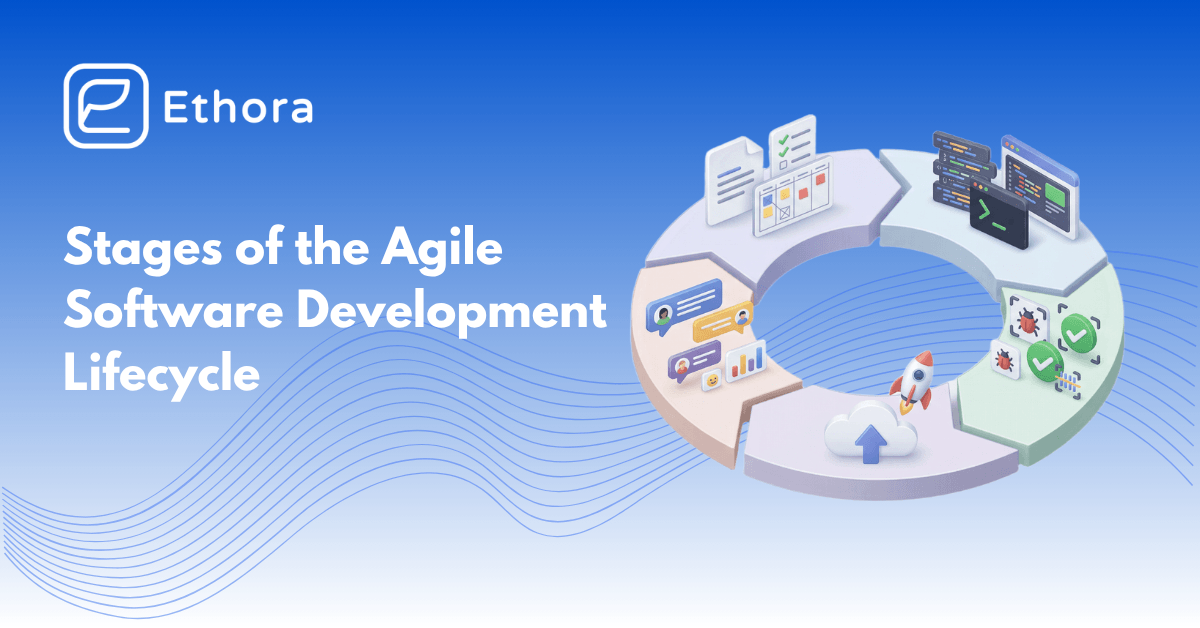
Crazy competition requires companies to be flexible and quickly react to changing conditions. In such an environment, you can’t stick to the old, documentation-heavy software development processes – they are too slow. To stay competitive, businesses pivoted to the Agile methodology – an iterative approach that prioritizes flexibility, speed, and user-centric results.
Why Ethora fits the Agile toolkit: Agile sprints move fastest when teams stop rebuilding undifferentiated infrastructure. Messaging, push notifications, presence, AI agents — these belong in a drop-in SDK, not in your sprint backlog. Ethora’s chat SDK and AI SDK let product teams focus sprints on actual product differentiation rather than reimplementing WebSocket reliability or push-notification routing for the tenth time. With that context, here’s the Agile SDLC walkthrough.
The Agile Methodology vs. Waterfall
Waterfall methodology is a software development approach with sequential phases. Using it, you begin the next phase only after the previous one is completed. It looks like this:
- Ideation
- Development
- Testing
- Deployment
- Operations & Maintenance
This approach lacks flexibility because you can’t respond quickly if requirements change in the middle of the project, leading to delays and higher expenses.
Agile methodology offers an iterative approach, with sprints 2-4 weeks long. Thus, it’s easier for teams to adapt and make necessary adjustments when anything changes. This is possible due to a continuous feedback loop, which is also the core advantage of the methodology:
- Users validate features early
- Bugs get caught immediately
- Product direction evolves based on real data
Agile gives teams more flexibility, reduces risks, and improves outcomes. Companies that use it report 71% faster go-to-market, and projects built with this methodology are 1.5x more likely to succeed than those built using the Waterfall model.
Phase 1: Ideation
First of all, it’s important to clarify that in Agile software development, there are no phases as such. Scrum is iterative and continuous – planning, development, review, and improvement happen every sprint.
Anyway, you need to start somewhere, and the first step is ideation. To provide the foundation for the project, teams define:
- project vision
- business requirements
- target users and use cases
Typical outputs:
- product backlog
- user stories
- initial UX/UI design (wireframes, user flows)
To have all of this in one place, teams create a “product backlog” – a list of everything that might be needed in the product. It’s ordered by importance (value, priority, risk, etc.) and may include features, bug fixes, technical improvements, compliance work, research, non-functional requirements, etc.
This is a critical stage, because poorly gathered requirements may lead to wasted resources and an underperforming product.
Phase 2: Development
The next phase is development, which entails software architecting and iterative coding. This is carried out in sprints, with daily calls and reviews for efficient teamwork and product quality. Short sprints allow devs to focus on specific features. They implement the core logic and UI components, and continuously refine the architecture.
Daily calls and reviews ensure alignment and product quality. Teams don’t build all at once – they ship small increments of the product, validate them with user feedback, and iterate quickly.
The incremental approach facilitates rapid changes based on user feedback, minimizing the need to redo tasks. Additionally, by including UX/UI design, developers design user-friendly applications for better adoption rates. These phases provide a robust platform for software development, with Agile teams delivering 250% higher quality than traditional approaches.
Phase 3: Testing
In Waterfall, testing and quality assurance are the last stage. In Agile, testing isn’t the last step – manual and automated tests are embedded into every sprint, including:
- Unit testing
- Integration testing
- User acceptance testing (UAT)
- Security assessments
This creates quick feedback loops, allowing you to detect and fix bugs early. Ongoing testing reduces help desk tickets by 55% compared to Waterfall, and minimizes the risk of costly fixes in the future.
Phase 4: Deployment
Software deployment means your product is going live. The rule for the release is simple: once the feature is stable, it gets released. In Agile, teams often use CI/CD (continuous integration/continuous deployment) pipelines to automate the build, test, and deployment of updates.
The apps are deployed to the cloud or on-premise servers, depending on the business needs. This approach enables the quick release of new features and the fixing of bugs.
To ensure that your software works as intended, you need to test it in the staging environment before deploying.
Phase 5: Operations and Maintenance
Your app’s long-term success depends on the post-launch support. This means: ongoing maintenance, performance monitoring, and bug fixing are a must. Make sure to track metrics such as engagement, retention, DAU/MAU, technical issues, and whatever else is important for your solution – this will help you assess the overall performance of the application. Additionally, gather user feedback to find out what you can improve, whether it’s additional functionality or design – adaptive maintenance increases customer satisfaction by 93%.
Improving Agility and the DevOps Connection
Many teams use Agile and DevOps together for faster development. While DevOps makes releasing and running software more efficiently, Agile focuses on developing it step-by-step. This combination can increase effectiveness by 20%.
Scaling for Success: Build Professional AI Apps with Ethora
Agile gives you the process, but you still need the engine. Ethora provides a high-performance engine. Move beyond simple templates by building a professional application powered by a robust mobile chat SDK. Whether you are creating a ChatGPT-like AI agent or need to facilitate deep AI integration, Ethora provides the professional toolkit to bridge business data with the world’s most powerful LLMs within your Agile sprints.
Ethora offers a self-hosted chat server, compatible with AWS application server and AWS node SDK, enabling a self-hosted messaging app.
For development, leverage SDKs like React Native chat SDK, web messaging SDK, iOS chat SDK, Android chat SDK, and mobile chat SDK. UI kits include a chat UI kit, a message kit, a chat UI template, and a React chat UI component. To get started, explore the optionally open-source GitHub repository for Ethora.

Share with your community


More Articles
Development
Oct 5, 2026
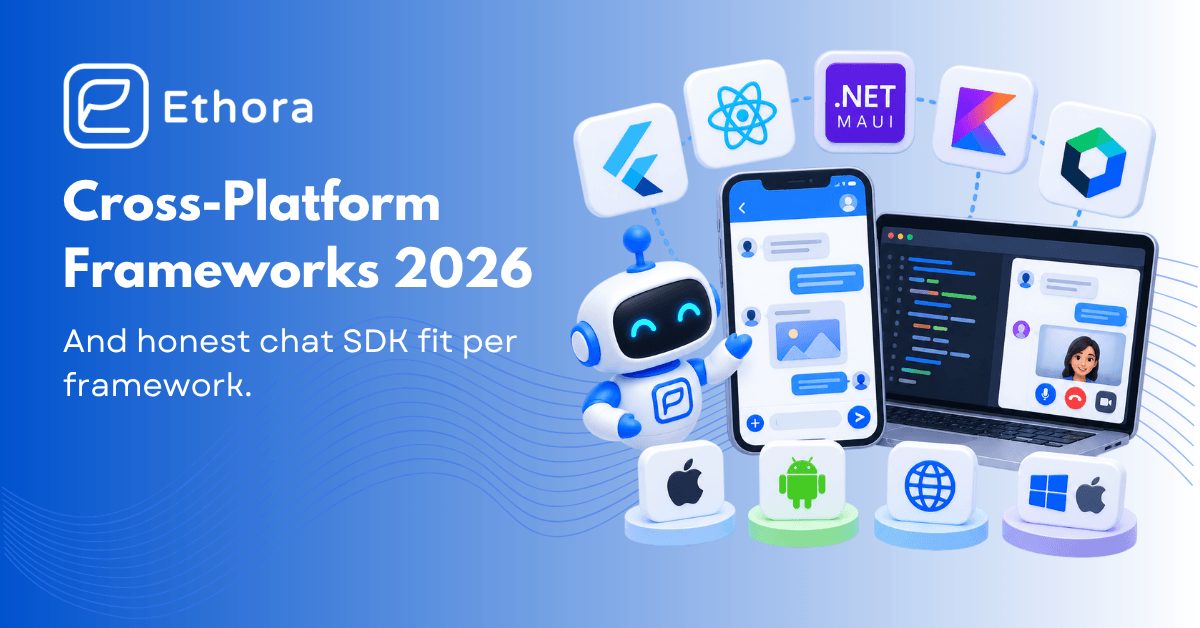
Cross-Platform App Development Frameworks in 2026: 10 Options Compared, Real Trade-offs, and Chat + AI SDK Fit
In 2026, evaluating cross-platform frameworks is a complex matter. There are many practical questions: Which ones have solid chat and AI SDK support today? Which ones won’t force a painful migration when the next major OS version drops? And what are the real engineering trade-offs once you move past the marketing claims? We’ll look at […]

Healthcare
Oct 1, 2026
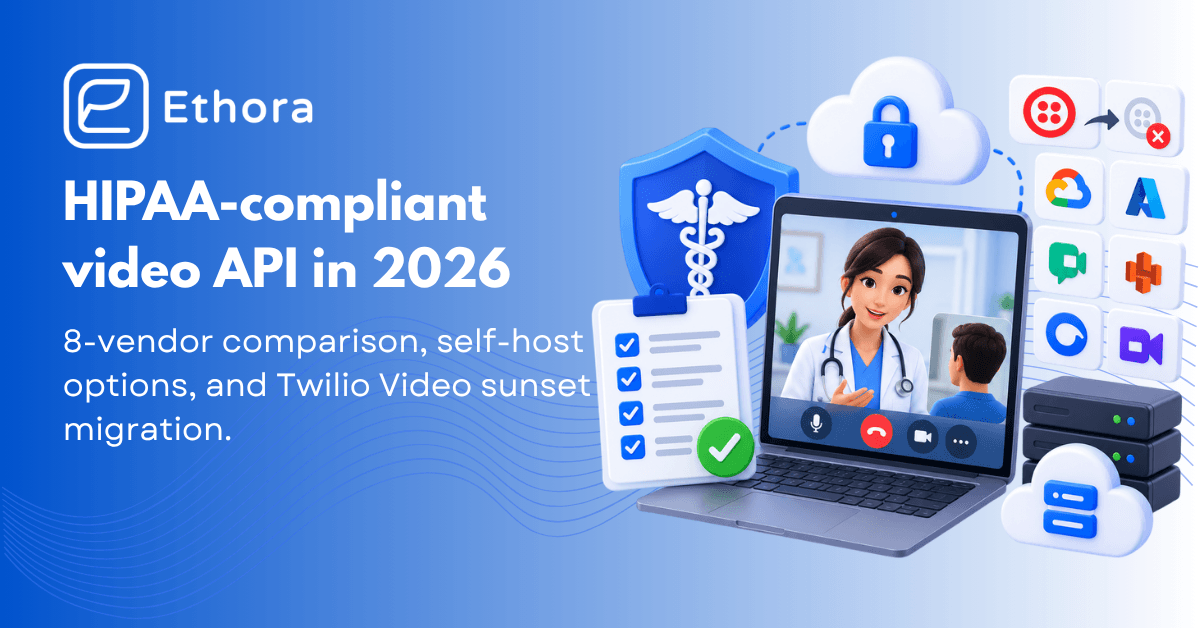
HIPAA-Compliant Video API in 2026: What Actually Makes One, Vendor Comparison, and Twilio Video Migration
Consultations, psychiatry meetings, medication management, triage, and other medical encounters often do not require physical presence. Adding video to your healthcare app or platform can be a great idea, as it allows you to hold sessions online without losing the human touch. Using a messaging API to incorporate video into your application makes the whole […]

Try Out Ethora in Action
Experience Ethora's messaging with a dedicated demo from our CEO or start building your App right now!