Artificial intelligence isn’t considered a nice-to-have feature anymore, it’s becoming a part of infrastructure. 92% of companies are going to increase their AI investments over the next three years. This tech is here to stay, and it seems those businesses that won’t adopt it might lose the competition.
Yet without knowing the differences between AI models, you won’t be able to use them effectively.
What is an AI Model?
An AI model is an intelligent computer program that can process natural language, recognize patterns, and predict outcomes. AI model training is conducted on a massive dataset (for example, 1 petabyte of data for the previous version of ChatGPT), analyzing examples that can be text, images, sounds, or user behaviour.
Algorithms provide data pattern recognition, which in turn allows the model to understand context and intent, and perform tasks.
We can say that:
- The model is the brain
- The data is experience
- The algorithm is how learning happens
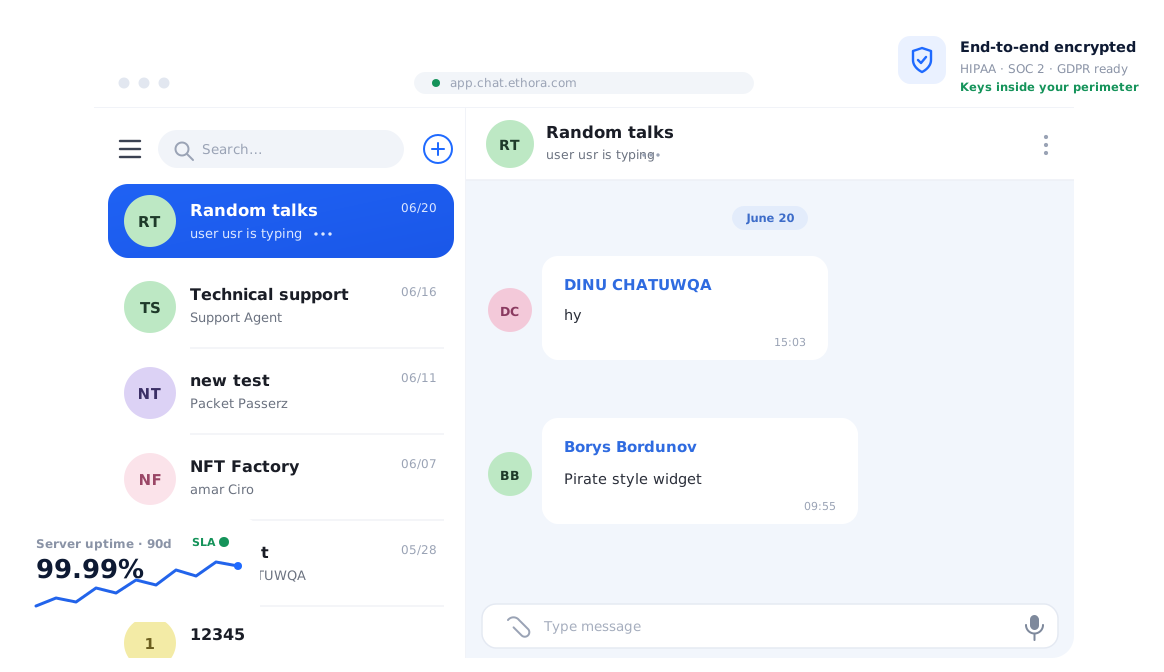
When you use a smart AI chat or build an AI assistant concept into an app, you’re not interacting with “AI” in the abstract – you’re interacting with a trained model designed for language, intent recognition, or conversation flow. That’s why choosing the right model is so important for AI chatbot integration.
Machine Learning: Supervised vs. Unsupervised
Machine learning is the most widely used subset of AI today. Instead of hard-coding rules, machine learning models improve by learning from data. The two most common approaches are supervised and unsupervised learning.
Supervised Learning
In supervised learning, the model is trained on labeled data. That means the system already knows the “right answer” during training. This approach is commonly used for:
- Spam detection
- Price prediction
- Customer churn analysis
If you’re building a smart chat app that needs intent classification or message routing, supervised learning is often the starting point.
Unsupervised Learning
Unsupervised learning works without labeled data. The model looks for structure on its own through data pattern recognition. This is useful for:
- User segmentation
- Anomaly detection
- Discovering hidden trends in conversations
You don’t have to choose between these types of AI training. You can combine both, using supervised learning for accuracy and unsupervised learning for discovery.
Deep Learning and Neural Networks
Deep learning is a subset of machine learning. It uses artificial neural networks to process information. Neural networks are kind of mimicking human brain to process complex information like sound or images. They have multiple layers and use interconnected nodes to just like biological neural synapses.
There are many types of neural networks, but the most prominent ones are CNNs and RNNs.
Convolutional neural networks (CNNs). They are used to process images and video. They look at a small part of the input to filter out the important information, analyzing shapes, colors, edges, etc.
Recurrent neural networks (RNNs). This type is used for data in sequences, including text and speech. This is how they work: RNN gets an input and remembers the information, then using it to understand what comes next. This makes recurrent neural networks useful for translation, speech recognition, predicting prices, and similar tasks.
Generative AI and LLMs
Generative AI models were a real revolution because instead of simply analyzing the data it could create content like text, images, code, video, or even music. Generative artificial intelligence is powered by large language models and are capable of:
- Holding natural conversations
- Writing structured content
- Powering smart chat bots
- Adapting to different tones and domains
Because of this capabilities, businesses embed LLMs in to their chat applications UI. This enhances customer experience as users don’t have to wait for a human agent and can get a context-aware answer around the clock. In 2026, LLMs aren’t considered a standalone tool, they are becoming an integral part of the product.
Common Models for Specific Tasks
If you’re wondering what AI model to choose, everything depends on the task you want to perform. Most applications often don’t need the most advanced models, and simple ones can be a better fit. The main thing here is to choose the one that fits your needs. Here are the most common AI models and tasks they are used for:
- Linear regression. Price forecasting and trend analysis
- Decision trees. Rule-based decisions and explainable AI
- Clustering models. User grouping and behavior analysis
- Deep Q-Networks (DQNs). Reinforcement learning for games and simulations
Some models are better for content creation, while others are designed to work with sound. First, define the task and then you’ll have no problems in choosing the right model.
Build Your Own: Scaling with Ethora
AI models can be a great tool, yet you need to know how to turn them into scalable, real-life solutions. To build one, you’ll need infrastructure, messaging logic, security, and a polished interface. With Ethora, it’s quite easy to do.
Ethora gives you a production-ready ecosystem built around a self-hosted chat server, designed for teams that want control, scalability, and flexibility. Whether you’re deploying on an AWS application server, building an AWS chat app, or running a fully self-hosted messaging app, Ethora connects your AI models to real users.
With SDKs like React Native Chat SDK, chat SDKs for iOS and Android, and a powerful web messaging SDK, you can integrate AI into mobile and web apps without reinventing core infrastructure. The included chat UI kit, message kit, and React chat UI component help teams move fast while keeping a professional look.
Ethora also supports niche use cases, from HIPAA-compliant live chat in healthcare to fintech messaging SDKs, gaming chat platforms, marketplace messaging, and travel messaging solutions. And for teams that want to customize deeply, the optionally open-source GitHub assets make it easier to connect business data with the world’s leading LLMs. Explore the optionally open-source GitHub repository for Ethora to start building your AI-powered app today.

Share with your community


More Articles
Development
Oct 5, 2026
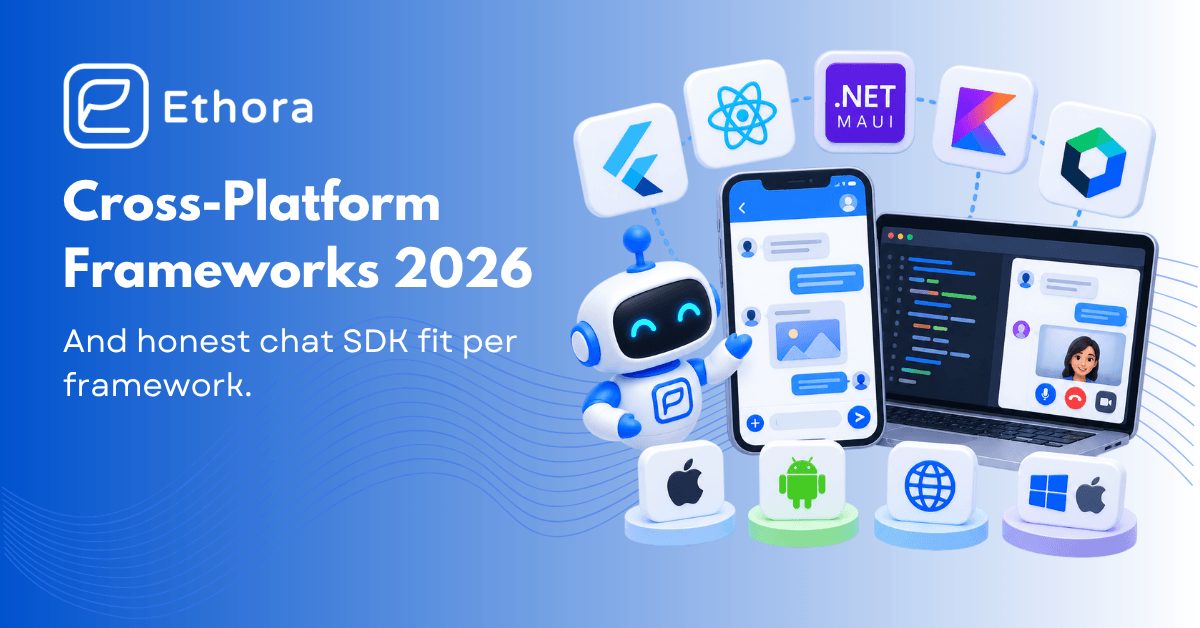
Cross-Platform App Development Frameworks in 2026: 10 Options Compared, Real Trade-offs, and Chat + AI SDK Fit
In 2026, evaluating cross-platform frameworks is a complex matter. There are many practical questions: Which ones have solid chat and AI SDK support today? Which ones won’t force a painful migration when the next major OS version drops? And what are the real engineering trade-offs once you move past the marketing claims? We’ll look at […]

Healthcare
Oct 1, 2026
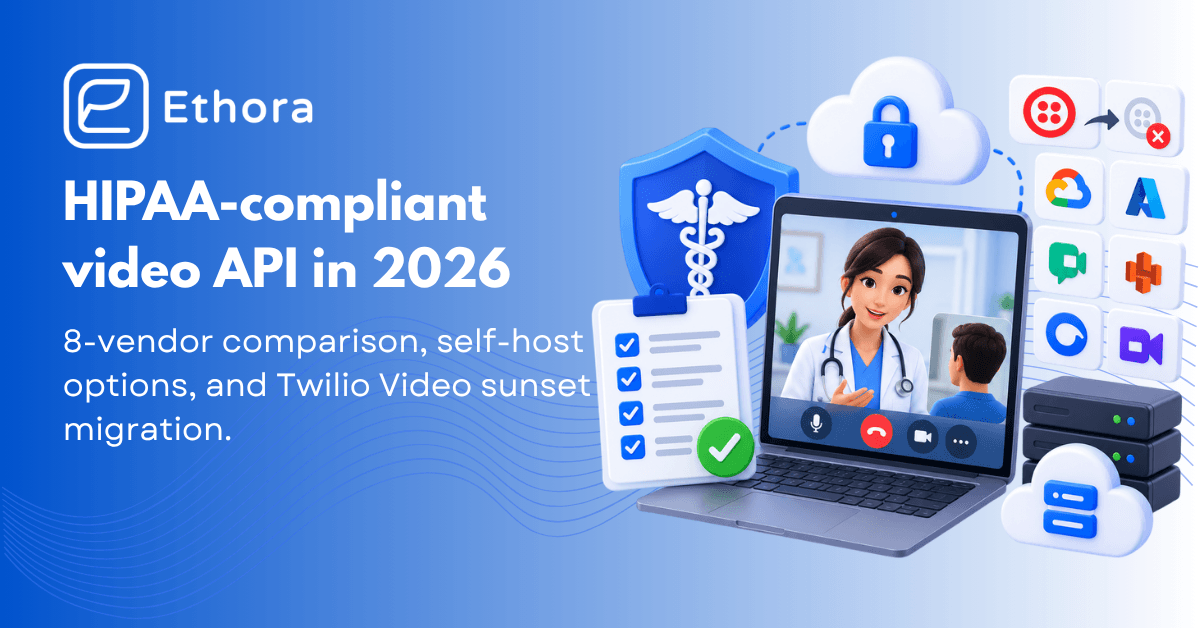
HIPAA-Compliant Video API in 2026: What Actually Makes One, Vendor Comparison, and Twilio Video Migration
Consultations, psychiatry meetings, medication management, triage, and other medical encounters often do not require physical presence. Adding video to your healthcare app or platform can be a great idea, as it allows you to hold sessions online without losing the human touch. Using a messaging API to incorporate video into your application makes the whole […]

Try Out Ethora in Action
Experience Ethora's messaging with a dedicated demo from our CEO or start building your App right now!