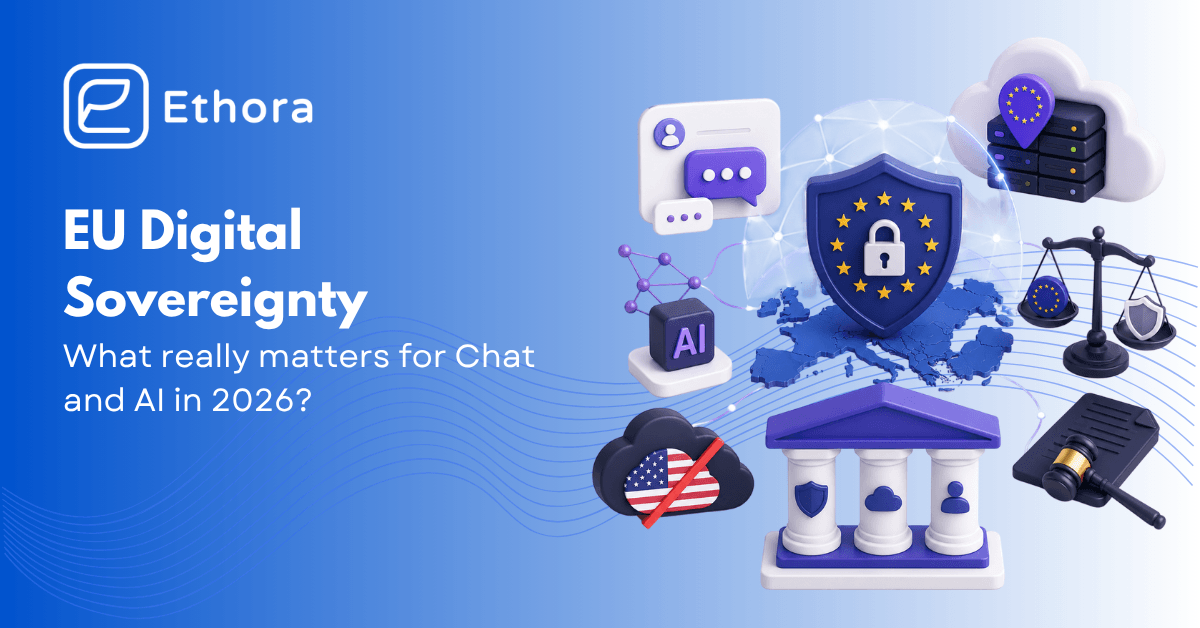
In 2026, EU digital sovereignty went from being a topic of debate in procurement to a requirement of everyday operations. If you use a chat and AI stack to process European customer data, you face new challenges. Three factors converged simultaneously:
- Schrems II (Case C-311/18) made the Privacy Shield irrelevant many years ago
- US CLOUD Act has consistently granted US law enforcement agencies the right to access data managed by any company based in the United States, regardless of the data centre’s location in an EU country
- The EU AI Act (Regulation 2024/1689) started to be enforced – prohibited practices since February 2025, general-purpose AI from August 2025, and Article 50 transparency requirements (chatbot disclosure, synthetic content labelling) from 2 August 2026. High-risk obligations of Annex III are postponed until 2 December 2027 due to Digital Omnibus, but the overall trend is obvious.
For a chat and AI solution, the threat surface is greater than most teams imagine. Messages, metadata, prompts, and completions from LLMs, as well as corpora used in the RAG approach, go through the same pipeline. If any single layer sits under US legal reach or lacks keys you control, the whole stack inherits the risk.
This piece maps the familiar three-pillar frame – data sovereignty, operational sovereignty, and technological sovereignty – onto real chat and AI workloads. It walks through the credible EU sovereign cloud options available right now, lays out a practical build-versus-buy decision, and finishes with an honest look at how a self-hostable chat and AI SDK fits into the picture.
In this article:
- Why 2026 is the tipping point for EU digital sovereignty
- Pillar 1 – Data sovereignty for your chat and AI stack
- Pillar 2 – Operational sovereignty: SDLC, runtime, admin, support
- Pillar 3 – Technological sovereignty: portability, openness, BYO LLM
- Vertical fit: which sectors must act now
- The build-vs-buy sovereignty decision
- Sovereignty audit checklist for your chat + AI stack
- Build Your Own: EU-Sovereign Chat + AI with Ethora
Why 2026 is the tipping point for EU digital sovereignty
The regulatory calendar no longer leaves room for “we’ll sort it in the next budget cycle.” You need to know and act now; otherwise you risk failing to comply with regulations and face fines of millions of dollars.
EU AI Act enforcement calendar
Prohibited AI practices under Article 5 have been enforceable since 2 February 2025. General-purpose AI model obligations under Chapter V kicked in on 2 August 2025. Transparency rules under Article 50 became live on 2 August 2026. Stand-alone high-risk systems listed in Annex III – employment screening, credit scoring, certain insurance underwriting, some healthcare triage uses – now face a deferred deadline of 2 December 2027.
Product-embedded high-risk systems under Annex I move to 2 August 2028. The highest-tier fines still reach €35 million or 7 % of global annual turnover. Anyone building a GDPR-compliant AI layer on top of chat already has EU AI Act compliance as a live design constraint, even before the high-risk wave fully arrives.
US CLOUD Act reach
Any US-headquartered cloud or SaaS provider can be compelled to hand over customer data under the CLOUD Act, no matter where the servers sit. Putting your chat API in an AWS or Azure EU region does not remove the US CLOUD Act chat exposure. That is the practical heart of the Schrems II chat API problem: Standard Contractual Clauses remain usable on paper, but they need supplementary measures that many US-controlled stacks simply cannot deliver.
Schrems II residual requirements
The European Court of Justice ruling in Case C-311/18 still shapes every transfer risk assessment. SCCs have to be backed by encryption with keys the customer controls, real data minimisation, and a clear preference for providers whose corporate control sits inside the EU whenever feasible. European Data Protection Board guidance continues to treat pure reliance on SCCs plus a US-controlled hyperscaler as incomplete for high-sensitivity workloads.
Gaia-X and EuroStack momentum
Gaia-X compliance labels and the emerging EUCS (EU Cybersecurity Certification Scheme for Cloud Services) are showing up more and more in public-sector and critical-infrastructure RFPs. SecNumCloud from ANSSI in France and the German C5 attestation remain the strictest operational benchmarks in daily use. Procurement teams treat them as de facto gates.
Pillar 1 – Data sovereignty for your chat and AI stack
Data sovereignty begins with a clear inventory of what the system actually holds. A modern chat-plus-AI deployment typically stores four distinct classes of data.
Message content – text, files, images – carries the obvious personal and commercial sensitivity. User metadata (identity, presence, contact graphs) is often more revealing than the messages themselves. LLM prompts and completions frequently embed the same personal data because users paste context straight into the conversation. And the RAG corpus – vector embeddings of internal policies, product documentation, or patient-facing materials – creates a persistent store of derived personal or sensitive information.
For GDPR-compliant chat and any workload that touches health data, the baseline is single-EU-region deployment plus encryption at rest under customer-managed keys (CMK). Vendor-managed keys leave a residual risk that the provider can decrypt under legal process. Bring-your-own-key arrangements through a sovereign KMS or an external key store shrink that surface.
LLM prompt traffic is a frequent compliance gap. Sending unfiltered user turns to a public LLM endpoint without a signed Data Processing Addendum that guarantees EU residency is both a GDPR problem and an EU AI Act transparency failure. Practical options include an EU-resident commercial endpoint (Azure OpenAI EU or equivalent with a proper DPA), a self host llm deployment of Llama 3.3 70B or Mistral Large on sovereign infrastructure, or a hybrid that keeps high-volume, lower-sensitivity queries local and only escalates the hard cases to a DPA-covered cloud model.
The RAG layer is often overlooked. Vector stores sitting in a US-controlled region still expose embeddings of European personal data under the CLOUD Act.
Pillar 2 – Operational sovereignty: SDLC, runtime, admin, support
Operational sovereignty asks who can actually reach the running system. Even perfect data residency is undermined if US-based SRE or support staff hold production access credentials.
A chat SDK hosted by a US vendor on an AWS Frankfurt region is therefore not operationally sovereign. The legal entity that employs the people with root access remains subject to US process. True operational sovereignty requires the runtime, admin console, monitoring, update pipeline and support flows to sit under EU corporate control.
Credible EU sovereign cloud providers in 2026 include:
| Provider | HQ / focus | Key certifications | GPU / AI notes | Best fit |
| OVHcloud | France | SecNumCloud (Private Cloud, Bare Metal Pod) | H100/H200 class available | Broad compute + regulated private cloud |
| Scaleway | France | ISO 27001, HDS; SecNumCloud in progress | Strong H100 / L40S availability in Paris & Warsaw | Developer-friendly LLM self-host |
| Open Telekom Cloud (Deutsche Telekom) | Germany | C5 Type 2 | Limited managed AI services | German regulated workloads |
| IONOS | Germany | C5, ISO 27001 | Growing GPU catalogue | Enterprise mid-market |
| STACKIT (Schwarz) | Germany | Growing C5 / ISO footprint | Expanding | German retail & enterprise |
| T-Systems Sovereign Cloud | Germany | Hybrid with air-gapped options | Partnership models | Hybrid sovereignty stories |
| S3ns / Bleu-type joint ventures | France/multi | SecNumCloud path for some | Variable | Audit carefully before assuming full isolation |
Hyperscaler EU regions can still serve lower-sensitivity workloads when paired with a robust DPA and CMK encryption. For high-risk EU AI Act systems or health-regulated chat they remain a compromise rather than a complete answer. Always request current SecNumCloud, C5 attestation or EUCS status before signing.
Pillar 3 – Technological sovereignty: portability, openness, BYO LLM
Technological sovereignty is the ability to change the underlying model or platform without rewriting the application. If the chat-plus-AI stack is hard-wired to a single US vendor’s LLM API, pricing changes, model deprecations or export controls become existential events.
BYO LLM removes that single point of failure. The application talks to an abstract inference interface. Behind it you can place Anthropic via an EU DPA, Azure OpenAI EU, a self-host LLM of Llama 3.3 70B or Qwen 2.5 72B, or a European model such as Mistral Large or Mistral Small. European options in 2026 also include Aleph Alpha’s Luminous family and Finnish Poro/Viking models. They do not always match the absolute frontier of GPT-class systems, yet they close the sovereignty gap for a large share of enterprise use cases.
Self-hosting cost has become realistic. A self host LLM of Llama 3.3 70B typically needs 2-4 high-end GPUs. On sovereign cloud the monthly infrastructure bill often falls in the low-to-mid four-figure euro range; on-premises capital cost is higher but amortises quickly once token volume exceeds roughly 20-30 million tokens per month. For private LLM for enterprise workloads above that threshold the economics already favour self-hosting before sovereignty is even counted.
Portability also applies to the chat layer itself. Prefer a self hosted chat server or an open protocol surface (WebSocket + REST + SSE) over a proprietary binary transport that cannot be exported. Own the message schema and integration contracts. Governance follows the same logic: every message and every LLM call needs a durable audit trail (timestamp, user, prompt, completion, model version, tool calls). That record-keeping maps directly onto EU AI Act Article 12 expectations for high-risk systems once they apply.
Vertical fit: which sectors must act now
Healthcare deployments that perform triage or diagnosis-adjacent tasks will fall under high-risk classification. They need a full sovereign stack – self-host LLM, HIPAA-compliant chat API patterns adapted for GDPR, and HIPAA-compliant patient communication channels that never leave the controlled perimeter.
Banking and insurance face both the deferred high-risk rules and the already-enforced DORA requirements on ICT third-party risk. Sovereign cloud is strongly preferred for any chatbot that touches underwriting, credit or fraud signals.
Public-sector tenders increasingly demand EUCS High or SecNumCloud equivalents. Non-EU vendors are frequently deprioritised.
Telecom and critical-infrastructure operators sit under NIS2 obligations; national regulators often expect sovereign infrastructure for customer-facing chat systems.
Even pure SaaS vendors discover that once EU revenue exceeds roughly 15-20 % of the total, enterprise buyers treat sovereignty as a hard sales gate rather than a nice-to-have.
The build-vs-buy sovereignty decision
Four realistic paths exist in 2026.
| Option | Cost | Sovereignty | Ops burden | Time to ship |
| US-vendor SaaS on EU region | Lowest (€0-€5k setup + usage) | Low (CLOUD Act residual) | Lowest (fully managed) | 1-4 weeks |
| EU-vendor SaaS on sovereign cloud | (€5-€20k setup + higher usage fees) | Medium–high | Low (mostly managed) | 4-8 weeks |
| Chat + AI SDK with self hosted chat server + BYO LLM on your EU cloud or on-prem | Medium (€15-€50k first year, incl. Infra _ LLM) | Highest practical | Medium (you manage infra + updates) | 6-12 weeks |
| Fully in-house (Matrix + self-hosted LLM + pgvector) | Highest (€80-€200k first year) | Maximum | High (full engineering ownership) | 4-9 months |
The sweet spot for most regulated enterprises is the third path: a portable chat and AI SDK that can run as a self-hosted chat server on OVHcloud, Scaleway or equivalent, with full BYO LLM freedom. It avoids both the vendor lock-in of pure SaaS and the multi-year engineering cost of building everything from open-source primitives.
Sovereignty audit checklist for your chat + AI stack
Score each item 0 or 1. A total below 8 signals material exposure; below 10 still warrants escalation to counsel and the DPO.
- Chat message data stored in an EU region under CMK encryption?
- User metadata indexed only within the EU?
- LLM API covered by EU-endpoint DPA or fully self-hosted?
- Vector store resident only in the EU?
- Backups replicated exclusively inside the EU?
- SRE and support access limited to EU-based staff for regulated workloads?
- Vendor headquarters free of US CLOUD Act reach?
- Encryption keys customer-managed rather than vendor-managed?
- Complete audit trail of every message and LLM call (EU AI Act Article 12 readiness)?
- Model provenance and training-data documentation available?
- Ability to export chat data, user data and model configuration in standard formats?
- Current SecNumCloud, C5 attestation, EUCS or equivalent ISO 27001 with EU annex?
EU digital sovereignty for chat and AI in 2026 is not a slogan – it is a concrete stack. Data lives in EU sovereign cloud regions under customer-managed keys. The LLM layer is swappable (BYO LLM, preferring European weights where quality permits). The messaging layer is either a fully audited EU vendor or a self-hosted chat server you control. Audit trails are durable enough to satisfy Article 12 once high-risk rules apply. Teams that treat sovereignty as an architecture decision now avoid the combination of multi-million-euro fines, Schrems-adjacent litigation risk, and enterprise sales blockers that come with a pure US-hyperscaler stack.
If you need a chat and AI SDK you can deploy on OVHcloud, Scaleway, IONOS, STACKIT or your own EU on-premises environment with full BYO LLM support (self-hosted Llama 3.3 or Mistral Large), Ethora’s Chat & AI SDK is built for that pattern – npm install @ethora/sdk. Your data, your keys, your model, your region.
If you’d like to learn more about how Ethora ensures that your messaging complies with regulatory requirements, don’t hesitate to contact us. Our experts will gladly answer all of your questions.

Share with your community


More Articles
Healthcare
Sep 28, 2026
Telemedicine App Development in 2026: Architecture, HIPAA, AI, and the Build-vs-Buy Decisions That Matter
Telemedicine app development in 2026: HIPAA + EU AI Act, architecture, AI-native patterns, video/chat SDK decisions, and real cost math.

Embeddable AI Widget
Sep 24, 2026
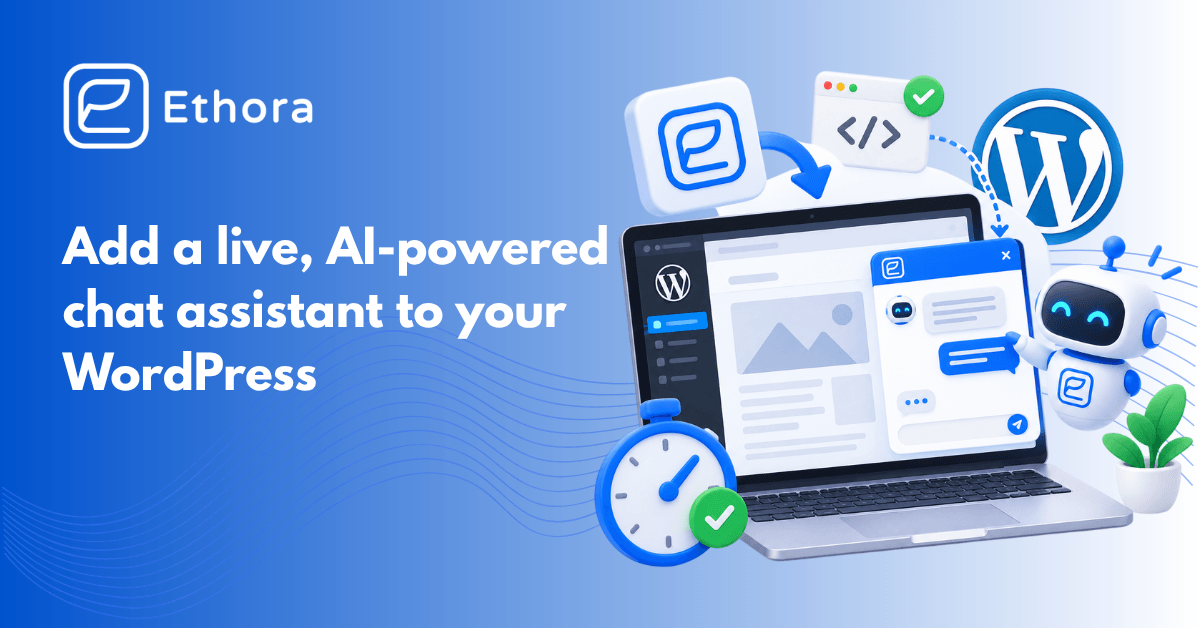
How to Add an AI Chat Assistant to WordPress in Under 10 Minutes
Adding a live, AI-powered chat assistant to your WordPress site does not require writing a single line of code. This guide walks through installing the free Ethora Chat Assistant plugin, connecting it to your Ethora agent, and confirming it works live on your site, screenshot by screenshot.

Try Out Ethora in Action
Experience Ethora's messaging with a dedicated demo from our CEO or start building your App right now!