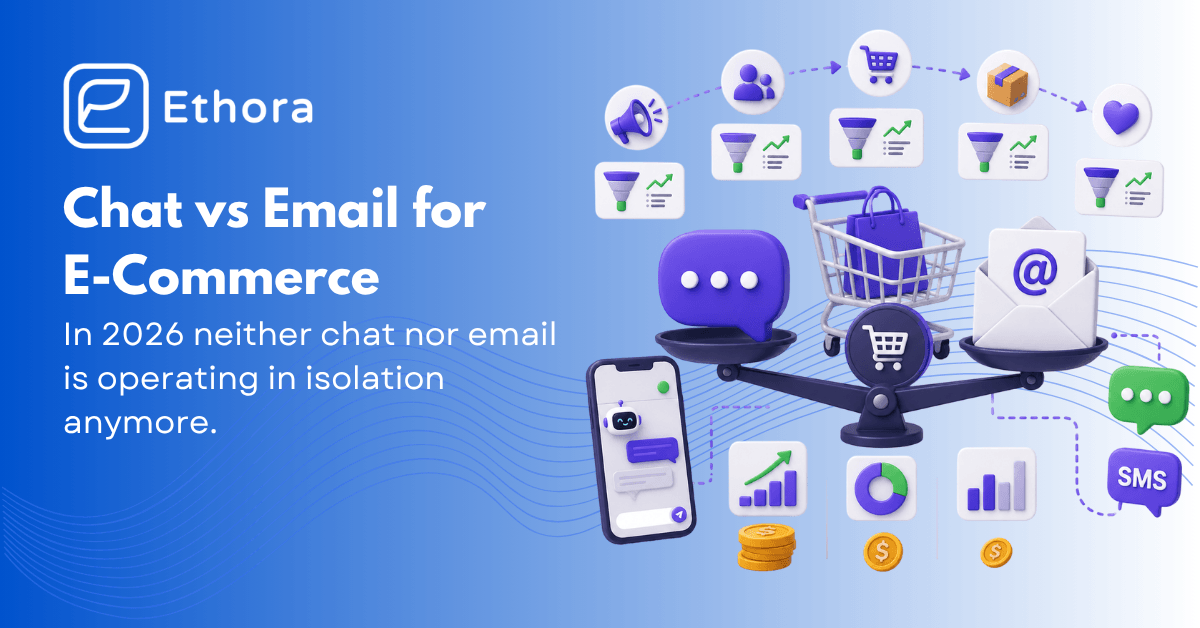
A customer browsing your product page at 11 pm with a question about fit is not going to wait until tomorrow for an email response – they’ll leave and buy from whoever answers them now. That same customer, who made a purchase last month and hasn’t come back, isn’t on your site, where chat can reach them. But email can.
These are different tools for different moments, and running only one of them means you’re losing revenue at whichever lifecycle stage you’re ignoring.
This article maps each channel to the lifecycle stage where it actually converts, puts real numbers behind the claims, and covers where SMS and WhatsApp fit into the picture – because in 2026 neither chat nor email is operating in isolation anymore.
In this article
- Chat vs email at a glance
- The lifecycle map: which channel wins where
- Chat: The Real Numbers
- Email: The Real Numbers
- When chat worsens your KPIs
- When email worsens your KPIs
- SMS, WhatsApp, and push
- Budget split by revenue tier
- Ethora Marketplace Chat SDK
Chat vs email at a glance
| Dimension | Live Chat / AI Chat | |
| Speed | Real-time – 80% of chats answered within 40 seconds | Minutes to 24+ hours; customers accept it |
| Reach | Only users currently on-site or in-app | Reaches the inbox regardless of whether the customer is on-site |
| Cost per interaction | Human agent typically $6-12 per chat; an AI handling the same query runs $0.005-0.05 per conversation at current OpenAI pricing – roughly 100× cheaper for the questions that don’t need a human | Fractions of a cent per send. The cheapest channel at scale by a wide margin, which is why ROI numbers look so good |
| Conversion impact | Chat users spend up to 60% more per purchase; on-site conversion lift averages 15-25% for stores that deploy it well on high-intent pages | ~$45 per $1 spent in retail e-commerce; abandoned cart flows specifically average $3.65 per recipient |
| Personalization | Real-time context from the current session – what page they’re on, what’s in the cart, how long they’ve been stuck on checkout | Historical context from the CRM – what they bought, when they last ordered, which segments they fall into, how engaged they’ve been |
| Compliance | Less regulated; EU AI Act consent requirements for bots | CAN-SPAM, GDPR opt-in, CASL – mature and well-understood |
| AI automation | AI handles 65-89% of routine queries in 2025-2026 | Automated flows drive 37% of all email sales |
The lifecycle map: which channel wins where
Chat (especially AI-powered) wins in the heat of the moment – on product pages, during checkout, or when a customer needs help right now. Email is unbeatable for staying in touch when they’ve left your site: newsletters, abandoned cart reminders, win-back campaigns, and building long-term relationships. Let’s look closer.
Awareness/top of funnel
Email wins
Newsletters, drip sequences, content marketing. Chat has essentially zero reach here because people who haven’t visited your site yet can’t be in a chat session. Email builds the list, nurtures it, and drives the first visit. This isn’t even a close call.
Browse/product page
Chat wins
The product page is where live chat earns back its entire cost in a single afternoon. Someone staring at a $180 jacket has a specific question, for example, “Can I return it if it doesn’t fit?” – and if they don’t get an answer instantly, they’ll leave. The ones who get an answer in under a minute buy at dramatically higher rates: chat-to-conversion averages 15-20% in e-commerce versus 2–3% for general browsing. The higher the product price and the more specific the consideration, the bigger the gap.
Cart/checkout
Chat wins
This is the highest-ROI moment for live chat in e-commerce. A customer who has reached checkout has shown buying intent – the conversion question is whether they have enough information to complete the purchase. Shipping cost confusion, return policy uncertainty, and payment security questions are the most common friction points at checkout.
An AI chat that answers them in under 30 seconds converts; an email that arrives 30 minutes later doesn’t. Still, email sequences can get your customers back, but they’re recovering the ones who already left, not stopping them from leaving.
Post-purchase/transactional
Email wins
Order confirmation, shipping updates, delivery notifications, review requests. Email is simply the right tool here – these messages need to arrive whether or not the customer is on your site, and transactional emails have the best open rates in all of email marketing (recipients expect them and open them). Adding chat to the post-purchase experience adds cost without meaningfully improving the outcome.
Support (after delivery)
Depends on urgency
When problems arise (e.g., a customer received the wrong item), users want to talk to someone immediately – not fill out a return form and wait 24 hours. In these situations, chat wins by default because email’s timeline is wrong for the emotional state the customer is in. But if it’s not a stressful situation – for example, they want to know when to expect a refund or need a prepaid return label, email works fine.
The best approach is to use an AI assistant to collect the details, resolve what it can, and escalate to a human agent if needed. The confirmation and the next steps can then be sent by email. That chain uses each channel for what it’s actually good at.
Retention/re-engagement
Email wins
Customers who made a purchase 2 months ago can be reached via email. You can send a message reminding them about your store, offering to check out what’s new, or informing them about loyalty updates. For chat, they are out of reach.
VIP/concierge
Chat wins
High-LTV customers benefit from 1:1 communication channels where response time and personalization signal that they matter. Live chat with dedicated agents or WhatsApp for customers in markets where it dominates, outperforms bulk email here. The goal is relationship maintenance, not broadcast reach.
Chat: The Real Numbers
The following statistics have been referenced from credible studies. This range depends on various factors like vertical, quality of implementation, and whether chat involves live representatives, AI, or both.
Lift in conversion when using live chat: Buyers who engage in live chat are willing to spend up to 60% extra per purchase. Virgin Airlines measured a 23% conversion lift from live chat (Which50). The range in the literature runs from modest (5-10% on low-AOV impulse purchases) to significant (25-40% on high-consideration items over $100).
Cart abandonment recovery: Cart abandonment rates drop 25-30% where active live chat is deployed. The Baymard Institute puts the average cart abandonment rate at 70.19% in 2025, meaning there’s significant recovery potential at that stage for most stores.
AI chat query resolution: Smartsupp’s analysis of 5 billion e-commerce site visits found that stores with chatbots resolved 89.2% of inquiries automatically, versus 71.2% for stores without. The same study found chatbot-equipped stores handled 6× more conversations per month (440 vs 75).
Cost per AI chat conversation: At current OpenAI pricing, GPT-4o-mini handles routine e-commerce queries (order status, return policy, size guide) at roughly $0.005–0.05 per conversation – far below the $2-8 cost of a human agent handling the same interaction.
Email: The Real Numbers
Email’s performance metrics are among the most thoroughly documented in marketing. The numbers below are sourced and consistent across multiple research bases.
ROI: Shopify’s e-commerce email marketing data puts the average ROI at $36 per dollar spent.
Automation: Automated flows drove 37% of all email-generated e-commerce sales in 2024 while making up just 2% of total email sends. Automated emails bring businesses $1.94 per recipient, while non-automated flows bring only $0.11. Abandoned cart flows specifically averaged $3.65 per recipient – the single highest number of any email type. If your automation stack is thin, you’re leaving the highest-ROI portion of email on the table.
Open rates are growing: The open rates for e-commerce increased from 25.16% to 29.44%, while the highest-performing brands even surpassed 40%. Also, personalized subject lines generate 26% higher open rates than non-personalized ones.
Purchase influence: 52% of consumers have made a purchase directly from a marketing email, and consumers who shop by email spend 128% more than those using other channels. Those are high numbers and worth holding against the channel’s cost structure – if email costs you fractions of a cent per send and 52% of the people on your list have bought via email, the case for investing in list quality and segmentation over acquisition cost is obvious.
When Chat Worsens Your KPIs
These are real patterns that produce negative outcomes.
Low-AOV (Average value order)
impulse purchases A sub-$30 impulse purchase doesn’t need pre-sales support. Chat adds friction, infrastructure cost, and a widget that distracts from conversion without lifting the purchase rate. Save chat for when the consideration is real.
Understaffed live chat
A widget promising “typically replies in a few minutes” that actually takes 45 minutes is doing active damage. Customers set their expectations based on what your chat widget tells them. Breaking that expectation is worse than not offering chat at all – at least a missing widget doesn’t create an explicit broken promise.
AI-only with no escalation path
Customers who hit two or three dead-end bot turns without reaching a human become significantly angrier than if they’d never started the chat. Dead-end AI is one of the fastest routes to a negative review.
Business-hours-only chat
A widget visible 24/7 that only staffs 9-5 weekdays destroys weekend conversion – exactly when many consumer e-commerce purchases happen. If you can’t staff it or automate it after hours, don’t show the widget after hours.
Chat as a support barrier
Some brands use chat to hide phone numbers and make human contact harder. Customers have learned to recognize this pattern, and it reliably generates resentment. Chat should expand access, not replace it.
Multi-language without translation
A chat widget that only handles English in a multilingual market becomes a language wall that explicitly excludes the customers you’re trying to serve. Build translation in or don’t deploy in those markets.
When Email Worsens Your KPIs
Email has its own failure modes that receive less attention because email problems are less dramatic than chat problems – they often show up as slow decline rather than acute crisis.
Cold outreach to people who didn’t opt in. Gmail and Yahoo now enforce a 0.1% spam complaint threshold before they start routing your sends to spam – and once sender reputation is damaged, it affects every email you send, including to people who are genuinely engaged. Bought lists collapse email performance to near zero, and recovering sender reputation takes months of careful list hygiene. The short-term gain is never worth it.
Batch-and-blast with no segmentation. Sending the same email to your entire list consistently produces the highest unsubscribe rates and the worst engagement signals, which tells inbox providers your content isn’t wanted and depress future deliverability for everyone on the list. Segmented campaigns outperform unsegmented ones by 760% in revenue terms – that gap reflects real money left on the table by teams that haven’t invested in the segmentation work.
Email for urgent support issues. Someone who received a damaged product or a wrong order and gets “thanks for contacting us – we’ll respond within 24 hours” is already on their way to filing a dispute. Email SLAs make sense for informational requests. For anything time-sensitive or emotionally charged, that timeline is a churn mechanism disguised as a process.
Sending from noreply@ on anything customers might want to respond to. A transactional email from a no-reply address tells the customer explicitly that their response isn’t welcome. Most will just take that frustration elsewhere – a public review, a social post, a chargeback. The fix is trivial: use a monitored alias and route replies somewhere that gets checked.
Hard-to-find unsubscribe links. GDPR and CASL both require a clear, functioning unsubscribe path. Making it difficult to find doesn’t reduce unsubscribes – it converts people who would have quietly unsubscribed into people who hit the spam button instead, which is far more damaging to your sender reputation.
SMS, WhatsApp, and Push
If you’re interested in customer engagement, then using SMS and WhatsApp will help you close the gaps that neither email nor chat covers well.
SMS is the channel for time-sensitive moments. Open rates above 98% and a typical response window under three minutes – those numbers make email look slow for anything that needs to happen now. A cart recovery text sent 20 minutes after abandonment, a flash sale notification, a delivery delay alert – SMS gets there before the customer has forgotten what they were doing.
The constraint isn’t cost or deliverability; it’s frequency. Three SMS messages a week from a brand start to feel invasive to most people; three emails per week are just normal marketing. SMS earns its keep for high-urgency, high-relevance moments and burns its welcome fast if used like email volume.
WhatsApp Business is not a niche consideration for international stores – it’s where customer service actually happens across much of the world. In Brazil, Mexico, Indonesia, India, Germany, and most of Africa, WhatsApp is how people communicate as a default. A customer in São Paulo who has a problem with their order is going to reach out on WhatsApp first, and if your brand isn’t reachable there, you’re creating friction that doesn’t exist for your competitors who are.
Push notifications are free and reach opted-in app users at essentially zero marginal cost. The catch is the audience size – only users who’ve downloaded your app and accepted push permissions – and the risk of fatigue if you overuse it.
Order tracking updates, delivery confirmations, and re-engagement for lapsed app users are the right use cases. Push is not a substitute for email or SMS; it’s an additive channel for a specific segment of your customer base.
Practical Budget Split by Revenue Tier
You don’t have to implement all channels at once. It’s critical to approach communication strategically, depending on revenue. Otherwise, you may face overspending without any positive outcome.
Under $50K/month revenue
Email tool plus a free or low-cost live chat widget (e.g., Ethora). Don’t invest in AI chat or SMS yet – the volume doesn’t justify the setup cost. Focus on building the email list and getting the abandoned cart flow working.
$50K-$500K/month revenue
Email tool plus AI chat. Add SMS for cart recovery. At this tier, AI chat begins to pay for itself through support deflection and cart recovery. The math on AI handling 65-89% of incoming queries becomes very attractive when you’re getting 50+ chat sessions per day.
$500K-$5M/month revenue
Email with advanced segmentation and automation. AI chat with human handover. SMS plus WhatsApp for markets where it’s relevant. A small live-agent team (2-5 people) for escalations and VIP customers. At this revenue level, the cost of not having live chat on high-AOV product pages becomes significant enough to measure directly.
$5M+/month revenue
Enterprise email and CRM. Self-hosted AI chat with BYO LLM to control both cost and data residency. An omnichannel inbox to unify chat, email, SMS, and WhatsApp into one view for the agent team. A live-agent team of 10+ for complex escalations, VIP management, and quality oversight of AI responses. At this scale, the difference between per-conversation AI pricing and flat-tier self-hosted AI becomes a material budget line.
The rule that holds across all tiers
Your monthly revenue tier determines your tool stack more than your product vertical does. A $500K/month fashion brand and a $500K/month supplement brand need roughly the same channel mix – the content differs, the infrastructure doesn’t.
Ethora Marketplace Chat SDK: AI Chat for Shopify, WooCommerce, and Magento
Ethora’s SDK is specifically designed for Marketplaces and e-commerce, including Shopify, WooCommerce, and Magento. We took care of all the nuances to satisfy the needs of big enterprises and small online businesses.
Self-hosted deployment is available at every pricing tier. For EU stores navigating GDPR, for health and beauty stores that touch regulated product categories, or for any store whose legal team has asked “where does customer conversation data live?” – self-hosting means the answer is “on our servers, in our AWS region” rather than “on our vendor’s servers, wherever they choose to locate their infrastructure.”
The chat widget installs in under an hour on any Shopify or WooCommerce store. The AI Bots SDK handles the product recommendation and order lookup logic through an RAG layer built on your catalog to ensure answers are accurate.
You use what you need at the current stage of your business. If you’d like to learn more about Ethora, just drop us a line, and we’ll gladly answer it.

Share with your community


More Articles
Healthcare
Sep 28, 2026
Telemedicine App Development in 2026: Architecture, HIPAA, AI, and the Build-vs-Buy Decisions That Matter
Telemedicine app development in 2026: HIPAA + EU AI Act, architecture, AI-native patterns, video/chat SDK decisions, and real cost math.
Embeddable AI Widget
Sep 24, 2026
How to Add an AI Chat Assistant to WordPress in Under 10 Minutes
Adding a live, AI-powered chat assistant to your WordPress site does not require writing a single line of code. This guide walks through installing the free Ethora Chat Assistant plugin, connecting it to your Ethora agent, and confirming it works live on your site, screenshot by screenshot.

Try Out Ethora in Action
Experience Ethora's messaging with a dedicated demo from our CEO or start building your App right now!