Development
WebRTC vs WebSockets: Real Differences, Real Benchmarks, and When to Use Both
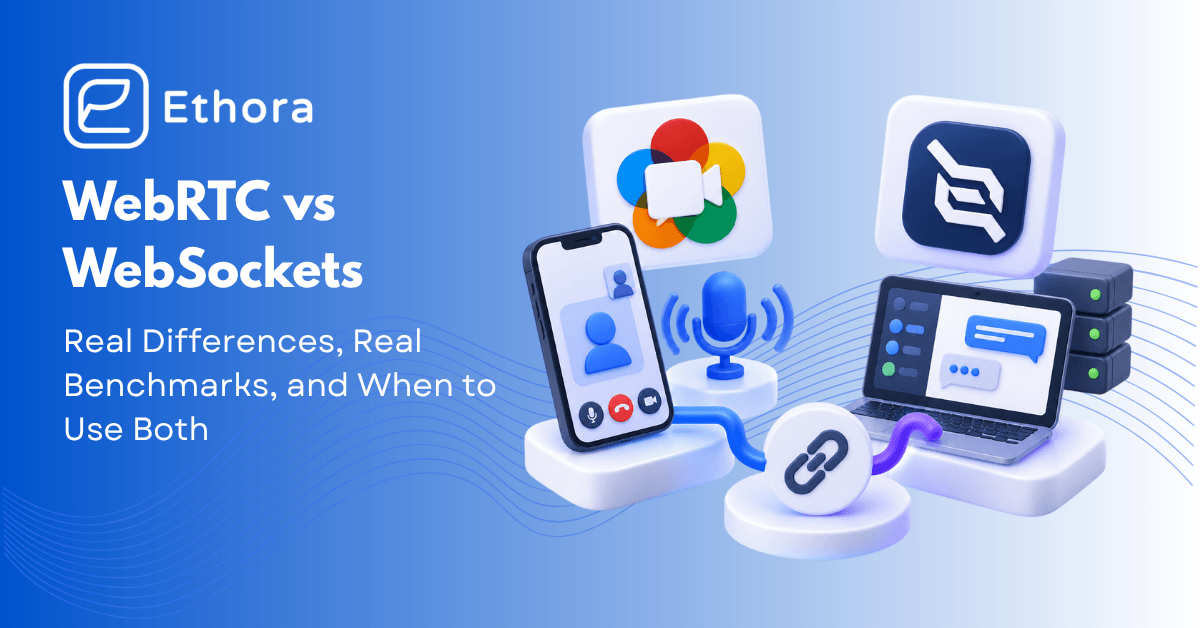
Real-time communication is an integral part of the vast majority of mobile and web applications. Whether you’re building a marketplace, a healthcare app, or something else, you’ll most likely need to integrate messaging.
There are two main protocols used in instant messaging – WebRTC and WebSocket. You may find guides on how to choose between them, but the real question is not the choice. It’s about how to effectively combine both of them, when WebRTC’s DataChannel is a better fit for a specific data path, and when WebTransport over HTTP/3 is a real WebSocket alternative.
Answers to these questions will help you prevent higher latency, increased costs, or performance issues. And in this piece, we answer these questions.
In this article
- What is a WebSocket?
- What is WebRTC?
- Head-to-head comparison
- Real benchmarks in 2026
- When to use WebRTC
- When to use WebSockets
- When to use both together
- WebTransport: the 2026 alternative
- Build vs buy Ethora: Chat + AI + Voice/Video SDK
What Is a WebSocket?
Simply put, a WebSocket is a two-way connection between the client and the server. Once established, one of the parties can transfer data at any moment without having to send an initial request. The client will send a special “upgrade” header, which the server will accept, and the connection will be upgraded to the WebSocket protocol. Then, the connection remains alive until it is closed by one of the parties.
On the TCP layer, the WebSocket connection is a persistent TCP connection carrying lightweight frames. Every frame consists of a very small header (2-14 bytes based on payload size and whether there is a mask) and the payload, along with the 32-bit masking key for client-server direction of data transfer (it serves to protect against cache poisoning by intermediaries). ws:// uses TLS; ws:// doesn’t. Always use ws:// in production.
Where there is a need for constant communication in both directions, WebSocket technology should be the choice. When you need to transfer text data, JSON, or even small binaries from one point to another, the solution would definitely be WebSockets.
// Server (Node.js, ws library)
const WebSocket = require('ws');
const wss = new WebSocket.Server({ port: 8080 });

wss.on('connection', socket => {
  socket.on('message', msg => {
    wss.clients.forEach(c => { if (c !== socket) c.send(msg); });
  });
});

// Client
const ws = new WebSocket('wss://api.example.com');
ws.onmessage = e => render(JSON.parse(e.data));
ws.send(JSON.stringify({ text: 'hello', room: 'general' }));
What is WebRTC?
WebRTC stands for Web Real-Time Communication. It is a technology that provides an open API to perform real-time voice, video, and data communication between two peers directly. The main difference between WebSockets and WebRTC is that, whereas WebSockets use a server to transfer data, WebRTC transfers data directly without a server.
WebRTC provides three major APIs for the browser:
- RTCPeerConnection. It establishes a P2P connection, including ICE candidate discovery, DTLS key agreement, codec negotiation, and media data streaming.
- MediaStream (via getUserMedia). This one gets video and audio input from the camera and microphone and connects it to the P2P connection.
- RTCDataChannel. This API allows you to transmit arbitrary data via a P2P connection over UDP with the SCTP protocol.
Protocols used along WebRTC: SDP (Session Description Protocol) handles negotiations of codec capabilities. ICE (Interactive Connectivity Establishment) discovers the best network path. STUN servers reveal a client’s public IP when behind a NAT. TURN servers relay traffic when direct P2P fails – this matters more than most implementations account for. RTP/RTCP carry and monitor the actual media streams once the connection is established.
// Signaling (SDP + ICE) happens over WebSocket — omitted here
const pc = new RTCPeerConnection({ iceServers: [{ urls: 'stun:stun.l.google.com:19302' }] });

// DataChannel for low-latency binary/text
const dc = pc.createDataChannel('state', { ordered: false });
dc.onmessage = e => applyState(e.data);

// MediaStream for camera/mic
const stream = await navigator.mediaDevices.getUserMedia({ video: true, audio: true });
stream.getTracks().forEach(t => pc.addTrack(t, stream));
Head-to-Head: WebSockets vs WebRTC
| Dimension | WebSocket | WebRTC |
| Architecture | Client ↔ server; all traffic routes through your infrastructure | Peer-to-peer; server only needed for signaling (and TURN relay when P2P fails) |
| Transport | TCP only – reliable, ordered delivery | UDP for media (fast, packet loss tolerable); SCTP over UDP for DataChannel; TCP fallback via TURN |
| Setup time | 50-150ms (HTTP upgrade) | 100–500ms (ICE gathering + NAT traversal + SDP exchange) |
| Message latency P95 | 10-30ms (same region) | <30ms P2P once established; higher via TURN relay |
| Media streaming | Not designed for it — binary frames work but overhead is wrong for continuous video | Purpose-built: adaptive bitrate, packet loss concealment, echo cancellation built-in |
| Signaling required? | No – connection is direct client-server | Yes – SDP offer/answer + ICE candidates must be exchanged before media flows |
| Encryption | TLS via wss:// (optional, use it) | Mandatory: DTLS for data, SRTP for media — no unencrypted WebRTC exists |
| Server RAM at 1M idle connections | ~2-4 GB (implementation-dependent) | Near zero for P2P calls; SFU adds ~1-3 GB per 1K active participants |
| Hidden cost | Egress bandwidth for large payloads | TURN relay: $0.05-0.15/GB when P2P fails (15-20% of user pairs) |
| Implementation effort | 1-2 days to working prototype | 2-6 weeks for signaling + STUN + TURN + SFU integration |
| Browser support | Universal since 2011 | Universal in modern browsers; caniuse: RTCPeerConnection |
Real Benchmarks in 2026
Numbers below are directional, based on protocol specifications and public benchmarks from Google, Cloudflare, and independent WebRTC research. Measure your own stack under production conditions before capacity planning
| Metric | WebSocket | WebRTC (P2P) | WebRTC via TURN | WebTransport (HTTP/3) |
| Connection setup | 50-150ms | 100-500ms (ICE) | +100-300ms on top of P2P | ~1 RTT (QUIC 0-RTT reconnect) |
| Media latency | N/A | <30ms | 60-150ms typical | N/A (not media-optimised) |
| Chat message P95 | 10-30ms | 10-30ms (DataChannel) | Adds relay RTT | 8-20ms (early benchmarks) |
| Per-message overhead | ~6 bytes framing | ~10 bytes SRTP framing | Same + relay overhead | ~8 bytes QUIC frame header |
| Server RAM / 1M idle | 2-4 GB | ~0 (P2P) | Scales with relay traffic | Similar to WebSocket |
| TURN relay cost | N/A | ~$0.05-0.15/GB when P2P fails | Applies to 15-20% of pairs | N/A |
| Latency vs WebSocket | Baseline | Lower for media; similar for data | Higher | 20-40% lower (QUIC advantage) |
The TURN cost problem nobody budgets for
Direct P2P works cleanly when both peers are on open networks. It fails through symmetric NATs and corporate firewalls – a combination that affects roughly 15-20% of real-world connections, based on data from Google’s WebRTC team and Twilio’s historical TURN usage reports. When P2P fails, a TURN relay takes over. TURN servers charge by bandwidth, typically $0.05-0.15/GB depending on provider and region. For a video call running at 1 Mbps in each direction, that’s 0.45 GB per 30-minute call per peer that can’t go direct – real money at any meaningful scale.
This is the line item that bites teams who prototype on a public STUN server and then discover in production that a significant chunk of their users are behind restrictive NATs. Budget for TURN from day one.
When to Use WebRTC
WebRTC provides reliable media exchange thanks to its peer-to-peer communication, adaptive bitrate, packet loss concealment, and echo cancellation. WebSocket won’t provide this level of performance, so if your product handles a lot of media, including audio and video, use WebRTC.
Use WebRTC for:
Voice + video calls
1:1 and small groups; multi-party needs an SFU selective forwarding unit to avoid N² connections
Live streaming <1 second
Video conferencing, live event broadcasts, webinars; HLS adds 5-30s delay
Collaborative whiteboards
Low-latency binary over DataChannel; drawing strokes at sub-30ms
Remote desktop
Screen capture stream + DataChannel for input events
Telehealth video
HIPAA-compliant WebRTC with DTLS/SRTP encryption, BAA-covered infra
Peer-to-peer file transfer
Direct device-to-device; avoids server bandwidth cost entirely when P2P succeeds
Distributed multiplayer games
When 30ms matters, and packet loss is preferable to delay
Real-money gaming/betting
Video proof-of-play + low-latency game events
When to Use WebSockets
WebSockets should be used if both parties have to communicate frequently using plain text, JSON, or small binary messages, where the payload is state rather than media. WebSocket implementation is easier, works on any network (even those like corporate proxies that drop WebRTC connections sometimes), and its scalability is well-understood.
It will work for:
Chat and messaging
1:1, group, community – the textbook WebSocket use case since 2011
Presence + typing indicators
Who’s online, who’s typing – lightweight signals that don’t need P2P
Live notifications
Activity feeds, stock ticks, live scores, push notifications inside an app
Collaborative documents
Shared state sync (Notion-style, Figma comments, Google Docs presence)
Real-time dashboards
Analytics, monitoring, DevOps ops boards – server pushes, client rarely writes
Multiplayer game state
Turn-based or any state where 30-100ms latency is acceptable
AI streaming responses
SSE matches OpenAI + Anthropic API shape more naturally, but WebSocket works too
IoT control plane
Command-and-control; for sensor telemetry, prefer MQTT
SSE vs WebSocket for AI responses
Both the OpenAI and Anthropic APIs stream token-by-token via SSE. If your architecture pipes those streams to a browser, SSE end-to-end is simpler than converting SSE to WebSocket at your server. For chat apps where the same connection carries both messages and AI responses, WebSocket is fine – you’re already using it.
When to Use Both Together – The Pattern Most Apps Actually Need
WebRTC has no built-in signaling channel. Before two peers can exchange media, they need to swap SDP offers and ICE candidates through some external mechanism. WebSocket is the de facto signaling channel. So the moment you add WebRTC to any app, you almost certainly already have or need a WebSocket connection – and you use it for signaling.
That’s the minimum pattern. The better architecture uses WebSocket for more than just signaling.
Reference architecture: video call app
WebSocket handles the messages for chatting, presence status and typing status, mute status, raise hand events, WebRTC signaling messages including SDP offer/answer and ICE candidates, and also any application state that must be retained after the peer disconnection. The states that need to be retained must not reside only in DataChannel, as they will be lost if the peer gets disconnected.
WebRTC takes care of audio and video streams and also DataChannel (optionally) for binary low-latency messaging where the 10-30 ms delay introduced by WebSocket to the server matters.
// Signaling over WebSocket — SDP offer/answer
ws.send(JSON.stringify({ type: 'offer', sdp: offer.sdp, to: peerId }));

ws.onmessage = async e => {
  const { type, sdp, candidate } = JSON.parse(e.data);
  if (type === 'offer') await pc.setRemoteDescription({ type, sdp });
  if (type === 'answer') await pc.setRemoteDescription({ type, sdp });
  if (type === 'ice') await pc.addIceCandidate(candidate);
};

// ICE candidates over WebSocket
pc.onicecandidate = ({ candidate }) =>
  ws.send(JSON.stringify({ type: 'ice', candidate, to: peerId }));
Additional pairings
- SSE + WebSocket + WebRTC: SSE for AI streaming responses (matches LLM API shape), WebSocket for chat + signaling, WebRTC for media.
- MQTT-over-WebSocket + WebRTC: MQTT for battery-optimised mobile push on IoT devices; WebRTC for the actual call.
- MediaStream Recording + WebRTC: Record locally while streaming; upload the recording to your server separately over HTTPS.
WebTransport: The 2026 Alternative to WebSocket
WebTransport is a Web API that provides a low-latency bidirectional transport over HTTP/3 (QUIC, RFC 9114). WebTransport is the most credible alternative to WebSocket in 2026 for client-server real-time transport, and not a replacement for WebRTC peer-to-peer media transport.
There are two different transport modes provided by WebTransport: an unreliable datagram mode (works as UDP does – useful when freshness is important rather than delivery) and a reliable ordered stream mode (works like TCP does – chat transport). The head-of-line blocking problem is solved by QUIC, which also has connection migration functionality (Wi-Fi switching to cellular and vice versa without reconnection) and 0-RTT session resumption support.
const transport = new WebTransport('https://api.example.com/chat');
await transport.ready;

// Reliable ordered stream — like a WebSocket channel
const stream = await transport.createBidirectionalStream();
const writer = stream.writable.getWriter();
await writer.write(new TextEncoder().encode(JSON.stringify({ text: 'hello' })));

// Unreliable datagrams — for game state where freshness beats delivery
const dgWriter = transport.datagrams.writable.getWriter();
await dgWriter.write(gameStateBuffer);
Why not switch everything to WebTransport today
Browser support is Chromium-first. Firefox has partial implementation; Safari is still catching up. Corporate networks that block HTTP/3 (UDP 443) fall back to TCP, losing the QUIC advantage. Server-side, you need an HTTP/3-capable reverse proxy – Nginx with a QUIC patch, Caddy, or Cloudflare. The debugging toolchain is less mature than what engineers are used to with TCP-based WebSocket. The right pattern is progressive enhancement: try WebTransport, fall back to WebSocket, and measure the latency difference in your specific environment before committing to the infra investment.
One important distinction: WebTransport is a WebSocket alternative for client-server transport. It is not a WebRTC alternative – WebRTC still owns peer-to-peer, optimised media codecs, echo cancellation, and adaptive bitrate. For more information, check our guide for the full comparison of SSE, MQTT, gRPC, and WebTransport.
Build vs Buy: Should You Write This Glue Code?
WebSocket reconnection with exponential backoff, offline message queuing, WebRTC signaling handshake (SDP + ICE + trickle ICE), TURN server failover, SFU integration for multi-party calls, adaptive bitrate switching, on every combination of iOS + Android + Web + React Native – each piece is individually manageable. The full stack is 6-12 weeks of engineering, and then it’s yours to maintain forever.
That trade-off is worth it in one situation: real-time is your product’s moat. If you’re building Discord, Zoom, or Figma, the transport layer is where your competitive advantage lives, and you should own it. If chat and video are features inside a marketplace, a telehealth portal, a gaming app, or a collaboration tool, you shouldn’t spend that time on transport plumbing – you should spend it on whatever makes your product worth using.
Chat application architecture when you use an SDK
A modern chat API with a built-in video module ships both protocols under one interface. Your application code doesn’t manage WebSocket reconnection or SFU forwarding – it calls sdk.sendMessage() and sdk.startCall(). The SDK handles the signaling flow, the TURN failover, the adaptive bitrate, and the SRTP encryption. The difference in time-to-production is measured in days versus months, and the ongoing maintenance burden disappears.
For regulated verticals – HIPAA video for telehealth, SOC 2 for fintech – a secure messaging API backed by a self-hosted deployment gives you both the compliance boundary and the transport stack without building either from scratch.
Conclusion
They are not competitors. WebSocket is the right default for chat, presence, state, and signaling. WebRTC is the right default for voice, video, and sub-30ms P2P data. Almost every real-time app uses both – the question is how to wire them together cleanly.
WebTransport is a genuine WebSocket alternative worth piloting on Chromium-first audiences. It does not replace WebRTC. Long-polling is a fallback, not a default. MQTT is the right protocol for battery-constrained IoT, not for browser chat.
Build the transport glue yourself only if real-time is your moat. Or use our SDK to simplify the process.
Ethora: Chat + AI + Voice/Video SDK – WebSocket + WebRTC in One API
Ethora’s chat SDK with WebRTC ships both protocols from a single module install: WebSocket for the chat and state layer, WebRTC with a built-in SFU for voice and video calls. You don’t wire signaling yourself – the same WebSocket connection that carries chat messages carries the SDP and ICE candidate exchange, and the SFU handles multi-party call forwarding so you’re not managing N² peer connections when a third person joins.
// npm install @ethora/sdk
import { EthoraChat, EthoraCall } from '@ethora/sdk';

const chat = new EthoraChat({ appId: 'YOUR_APP_ID' });
await chat.sendMessage(channelId, 'hello');   // WebSocket

const call = new EthoraCall({ channelId });
await call.start({ video: true, audio: true });  // WebRTC + SFU
The AI layer connects via the AI Bots SDK with SSE streaming – token-by-token streaming from OpenAI, Anthropic, or a self-hosted Llama/Mistral model, displayed in the same chat thread alongside human messages. BYO LLM means swapping models is a config value, not a reintegration.
Four differentiators vs the typical chat + video combination
Self-host the full stack. The self-hosted chat server puts WebSocket chat, WebRTC signaling, SFU, and AI inference on your own infrastructure. Data never leaves your environment – relevant for HIPAA-compliant chat and video where a BAA must cover the full call path, not just the messaging layer.
BYO LLM. Connect any OpenAI-compatible endpoint. Run Llama Guard 3 locally for content moderation so message content never hits a third-party API.
Flat-tier pricing. Not per-MAU, not per minute of video. The monthly cost doesn’t grow when your users are more active than your model assumed.
Modular. Chat only, chat + AI, chat + voice/video, or all three. Add modules when your product needs them. See the React Native chat SDK, iOS chat SDK, and Android chat SDK.
If you’d like to learn more about building with Ethora, drop us a line. Our team will guide you through the process, and you’ll see how easy it is.

Share with your community


More Articles

Embeddable AI Widget
Sep 24, 2026
How to Add an AI Chat Assistant to WordPress in Under 10 Minutes
Adding a live, AI-powered chat assistant to your WordPress site does not require writing a single line of code. This guide walks through installing the free Ethora Chat Assistant plugin, connecting it to your Ethora agent, and confirming it works live on your site, screenshot by screenshot. What you need before you start Step 1: […]

Development
Sep 17, 2026
Chat and Messaging Protocols in 2026: What Each One Is, When to Pick, and How to Skip the Choice
In this article, we’ll cover the ten core protocols, 5 protocols that are often missed, real benchmark numbers, and a decision framework.

Try Out Ethora in Action
Experience Ethora's messaging with a dedicated demo from our CEO or start building your App right now!