


Case study · Workers’ comp insurance · Healthcare
In-app chat integration for a workers’ comp health insurance provider (HIPAA compliant)
A US workers’ compensation health insurance provider needed injured workers, case managers, nurses and adjusters to talk securely about each claim, inside the tools they already use. Ethora supplied the chat server, SDKs and a white-label mobile app, and we built the claims integration on top.
By the numbers
The project at a glance
1 claim = 1 room
secure chat room created automatically for every open case, live in production
iOS + Android
white-label injured-worker app, live in the App Store and Google Play
1,000 req/s
load-tested on the production infrastructure before launch
Every 5 min
claims feeds from multiple claims administrators imported automatically
Overview
A claims business where every conversation carries PHI

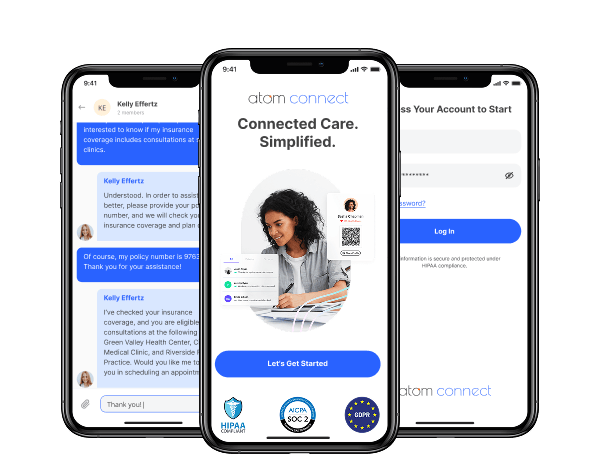
The provider, Atom Advantage, runs services for workers’ compensation claims in the US. Its product Atom Connect is the communication hub built on Ethora. Every claim involves an injured worker, the case manager or nurse coordinating care, a supervisor, often an adjuster, and treating doctors and pharmacies outside the company.
The challenge. These conversations were spread across phone calls, email and the claims portal. Every message about a claim is protected health information. Case managers already work in a web-based case-management system, so a separate chat tool with its own login would not be used. Many injured workers prefer Spanish, Portuguese, Creole or Mandarin. And claim data arrives from several claims administrators, each with its own file format.
The approach. Instead of building a messaging stack, the provider licensed Ethora as its chat and backend engine and had us build a thin custom layer for workers’ comp. That layer covers case-based room provisioning, a claims-data importer, claim-based login and the integration with the existing portal. Everything else, including messaging, files, push, translation and bots, is the standard Ethora engine. Everything runs on a dedicated Ethora server in the provider’s own AWS account. See how the same engine serves other healthcare chat projects.
Requirements
What the project needed, and how Ethora met it
Each requirement is tagged by what came from the Ethora engine and what we built as the workers’ comp layer on top.
Chat inside the existing case-management portal, no second login
Ethora’s React chat UI is embedded in the portal’s case tab as an iframe. The portal passes a signed token and the case manager’s case IDs, so the right claim conversation opens without signing in again. A small postMessage API lets the host page switch cases and show unread badges. The later version moved to the Ethora Chat Component, so the same UI could be dropped into other portals or shipped as a standalone web portal.
One secure conversation per claim, created and closed by the claims system
A backend-to-backend Case API (documented in Swagger) lets the claims system call POST /case when a case opens. The platform then creates an XMPP room named after the case ID, plus accounts for the injured worker and case manager. Separate routes add supervisors and admins across their cases, so another case manager can step in when needed. The room is deleted automatically 30 days after the claim is marked closed.
Injured workers on mobile, without account friction
A white-label React Native app for iOS and Android, built on Ethora’s mobile engine and published to both stores under the provider’s brand, with per-client colours and splash screens. Workers sign in with details from their claim (for example case ID and date of injury), which are checked against cases already created through the API. The account is then provisioned through Ethora’s Users API with the case ID as the external ID, so nobody has to invent a password on day one.
A claim card in the worker’s pocket
The app shows the worker’s claim and patient details, pharmacy help, durable medical equipment and scheduling contacts, and forms for the treating physician. A QR code lets a doctor open the same information on a web page, verified with the worker’s claim details, and print the forms.
Multilingual injured workers
Ethora’s built-in message translation lets each worker pick a preferred language. Messages appear in the original and in translation, and earlier messages are re-translated when the language changes. The priority languages here were Spanish, Portuguese, Creole and Mandarin. Translation is part of the standard Ethora chat SDK and backend, so any app built on Ethora can switch it on.
Claims data from several administrators, each in its own format
An SFTP importer checks each administrator’s folder every 5 minutes. It runs a separate parser per file layout, validates file type and size, replaces duplicate claims, and logs every file as imported or failed. Operations staff get a daily summary email of errors. Raw files are kept for a configurable period and then deleted, and claim counts feed a billing report.
Files and documents in the conversation
Attachments, images and voice messages use Ethora’s file service, backed by encrypted object storage on the dedicated server. File links travel with the chat history, so conversations and attachments can be exported into case notes.
Automation for routine steps
Bots built on Ethora’s TypeScript bot framework handle intake questionnaires, allergy and medication capture, medication reminders and translation. The framework runs many bots side by side under one process manager, so new assistants don’t need new infrastructure.
Deployment
A dedicated chat server in the provider’s own AWS account
Nothing is shared with other Ethora customers. The production environment runs in the provider’s AWS account on encrypted volumes, with encrypted S3 storage and daily database backups to S3. The same stack can be self-hosted on AWS or installed from a marketplace.
Where this stack runs
Security
HIPAA and SOC 2 compatible
The provider passed its SOC 2 certification with Ethora in its stack. These are the controls that let claim conversations carry protected health information. Compliance for any specific project depends on its configuration and hosting. More on HIPAA-compliant chat.
Data isolation
A dedicated instance per customer, running in the provider’s own AWS account. No database shared with other Ethora customers.
Encryption
TLS in transit, encrypted volumes and encrypted S3 at rest, and encrypted file storage for attachments.
Retention by design
Rooms deleted 30 days after a claim closes, raw claim files deleted on a schedule, and claim data kept for a configurable period after the last login.
Role-based access
Injured worker, case manager, supervisor and admin roles. Workers see only their own claim’s room, and supervisors see only their assigned cases.
“Ethora technology and expertise were instrumental in delivering Atom Connect, our product for streamlined communication in the workers’ comp market.”
 Carol ValenticCEO, Atom Advantage
The outcome
Claims-grade chat without building a messaging stack
The injured-worker app went live in the App Store and Google Play in May 2024, with a soft launch across the provider’s first four client companies, and the case chat runs in production inside the claims portal. The integration was packaged as a reusable template: Case API, embeddable chat, white-label app and claims importer. That turned onboarding a new claims client into a planned project (roughly 10 days of mapping, 25 days of development and 10 days of QA for the chat interface) rather than a new build.
The pattern carries over to any regulated workflow where conversations belong to a record: claims, care episodes, cases or policies.
FAQ
Can each claim or case get its own chat room automatically?
Yes. Your backend calls the Ethora API when a case opens. The platform creates a room for that case and its participants, adds supervisors through role routes, and can remove the room on a retention schedule after the case closes.
Is Ethora HIPAA and SOC 2 compliant?
Ethora is HIPAA and SOC 2 compatible: this provider passed its SOC 2 certification with Ethora in its stack. Ethora runs as a dedicated or self-hosted server, in your own cloud account if you prefer, with encryption in transit and at rest, role-based access and configurable retention. Compliance for a specific project depends on its configuration and hosting, and handling PHI requires an Enterprise agreement with a BAA.
Can injured workers or patients use the app without creating a password?
Yes. Login can be verified against data you already hold (for example a claim number and date of injury), and the account is then created through the Ethora Users API with your record ID as the external ID.
Can messages be translated for workers who prefer another language?
Yes. Translation is built into Ethora’s standard chat SDK and backend. Each user picks a preferred language and sees each message in the original and in translation.
Can we run the whole stack in our own AWS account?
Yes. See Get Ethora for AWS Marketplace and other self-hosted options, or the self-hosted chat server on AWS guide.
More case studies
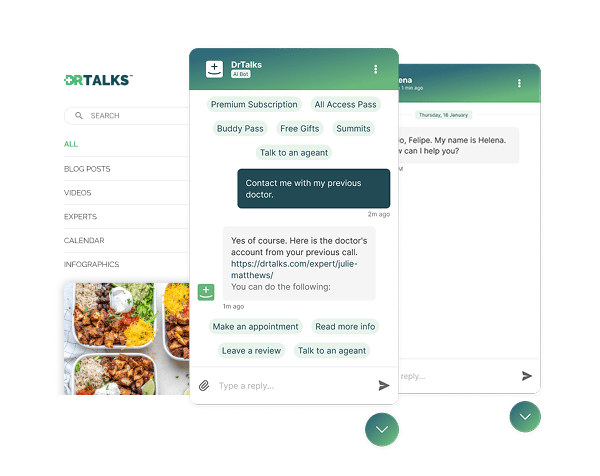

Healthcare: HIPAA-compliant AI assistant (RAG) over a medical video library
Dr. Talks is one of the most prominent organizers of online healthcare conferences and summits.
Ethora enabled them to create a context-aware AI-powered chatbot to help users navigate thousands of pages of medical content, correctly referencing pages, authors, videos and timestamps. 100% secure and HIPAA-compliant.
This assistant enhances user experience by simplifying interaction with the platform and reducing search time.
- 1000+ summits indexed by AI bot
- Instant user engagement
- Vector embeddings enable intelligent domain expert AI responses

Healthcare: self-hosted patient messaging for a multi-clinic digital health platform in Canada
VITALL is a Canadian digital health platform used by hospitals, clinics and private practices.
Ethora runs as a self-hosted chat server in VITALL’s own AWS account in Canada, with one isolated tenant per clinic, chat in the practitioner portal and in native iOS, Android and React Native patient apps.
Users, rooms and clinics are provisioned by VITALL’s backend through the Ethora API.
- Self-hosted in the customer’s AWS account in Canada
- One isolated tenant per clinic, created by API
- Web portal, iOS, Android and React Native SDKs
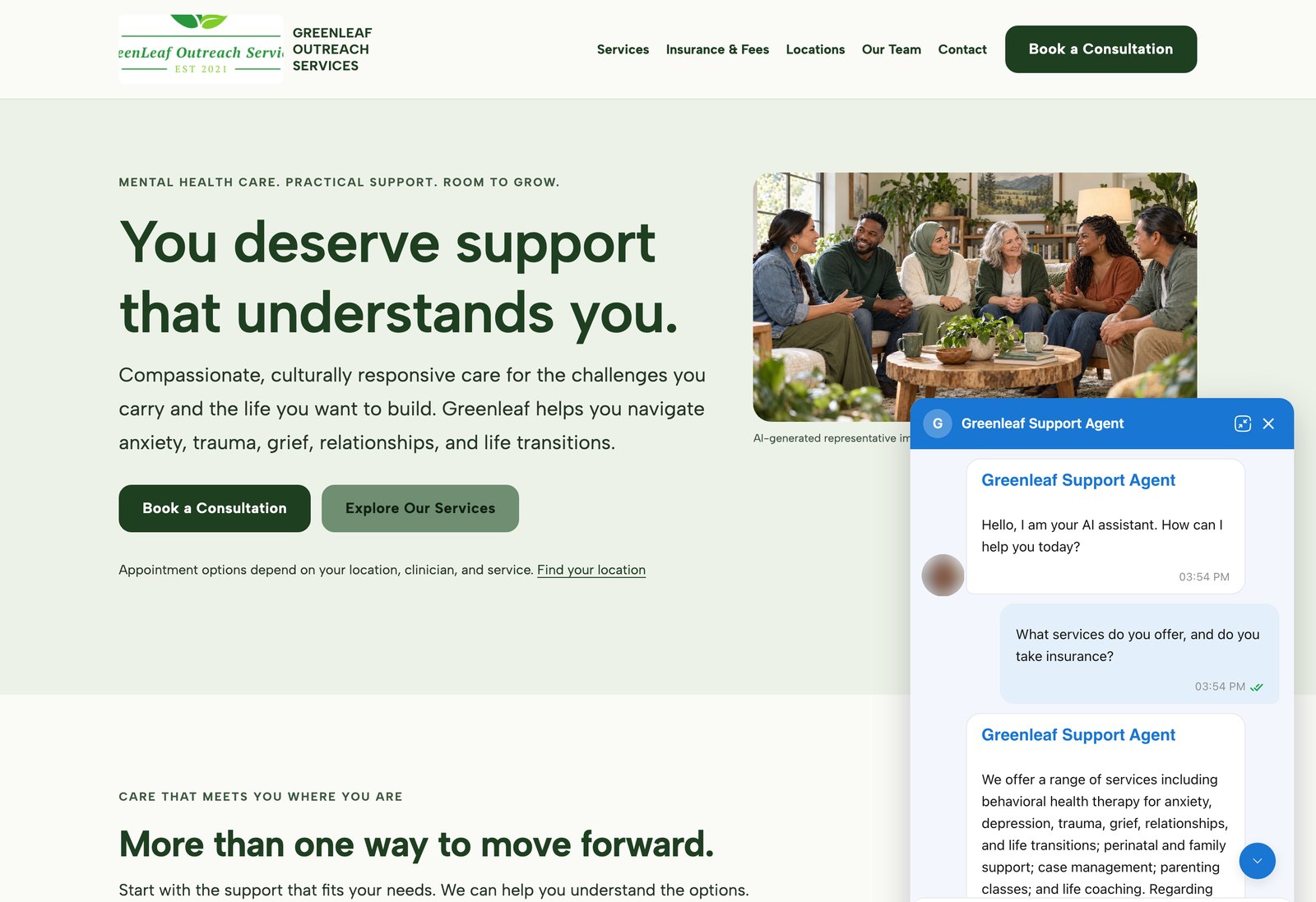
AI agents on customer websites: support, intake and teaching assistants
Clinics, schools and small businesses build AI agents on Ethora themselves and put them on their own websites, often on the day they sign up.
2 live examples, from a US mental health provider to a university pharmacology course.
- WordPress plugin or one script tag
- Answers from the customer’s own pages and documents
- Self-serve, no developer needed

Energy: dedicated chat server, AI-agent rooms and a React Native app for a procurement platform
Preshent is a US platform for energy-project procurement with AI-driven decision support.
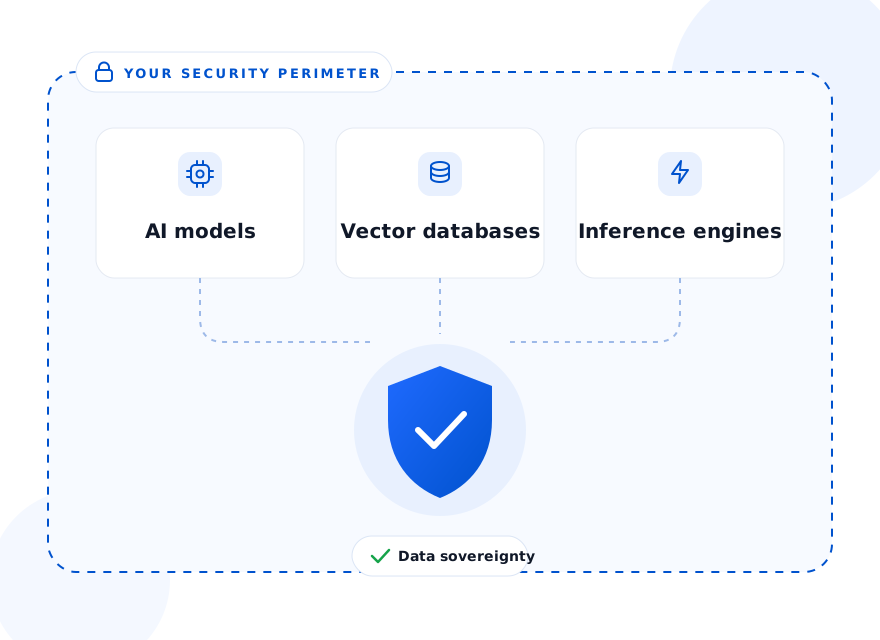
Ethora provides the conversation layer: a chat room per project workspace shared by people and the AI agent, a dedicated chat server in Preshent’s own cloud, push notifications and a React Native app.
- 1,130 chat rooms, one per workspace
- AI agent as a participant in every room
- Dedicated chat server, 99.99%+ uptime

Defence: on-premise, end-to-end encrypted messaging for a European defence prime
An EU-based defence and aerospace prime, under NDA.
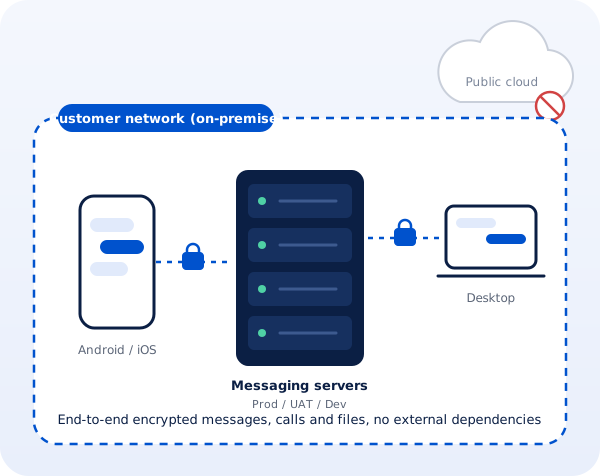
Ethora Professional Services built a fully on-premise, end-to-end encrypted messaging system with branded mobile and desktop clients, an offline build chain and no dependency on public cloud services.
- On-premise, air-gapped deployment
- End-to-end encrypted messages, files and calls
- Branded Android, iOS and desktop clients
Add compliant chat to your claims or care platform
Case-based rooms, an embeddable portal chat and a white-label mobile app, on a dedicated server in your own cloud.
