
Glossary
AI Persona
The character an agent plays: who it says it is, how it speaks, what it will and will not do. Set in the system prompt and tested like any other product surface.
General definition
An AI Persona is the consistent identity a language-model agent presents: a name, a role, a tone of voice, a point of view and a set of boundaries. It is mostly written into the system prompt, the instructions the model receives before any user message, and reinforced with examples, a style guide and sometimes a retrieved profile of the person or brand it represents. Without a persona a model falls back to its default assistant voice, which is fine for a tool and wrong for a product.
A persona definition usually covers:
- Identity and role: who the agent is, who it serves and what it is for (a support agent for one product, a tutor, a concierge, a character in a game)
- Voice: formality, sentence length, vocabulary, humour, languages, and the things it never says
- Knowledge boundaries: what it knows, what it should look up, and what it must decline
- Behavioural rules: how to handle abuse, requests outside scope and personal data, and when to hand off to a person
- Disclosure: that it is an AI, which the EU AI Act and some US state laws require when a bot talks to consumers
Two uses dominate. Brand voice: a company wants every automated reply to sound like its own writing, so the persona encodes the style guide. Digital twins: an agent that stands in for a specific person or expert, built from their writing and knowledge, the pattern described under digital twin. In both cases the persona is a product decision rather than a prompt trick, and it should be versioned, reviewed and tested against real transcripts.
Personas also need guardrails. Users will try to make the agent break character, reveal its instructions or act outside its role, and prompt injection can do the same through a document. Treat the persona text as policy the model follows, backed by moderation on input and output and by permissions that do not depend on the model obeying its prompt.
Want to try it yourself? Build an AI agent that answers from your own pages and documents with the Ethora no-code AI agent builder. No coding is needed and it is free to start.
In the Ethora ecosystem
In the Ethora AI SDK every agent has its own profile in the chat, its own system prompt and its own knowledge base, so a persona is a first-class object rather than one shared bot. You can run several personas in one app, each attached to different rooms or channels and each on a different model if you want a cheaper model for a lightweight character and a stronger one for an expert. Per-room transcript memory keeps the character consistent through a long conversation, and the no-code agent builder lets a non-developer write and revise the persona.
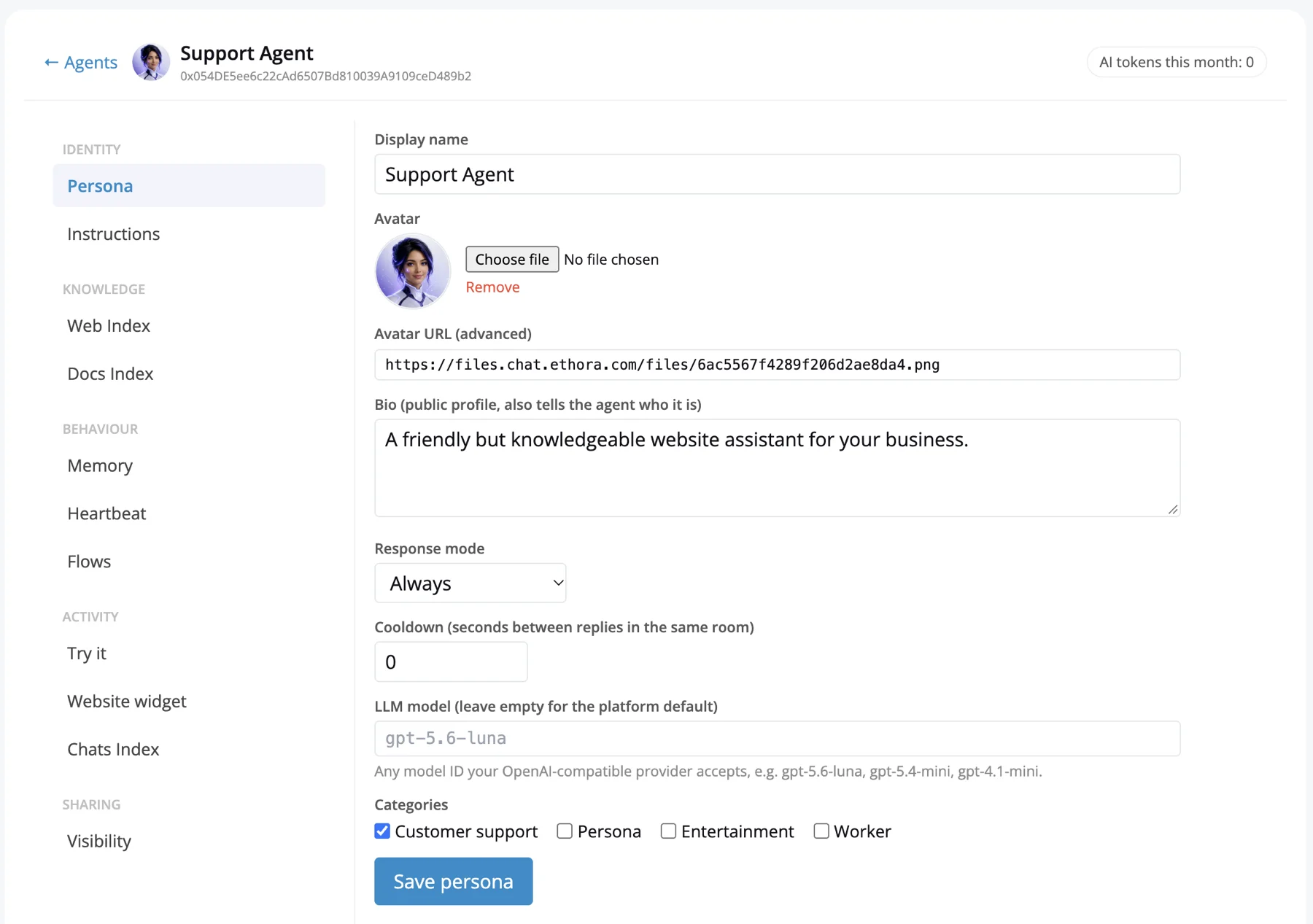
Ethora Agents, the showcase at agents.ethora.com, is built on exactly this: digital twins and bots with distinct voices, each one an agent with a persona, a knowledge base and a room. For products that put personas in front of the public, the Trust and Safety layer moderates what the agent says as well as what users say, and the server-side archive keeps every reply for review. The AI chatbot entry covers the surrounding mechanics.
