Adding a chat box to your app is an afternoon. Running a messaging system that thousands of real users trust, on flaky mobile networks, with an AI assistant that answers from your own data and never leaks it, is a roadmap. The gap between those two things is where product teams quietly lose six months and a chunk of runway they had earmarked for the features only they can build.
This is an honest look at what building in-app chat and AI agents in-house actually costs. Not the license-fee comparison (we did that in our honest chat API comparison), but the engineering bill: the hidden subsystems, the maintenance that never ends, and the middle path most teams miss, where you buy the SDK and still own your data.
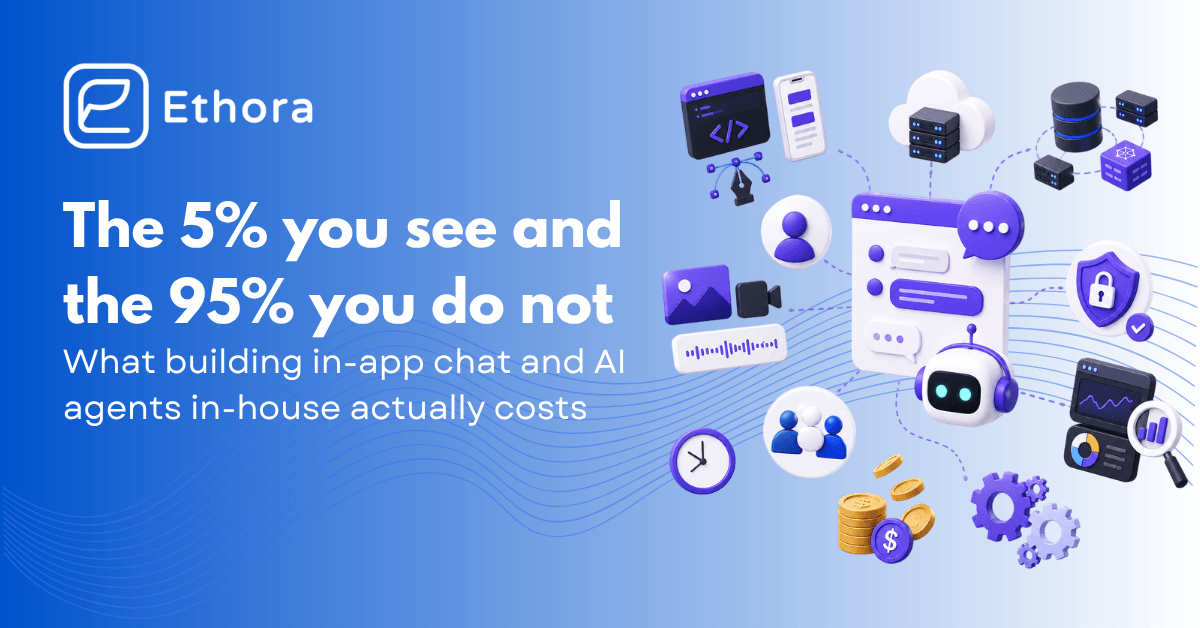
The 5% you see and the 95% you do not
A chat bubble and a text input are the visible 5% of a messaging product. Every tutorial stops there. Here is the 95% that arrives the moment real users do, and roughly what each piece costs a competent team building from scratch.
Real-time transport and presence
WebSockets or XMPP, connection state, reconnect logic that survives a subway tunnel, presence (who is online), typing indicators, and delivery and read receipts. Chat bubbles UI, message reactions, emojis, file attachments and previews. Each of these is a small project with its own edge cases. Reconnection alone, done properly across iOS backgrounding, Android doze mode, and web tab-sleep, eats weeks. Rough cost: 1 to 2 engineer-months.
Message delivery and multi-device sync
Offline queues, ordering, deduplication, and history that syncs across a phone and a laptop. Users expect a message sent on one device to already be there on the other. That is an archive and sync system, not a feature, and it is where naive implementations corrupt or drop messages under load. Rough cost: 2 to 3 engineer-months.
Push notifications
APNs and FCM, token lifecycle, and the logic to notify a user only when they are not already looking at the conversation. Getting the “do not buzz me for a message I just read on web” behavior right across devices is fiddly and never truly finished. Rough cost: 3 to 4 engineer-weeks.
Moderation, safety, and audit
Blocking, reporting, profanity and abuse handling, and an audit trail. This becomes non-negotiable the instant strangers can message each other, and it is a genuine sub-discipline in its own right. We wrote a whole guide on it in chat moderation for product and trust teams, plus a deeper piece on how AI content moderation actually works. Rough cost: 1 to 3 engineer-months, then ongoing forever.
Files, media, and scale
Upload, storage, thumbnails, and access control on every attachment. Then the scaling reality: a chat server that is fine at 100 concurrent users behaves very differently at 10,000. Fan-out, group rooms, and rate limiting all need real engineering, and you usually discover the limits in production. Rough cost: 2 to 4 engineer-months, load-dependent.
Add it up and production-grade messaging is a realistic two strong engineers for six to twelve months, plus permanent ownership of a system that is now load-bearing for your product. Teams routinely budget a sprint and spend a year. The video equivalent is even steeper, which we broke down in how to build a video chat app.
Then you add the AI agent layer
Two years ago “add an AI assistant” meant wiring an LLM API into a text box. In 2026, users and buyers expect more, and a useful in-product agent needs four things that each carry their own cost.
- A conversational surface that already handles history, context, and multi-user threads. This is the exact messaging layer above, which is why chat and AI have converged. An agent is just another participant in the conversation.
- Retrieval (RAG) so the agent answers from your knowledge (docs, tickets, product data) instead of hallucinating. Chunking, embeddings, a vector store, and freshness handling are a project on their own.
- Tool calling and actions so the agent can create a ticket, look up an order, or trigger a workflow, not just talk.
- A model choice that fits your privacy posture, including the option to run open or self-hosted models when sending customer data to a third-party API is off the table. If you have never done it, our guide to running LLMs locally shows why “just self-host the model” is its own rabbit hole.
The practical takeaway: if you are building chat anyway, the AI agent should sit on the same messaging layer as your human conversations. Bolting a separate AI vendor onto a separate chat vendor is how you end up maintaining two systems that disagree about what a “conversation” is.
The cost that shows up after launch
The build estimate is only half the bill. Once messaging is live it is load-bearing, and load-bearing systems demand maintenance: on-call for the real-time layer, keeping up with APNs and FCM changes, patching the XMPP or WebSocket stack, scaling the datastore as history grows, and re-testing the whole thing on every new iOS and Android release. This is the number teams forget. A feature you buy is someone else’s maintenance burden. A feature you build is yours, every quarter, indefinitely.
The criterion that decides it: who owns the data
Here is where most teams historically talked themselves into building. Plenty of chat SDKs are cloud-only: your messages, user data, and attachments live on the vendor’s multi-tenant infrastructure, in their region, under their terms. That is fine for a consumer side project. It is a deal-breaker the moment you sell into healthcare, finance, insurance, or any enterprise with a security team, because their questionnaire opens with three questions:
- Where does our data physically live?
- Can we host it ourselves or in our own cloud account?
- What is the SLA, and what happens if you change pricing or get acquired?
If the answer to the first two is “wherever our chat vendor decides,” you have added friction to every enterprise deal you will ever try to close. Wanting to control that answer is the single most common reason teams decide to build the whole thing themselves.
The good news in 2026 is that you no longer have to. This is the middle path most build-versus-buy debates skip: a self-hosted chat server. You take the same SDK and components and deploy the backend into your own AWS account, or your own data center, so the data never leaves infrastructure you control. You get the speed of buying an SDK with the data ownership and deployment control of building it yourself. For regulated verticals this is not a nice-to-have, it is the difference between passing a vendor review and being cut in round one, which is exactly why we built a dedicated HIPAA-ready healthcare chat SDK.
A reasonable staged approach exists too: start on a managed cloud instance to ship fast, then move to self-hosted or dedicated deployment when a customer requires it, without changing your application code. The ability to make that move later, without a rewrite, is worth checking for before you commit to any platform.
When building from scratch still makes sense
Buying is not automatically right. Build from scratch when messaging is your product (you are building the next Slack), when you need behavior no SDK can express, or when you genuinely have engineers who have shipped real-time systems before and the months (or even years) to spend. For everyone else, the math points the other way: buy the infrastructure and spend your scarce engineering time on the parts of the product only you can build. If you want the landscape of options, our free live chat apps comparison and the chat API comparison lay out where each tool fits.
How to evaluate a chat and AI SDK
When you do go shopping, score each option against this. It separates real platforms from thin wrappers fast.
- Deployment options: cloud, dedicated, and self-hosted. If only one exists, your future is decided for you.
- Data ownership: can you export everything, and host where your customers require?
- Cross-platform SDKs: web, iOS, and Android, ideally including React Native, so you are not integrating three products.
- AI built in: bots, RAG, and LLM agents on the same layer as messaging, not a separate bolt-on.
- Open source or open core: being able to read the code, run it locally, and avoid lock-in is a real risk reducer.
- The (unglamorous) essentials: push, moderation, file handling, presence, and receipts, all present and documented.
- Pricing model: per-message and per-MAU pricing can scale into a nasty surprise. Understand the curve first.
- SLA and support, especially if you are betting your compliance or an enterprise deal on it.
Where Ethora fits
Ethora is an open-source chat and messaging SDK with a built-in AI agent and chatbot framework, cross-platform SDKs for web, iOS, and Android, and one property that matters most to the teams reading this: you can run it on managed cloud to move fast, or self-host it in your own environment to own your data and pass enterprise security review, using the same code either way. Messaging, AI agents, and deployment control in one stack, instead of the multi-vendor sprawl most teams end up maintaining.
FAQ
Is it cheaper to build or buy chat?
For almost everyone, buy. Building production messaging is a realistic two-engineer, six-to-twelve-month commitment plus permanent maintenance. Buy the infrastructure and spend your engineering budget on your actual product. Build only if messaging is the product itself.
Can I add AI agents without managing my own LLM infrastructure?
Yes. Modern chat-and-AI SDKs include bot, RAG, and LLM-agent frameworks, so you can ship an assistant without standing up a model-serving stack. If privacy rules out third-party model APIs, look for platforms that also support open or self-hosted models.
What does self-hosted chat actually mean?
You deploy the chat backend into infrastructure you control (your own cloud account or data center) instead of a vendor’s multi-tenant cloud. Your messages and user data stay on your servers. It is the standard requirement for healthcare, finance, and enterprise buyers with data-residency rules.
How do I avoid vendor lock-in?
Favour open-source or open-core platforms, confirm you can export all your data, and check that you can move from cloud to self-hosted later without rewriting your app. If you can run it locally yourself, or there is server source code access option, you are not locked in.
The bottom line
Building real-time chat and AI agents from scratch is rarely the best use of your best engineers time, and the old reason to build anyway, keeping control of your data, has mostly evaporated. You can now buy a chat and AI SDK and still self-host it, own your data, and pass enterprise security review. Spend your scarce engineering on the product only you can build, and let infrastructure be infrastructure. If you want to see what that looks like end to end, you can get a cloud account with Ethora, and send yourself a message before lunch. Once you are happy with the service, get a self-hosted version of Ethora chat server, choose your SLA option and you solved it.

Share with your community


More Articles
Development
Oct 5, 2026
Cross-Platform App Development Frameworks in 2026: 10 Options Compared, Real Trade-offs, and Chat + AI SDK Fit
In 2026, evaluating cross-platform frameworks is a complex matter. There are many practical questions: Which ones have solid chat and AI SDK support today? Which ones won’t force a painful migration when the next major OS version drops? And what are the real engineering trade-offs once you move past the marketing claims? We’ll look at […]

Healthcare
Oct 1, 2026
HIPAA-Compliant Video API in 2026: What Actually Makes One, Vendor Comparison, and Twilio Video Migration
Consultations, psychiatry meetings, medication management, triage, and other medical encounters often do not require physical presence. Adding video to your healthcare app or platform can be a great idea, as it allows you to hold sessions online without losing the human touch. Using a messaging API to incorporate video into your application makes the whole […]

Try Out Ethora in Action
Experience Ethora's messaging with a dedicated demo from our CEO or start building your App right now!