Blog
React Native
Blog
React Native
React Native
How to Create an App in 2026: A Step-by-Step Guide for Beginners and Builders

In 1995, Bill Gates said: If your business is not on the Internet, then your business will be out of business.” Today, almost every business has its mobile app, from banks and insurance companies to coffee shops and gas stations. And the number of apps is only growing – the market size is expected to reach more than $1 trillion by 2034. The competition is insane, but opportunities are also great.
Apps can help you increase visibility and boost revenue, streamline workflows and enhance the customer experience, and provide valuable insights into the app’s performance and customer behaviour. So, creating an app is a good idea, whether it’s a customer-facing solution, a corporate one, or a unique idea with strong product–market fit that helps you carve out your own niche and truly take off.
In this blog, we’ll walk you through the entire app development process, from a prototype to a fully-functional tool.
Getting Your App Idea on Paper
If you’re wondering how to start an app, you need to know that in 2026, it takes more than just writing code. And the first step is your app idea validation. To do this, clearly define:
- The problem your app solves
- Your target audience
- The value it delivers
- Business model (how it will generate revenue)
Don’t forget about integrating modern tech, as it’s a matter of staying competitive. For example, if you’re building a customer-facing tool, consider adding an AI assistant to your concept. In 2026, smart AI chats, robo-advisors, conversational search, smart analytics, and other AI-powered functions are a baseline, not a bonus.
Choosing the Right App Type
The next step of your mobile app development journey is to define the type of app you want to build. This may be a native app built specifically for iOS or Android, a web app, or a cross-platform solution that works on various devices.
Native apps are often considered the ones providing the smoothest experience. Still, modern programming languages like React allow you to run a codebase with the same architecture for multiple operating systems without sacrificing performance.
Progressive web apps are run in a browser or downloaded. These might be live chat web apps, marketplaces, collaborative tools, task managers, online wallets, and many more. Usually, you can access them via the website, browser extension, or desktop version.
App UI, UX, and Interaction Design
Put simply, UI/UX is how users see and interact with your app. For better understanding, here’s what UI and UX mean:
- UI – user interface (colors, fonts, icons, layouts)
- UX – user experience (speed, interaction flow, responsiveness)
UI/UX design is not about the appearance alone. This is a crucial part, as it determines how easily users can navigate and complete actions, directly impacting their satisfaction and retention. For example, if customers open your app, and they can’t immediately understand the value, or if onboarding is complicated, 74% will likely switch to another provider.
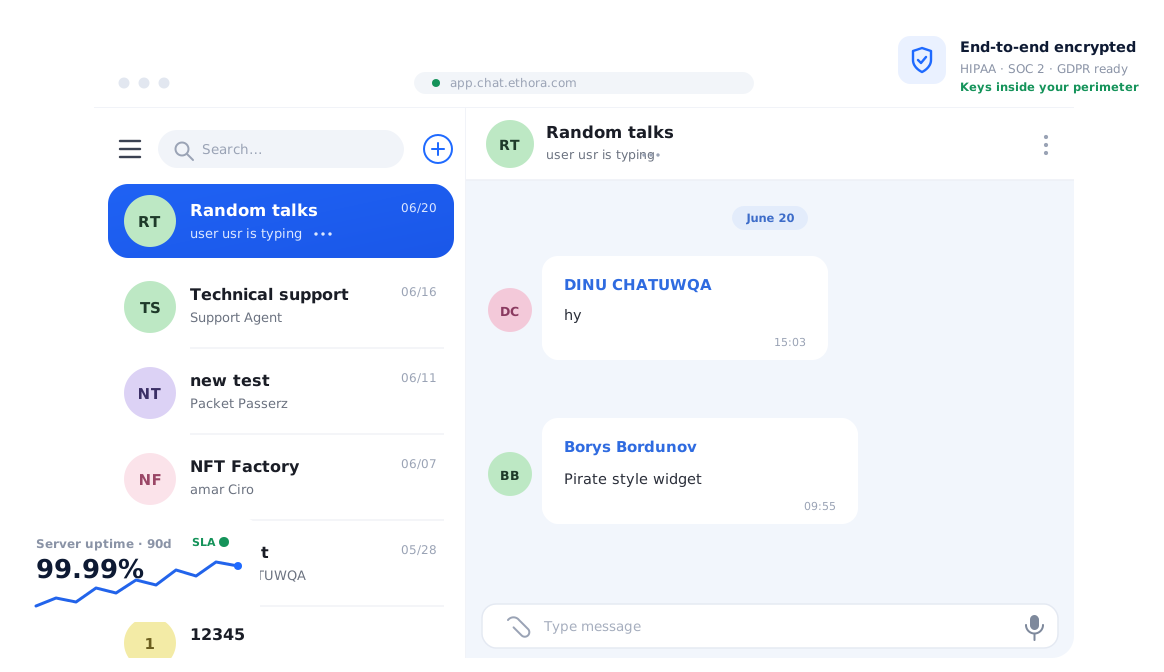
Creating a quality design may be a complicated and time-consuming process, but you don’t have to create it from scratch. Using SDKs with UI kits will save you a lot of time and effort, as they usually include all the essential layouts and features you need. For example, Ethora’s kit offers ready-to-use components for chat apps: messaging interface, chat threads, and an input box – all designed for a clean and simple UI.
Building the App (MVP First)
Even if you have a great app idea with millions of features, your goal at this stage should be to solve the main customer’s problem. Focus on core features and build a minimum viable product (MVP).
This way, you’ll build a solution that’s understandable and really helps, delivering immediate value and validating your idea in the real world. If you don’t want to spend many months building an MVP, you can use no-code or low-code app builders. They will simplify the overall process and accelerate go-to-market.
Testing, Publishing, and Launch
Before you go live, test the app. This will help you ensure, that it functions as intended. Performance under poor connectivity, chat logs, synchronization behavior, push notification delivery, and everything else your app does should be tested rigorously. Once you’re done, you can publish your app on stores.
Publishing requires registering developer accounts:
- Apple Developer Program (for iOS apps)
- Google Play Developer account (for Android apps)
Carefully read the guidelines before Google Play and App Store submission, and provide clear documentation. This will reduce the risk of possible delays or publishing failures.
Maintaining and Growing Your App
Launching the app is a major milestone, yet it’s only the beginning. After you have the basic tool, it’s time to grow and improve it. Simplify processes, remove friction, add new features, like gamification, in-app messaging, in-app communities, or AI capabilities, and do whatever is useful for your customers.
This is a continuous process that requires app updates, setting KPIs, and analytics. Analysis of the app’s performance will provide you with invaluable insights about what you should do to improve user experience and increase engagement.
Build Your Own: Scaling an App with Real-Time Communication
While basic tools help you start, professional-grade applications in 2026 demand integrated intelligence and robust infrastructure. If your vision includes conversational AI, marketplace messaging, or enterprise-grade communication, you need more than templates.
Ethora offers a chat SDK architecture that enables you to build a wide range of communication tools, from website support chats and social media platforms to enterprise-ready solutions and AI-powered solutions. And all the infrastructure you need to scale.
Companies seeking full control can use a self-hosted option or deploy on the cloud. We support environments such as AWS application servers, AWS node SDK, AWS mobile SDK, and AWS chat service.
Rather than assembling fragmented tools, Ethora bridges business data with advanced AI systems through a scalable messaging architecture. Check out our GitHub and start building.

Share with your community


More Articles
Development
Oct 5, 2026
Cross-Platform App Development Frameworks in 2026: 10 Options Compared, Real Trade-offs, and Chat + AI SDK Fit
In 2026, evaluating cross-platform frameworks is a complex matter. There are many practical questions: Which ones have solid chat and AI SDK support today? Which ones won’t force a painful migration when the next major OS version drops? And what are the real engineering trade-offs once you move past the marketing claims? We’ll look at […]

Healthcare
Oct 1, 2026
HIPAA-Compliant Video API in 2026: What Actually Makes One, Vendor Comparison, and Twilio Video Migration
Consultations, psychiatry meetings, medication management, triage, and other medical encounters often do not require physical presence. Adding video to your healthcare app or platform can be a great idea, as it allows you to hold sessions online without losing the human touch. Using a messaging API to incorporate video into your application makes the whole […]

Try Out Ethora in Action
Experience Ethora's messaging with a dedicated demo from our CEO or start building your App right now!