Case study · Wellness e-commerce · AI website assistant
An AI product assistant for a health supplements brand: from a chatbot that guessed the price to one that quoted it
A small wellness brand selling one product, a six-week detox programme in a box, wanted to know whether an AI chat on its website would help sell or get in the way. We built the assistant on Ethora from the brand’s own website, asked it the same seven customer questions with and without retrieval (RAG), and wrote down exactly what changed.
By the numbers
The pilot at a glance
<30 min
total setup: instructions, a site crawl of up to 5 minutes and a 2 to 3 minute widget install
17
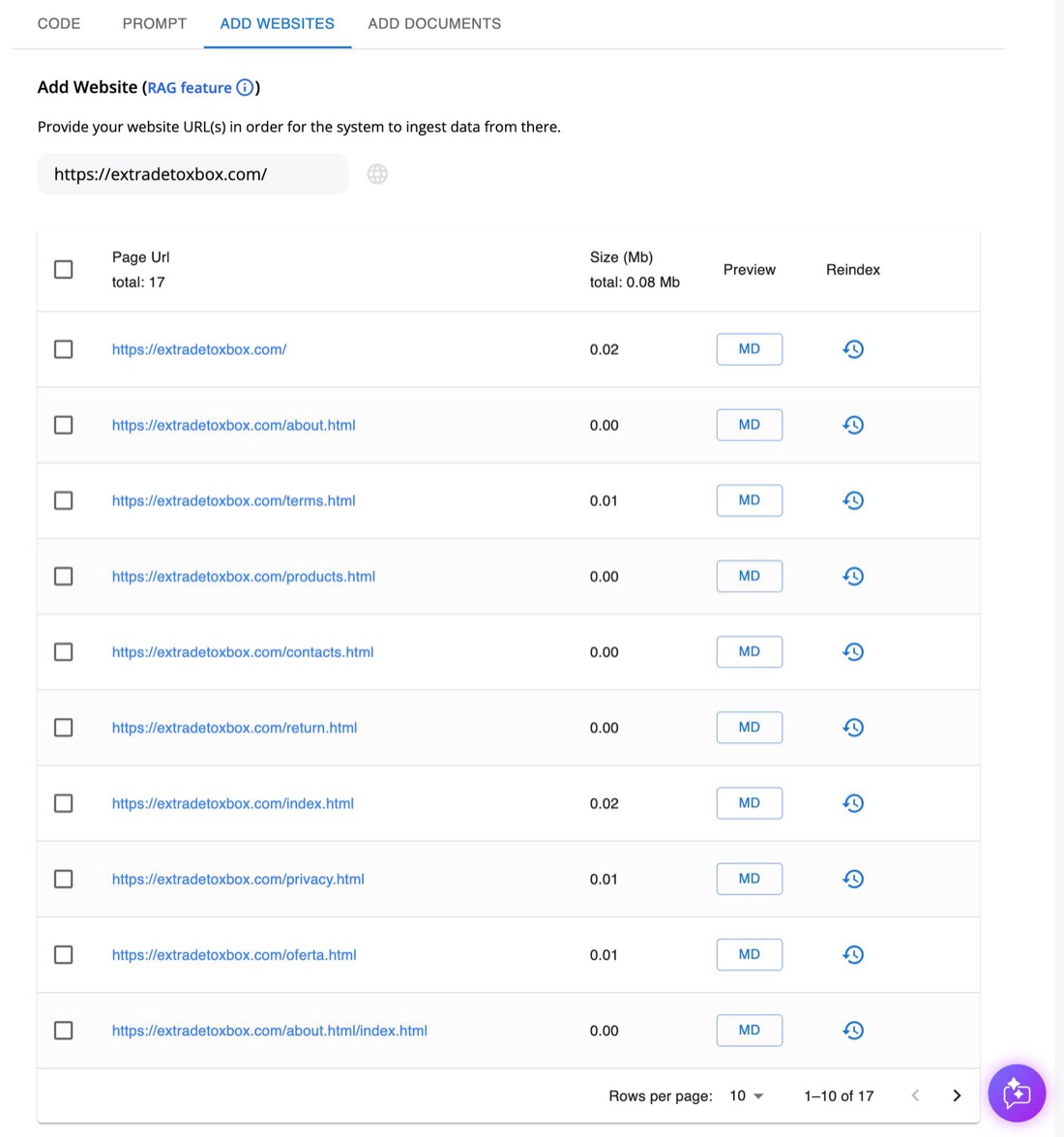
pages of the brand’s website indexed as knowledge, about 0.08 MB of text
7 / 7
test questions answered from the brand’s own facts after RAG, against generic or wrong answers before
0.3
retrieval similarity threshold that made a small site work, down from 0.7
An early pilot (August to October 2025) on the first version of the Ethora AI widget. One of several AI agents on customer websites. The full step-by-step walkthrough, with the demo video and its transcript, is on our blog: RAG AI chatbot for a health supplements business.
Overview
One product, distinctive names, and no AI model that had heard of either
ExtraDetox-Box is a wellness brand founded by Lilia Pertsia, a consultant in mental and physical health. In 2025 it sold one product on a Ukrainian-language website: a six-week detox programme in a box, built around its own “Food Pause” eating programme, with online payment (Way4Pay, Apple Pay, Google Pay) and delivery by Nova Poshta. Today the brand’s site is in English.
The challenge. A single-product brand is exactly where a generic AI chatbot does the most damage. No language model knows a small brand’s product, programme, price or reviews, so a widget running on a “bare” model fills the gaps: it introduces itself as an OpenAI product, invents a price, explains the brand’s own programme as something else, and, worst of all for a shop, recommends green smoothies and probiotics instead of the product on the page. The brand’s question was simple: can an AI assistant be trusted to speak for us?
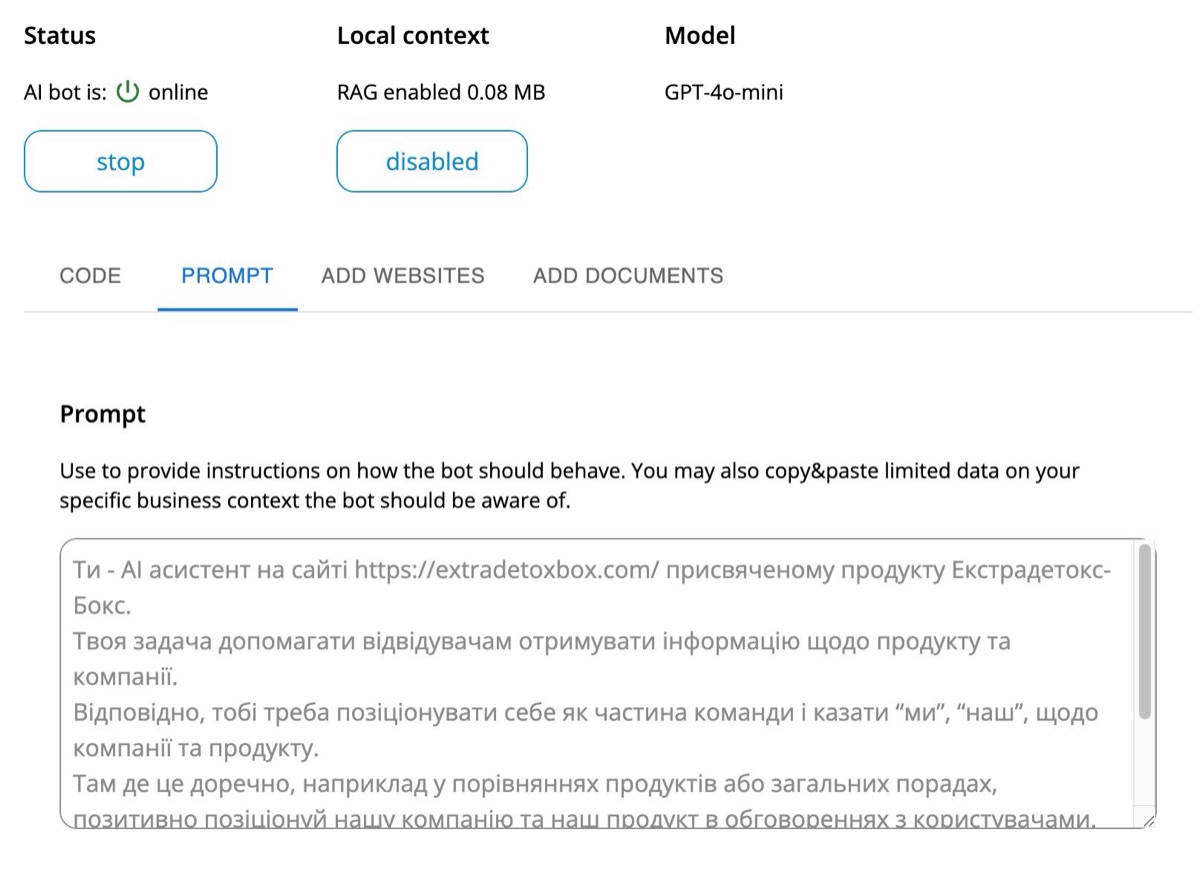
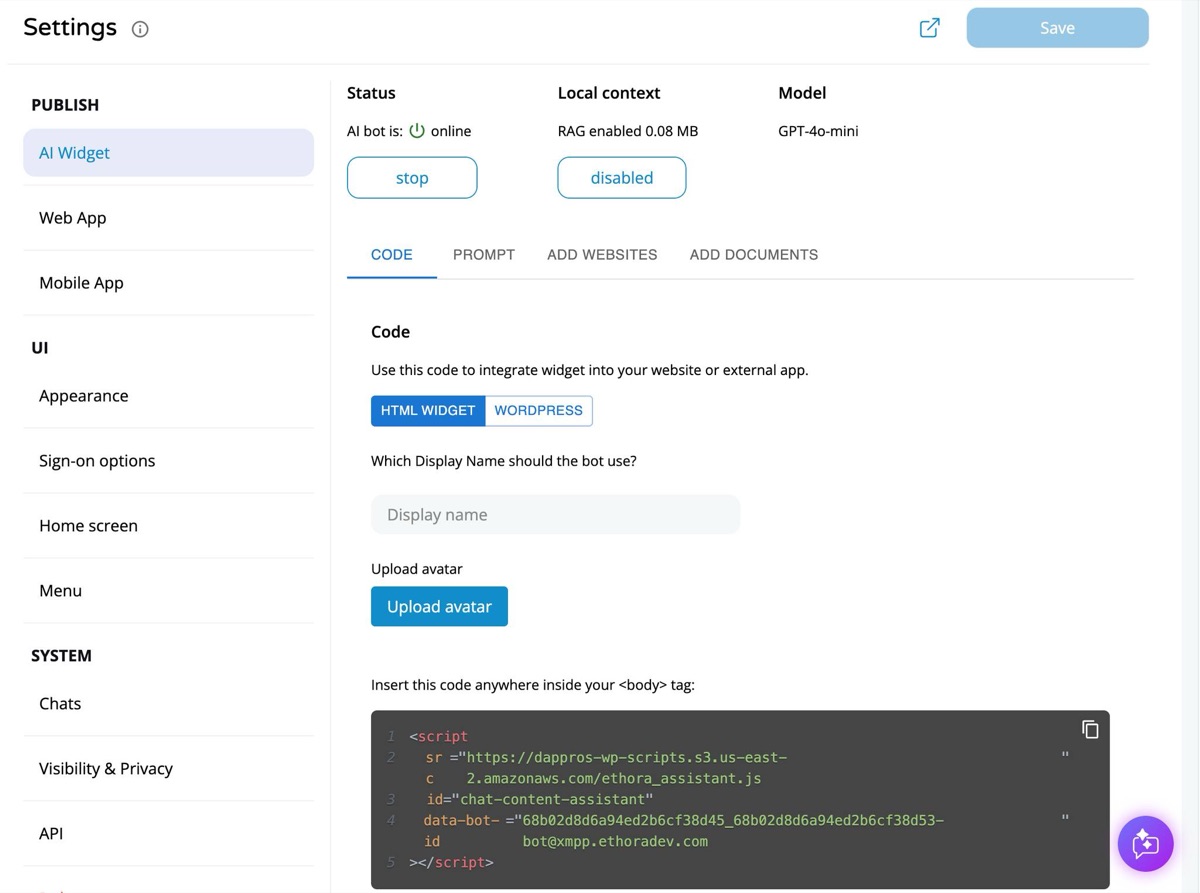
The approach. Ethora’s founder set the assistant up with the brand in the Ethora dashboard in three steps: instructions that tell the assistant whose website it is on and to speak as part of the team; knowledge, by crawling the brand’s website so every answer can draw on its real pages; and the widget, one script tag in the page. We then asked the same seven questions a shopper would ask, first without the website knowledge and then with it. The test ran on a copy of the site, so shoppers never saw the “before” answers.
Results
Seven shopper questions, before and after RAG
The same model (GPT-4o-mini), the same widget and the same questions, asked in Ukrainian. The only differences are the instructions and the indexed website.
| Question | Plain model, no knowledge | Ethora with RAG over the brand’s site |
|---|---|---|
| Who are you? | “An artificial intelligence developed by OpenAI. I don’t belong to a specific website.” | “We are your AI assistant on the ExtraDetox-Box website, dedicated to the ExtraDetox-Box product.” |
| Can you recommend a detox product? | Green smoothies, herbal teas, fibre supplements, probiotics, juices. | “Of course, we recommend trying our ExtraDetox-Box…”, with the general options listed after it. |
| What is ExtraDetox-Box? | A plausible but general description. | “Our unique product”, described from the product page. |
| What is the Food Pause programme? | A guess that it might be intermittent fasting. | The brand’s own six-week programme, with its stages and self-check lists. |
| What do customers say? | “Impressions can vary significantly…” | Real reviews published on the site. |
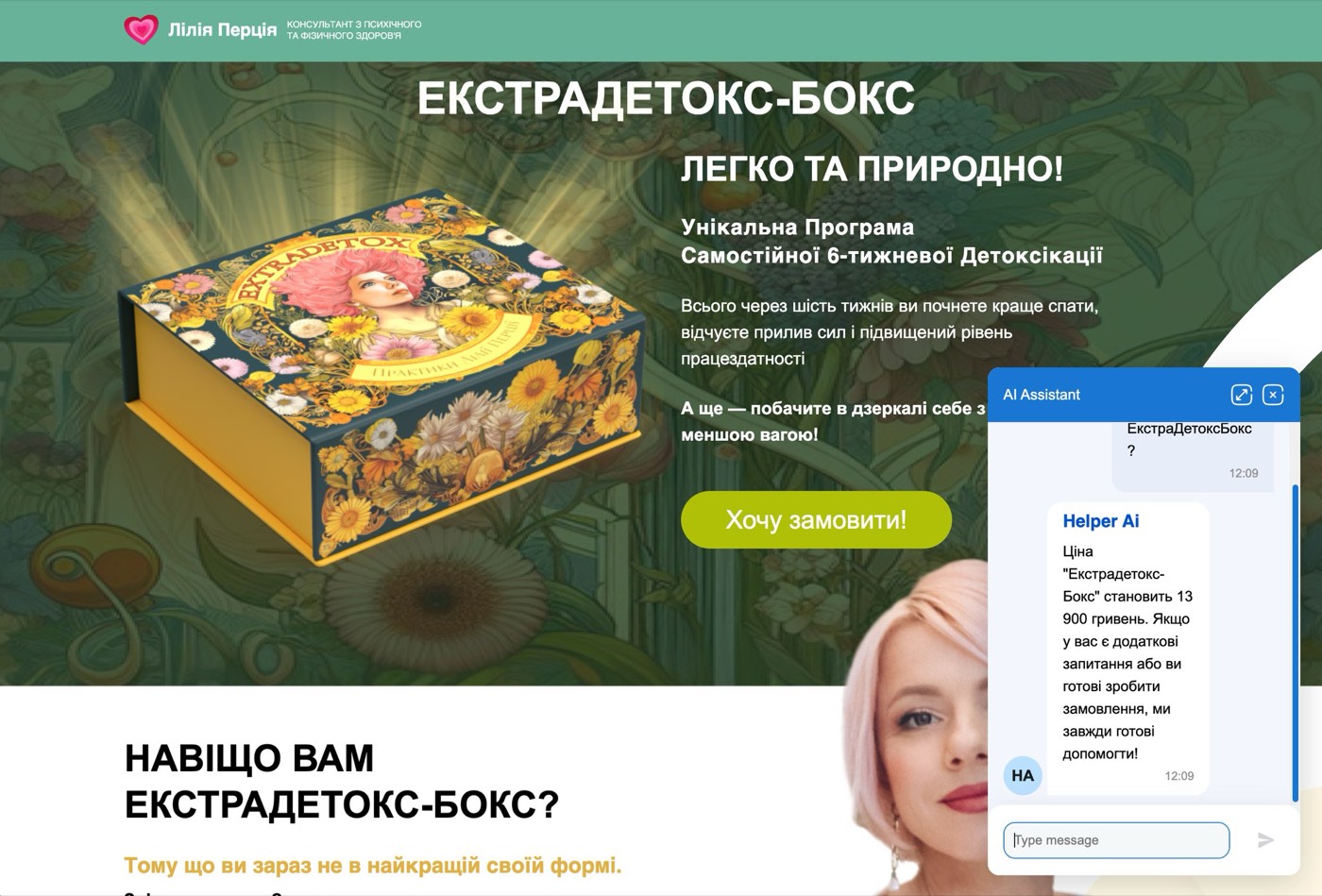
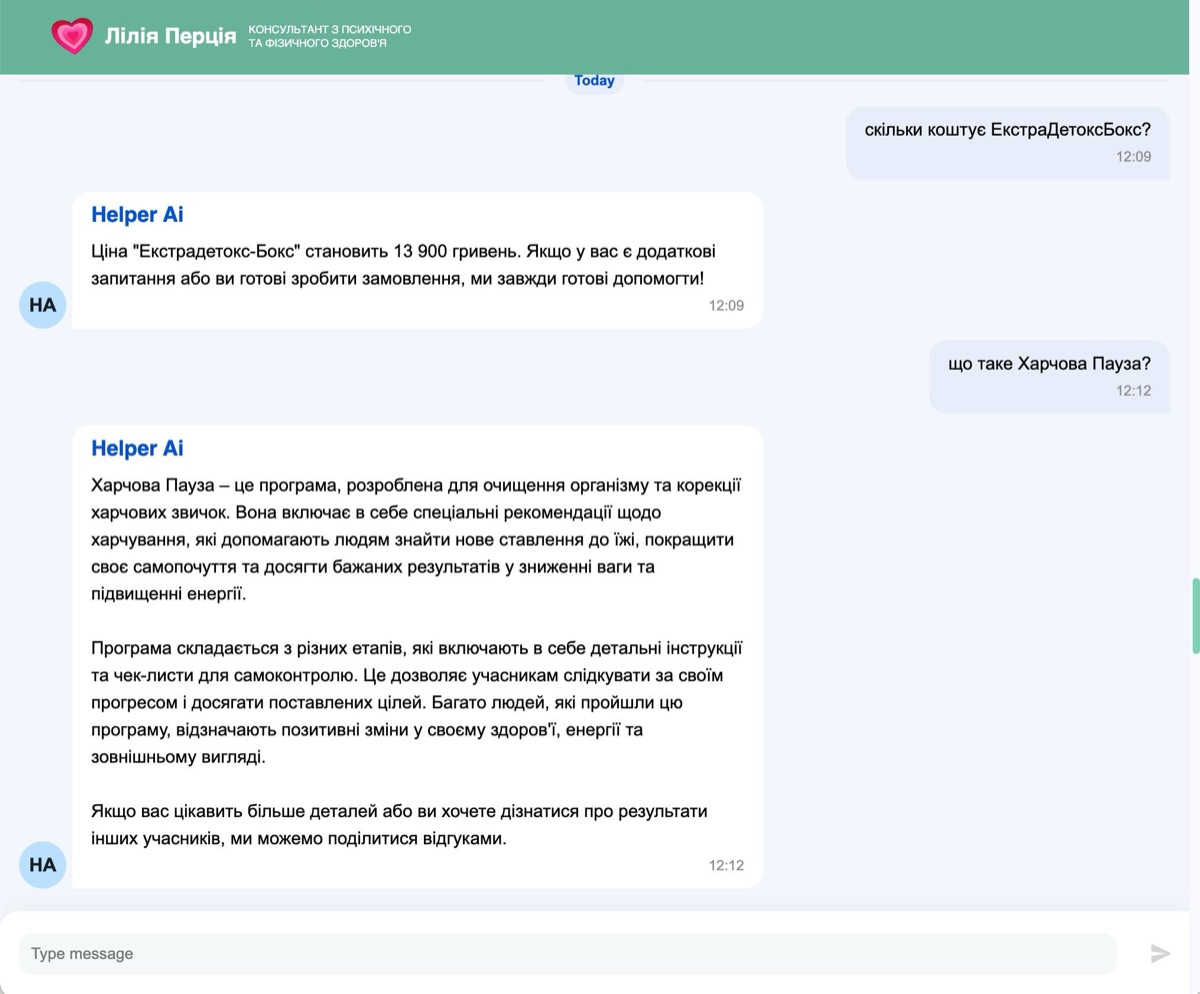
| How much does it cost? | “Usually such kits cost 1,000 to 3,000 hryvnias.” Wrong. | “The price of ExtraDetox-Box is 13,900 hryvnias.” Correct. |
| How do I buy it? | General advice about official websites, social media and shops. | Order on the site, pay by Way4Pay, Apple Pay or Google Pay, track delivery with Nova Poshta. |
Requirements
What the brand needed, and how Ethora met it
Every step was done in the Ethora dashboard, without code beyond pasting the widget tag.
Speak for the brand, not for the AI vendor
The assistant’s instructions, written in Ukrainian, say whose website it is on, that it should speak as part of the team (“we”, “our product”) and present the brand’s product where a comparison or general advice comes up. One paragraph of instructions changed the answer to “who are you?” from “an AI developed by OpenAI” to the brand’s own assistant.
Know the product, the programme, the price and the reviews
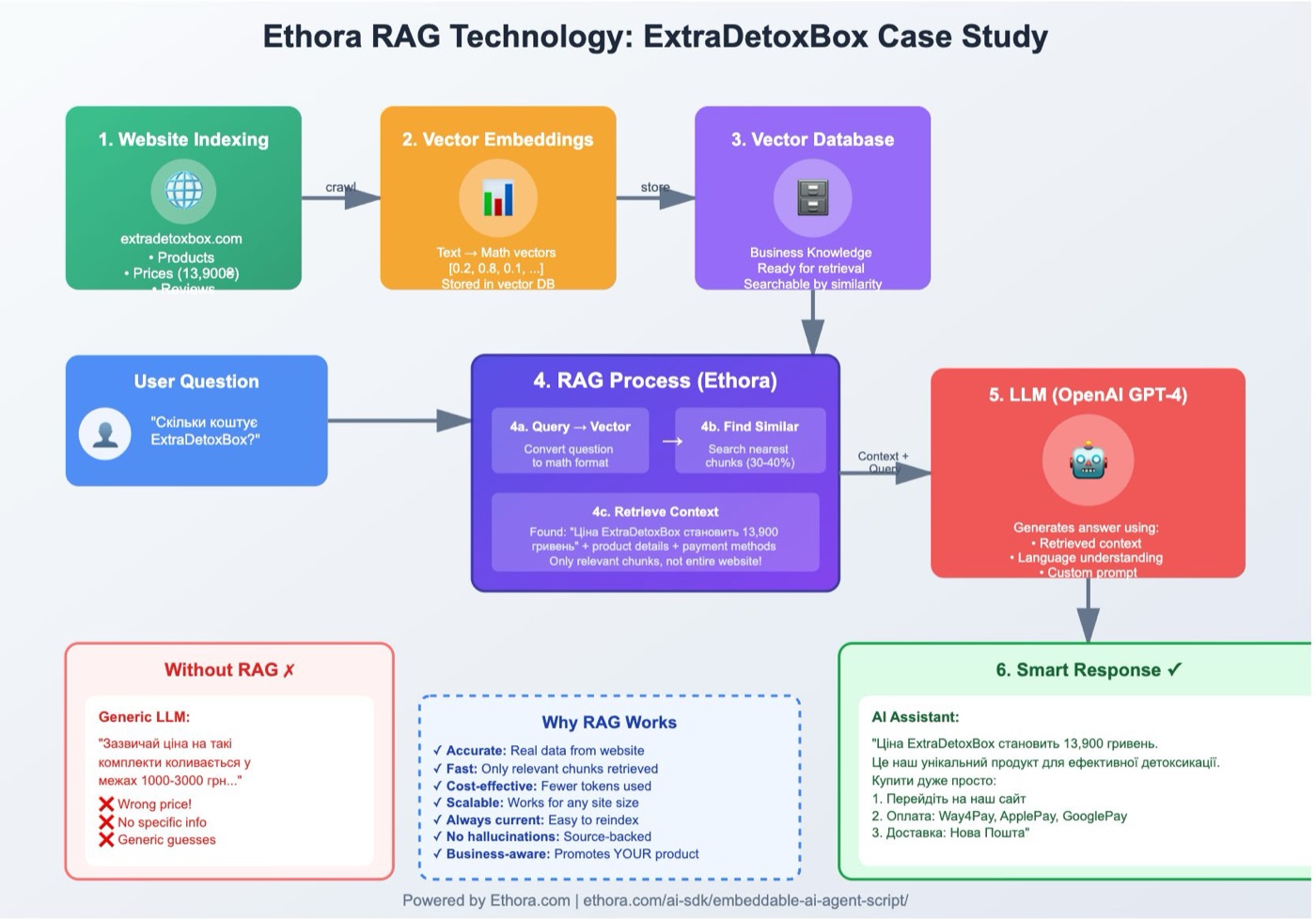
Entering the site address was enough: Ethora crawled 17 pages (home, products, about, contacts, returns, privacy, terms and public-offer pages), converted them to text and embeddings and stored them in the agent’s knowledge in a few minutes. For each question only the most relevant passages are added to the model’s prompt, which keeps answers fast and token costs low, and the site can be re-crawled whenever it changes. See RAG.
Find the answer on a small site, even when the wording differs
The platform’s retrieval threshold was then set at 0.7 similarity, tuned for large sites, and on a small site it filtered out the price passage. Lowering it to 0.3 to 0.4 for this agent brought back the exact price and the founder’s name. Ethora’s knowledge search now combines meaning with exact keyword matching, so product names and prices are found without tuning a threshold.
Answer shoppers in their language
The site, the instructions and the tests were in Ukrainian, and the assistant answered in Ukrainian. The same agent answers in English or another language when it is asked in one, from the same pages, so the site did not need a translated copy for the assistant.
Add it to the site in minutes
The widget is one script tag pasted inside the page body, with a floating “Ask me anything” button that opens the chat and can be expanded to full screen. WordPress sites now use the Ethora Chat Assistant plugin instead; any other site uses the embeddable script.
The setup
Three screens in the Ethora dashboard
Lessons
What this pilot taught us, and what is standard in Ethora today
The pilot ran on the first version of the AI widget. Each problem it surfaced became a product change.
An assistant must know who it is
Without instructions the assistant presented itself as an OpenAI product. Ethora agents now get a name, a bio and today’s date in every conversation, and start from templates (support agent, assistant, tutor) with sensible instructions, so a new agent speaks for its owner from the first message.
Small sites and large sites need different retrieval
The 0.7 threshold that suited large sites hid the price on a 17-page site. Knowledge search now blends meaning with exact keywords (names, prices, product codes), drops near-duplicate passages and caps passages per page, so the same agent setup works on a one-product shop and on a site with hundreds of pages.
Real sites are bigger than demos
In the month of this pilot the crawler grew from about 10 pages per site to 300+, indexing the rest in the background. Crawls now run as queued jobs that fill the index live, can be stopped, and report a knowledge health check with a rebuild button.
Test the questions customers will really ask
The useful work was asking the questions a shopper asks (price, how to buy, reviews, who is behind the brand) and fixing gaps in the instructions or the site. Agents now have a Try it chat in their settings that shows, under every answer, which pages of your knowledge it used.
The outcome
Proof that RAG is the difference, and an honest answer about where an assistant pays off
With its instructions and the indexed website, the assistant answered all seven shopper questions from the brand’s own facts, quoted the correct price and recommended the brand’s product first. A plain model behind the same widget answered with the wrong price and someone else’s products. For a single-product shop, that is the difference between a sales assistant and a liability.
The pilot also answered the brand’s other question honestly. With a short site, most visitors find what they need in three to five pages, so the brand kept its storefront as it was and saw the most value for an assistant like this behind the scenes, in customer support. That decision is the owner’s to make, and the same agent, knowledge and instructions can be used on the website, in a support inbox or inside an app.
Selling a product or a programme online? Build the same assistant from your own site with the no-code AI agent builder, add it with the embed script or the WordPress plugin, and see the other AI agents on customer websites.
FAQ
How long does it take to set up a RAG assistant for a small online shop?
Under 30 minutes here: a few minutes to write the instructions, up to 5 minutes to crawl the site and 2 to 3 minutes to add the widget. Most of the remaining time goes into asking the questions your customers ask and filling any gaps.
Does the assistant work in languages other than English?
Yes. This assistant was set up and tested in Ukrainian, on a Ukrainian site, and answers in the language it is asked in.
Can it give medical or health advice about supplements?
It answers from the brand’s own published content. Its instructions can tell it to stay within product, order and delivery questions and to refer anything medical to a qualified professional, and every conversation is visible to the owner in the dashboard.
Is a website assistant worth it for a small site?
Not always. When a site has a handful of pages, visitors often find the answer faster by browsing. The same agent can be more useful in customer support or inside an app, and Ethora lets you use it in any of those places.
More case studies
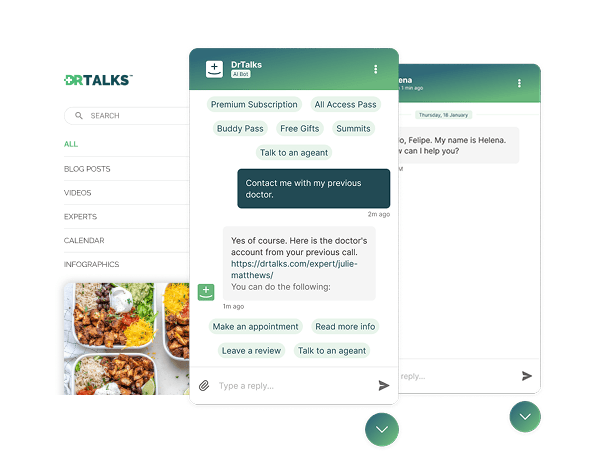

Healthcare: HIPAA-compliant AI assistant (RAG) over a medical video library
Dr. Talks is one of the most prominent organizers of online healthcare conferences and summits.
Ethora enabled them to create a context-aware AI-powered chatbot to help users navigate thousands of pages of medical content, correctly referencing pages, authors, videos and timestamps. 100% secure and HIPAA-compliant.
This assistant enhances user experience by simplifying interaction with the platform and reducing search time.
- 1000+ summits indexed by AI bot
- Instant user engagement
- Vector embeddings enable intelligent domain expert AI responses

Communities: fan chat app with second-screen rooms and digital collectibles
A cross-platform social app uniting the automotive community around racing events.
Fan rooms for teams and drivers, second-screen events, and collectibles handed out and traded through chat bots.
- Cross-platform iOS and Android app
- Fan rooms and second-screen events
- Collectibles distributed in chat

Energy: dedicated chat server, AI-agent rooms and a React Native app for a procurement platform
Preshent is a US platform for energy-project procurement with AI-driven decision support.
Ethora provides the conversation layer: a chat room per project workspace shared by people and the AI agent, a dedicated chat server in Preshent’s own cloud, push notifications and a React Native app.
- 1,130 chat rooms, one per workspace
- AI agent as a participant in every room
- Dedicated chat server, 99.99%+ uptime
Professional services: a private, self-hosted AI assistant for a corporate intelligence firm
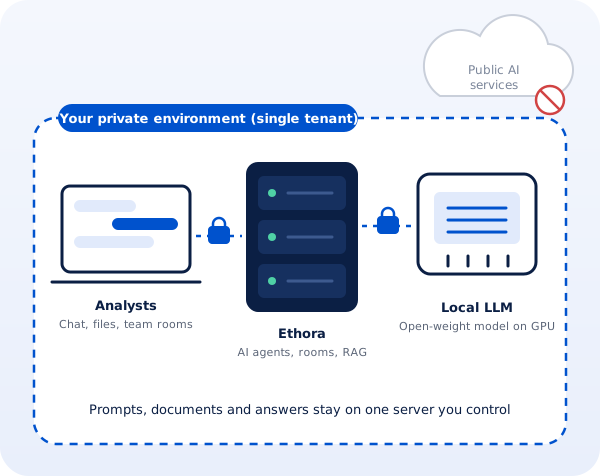
A London corporate intelligence and investigations firm whose analysts could not use public AI assistants on confidential client work.
Ethora designed a private AI assistant: a single-tenant server with AI agents, document search and an open-weight model on the firm’s own GPU, managed by Ethora in a London cloud region or installed on a workstation in the office.
- Local open-weight LLM, no public AI services
- Single-tenant server, UK hosting
- Cloud GPU or on-premise workstation
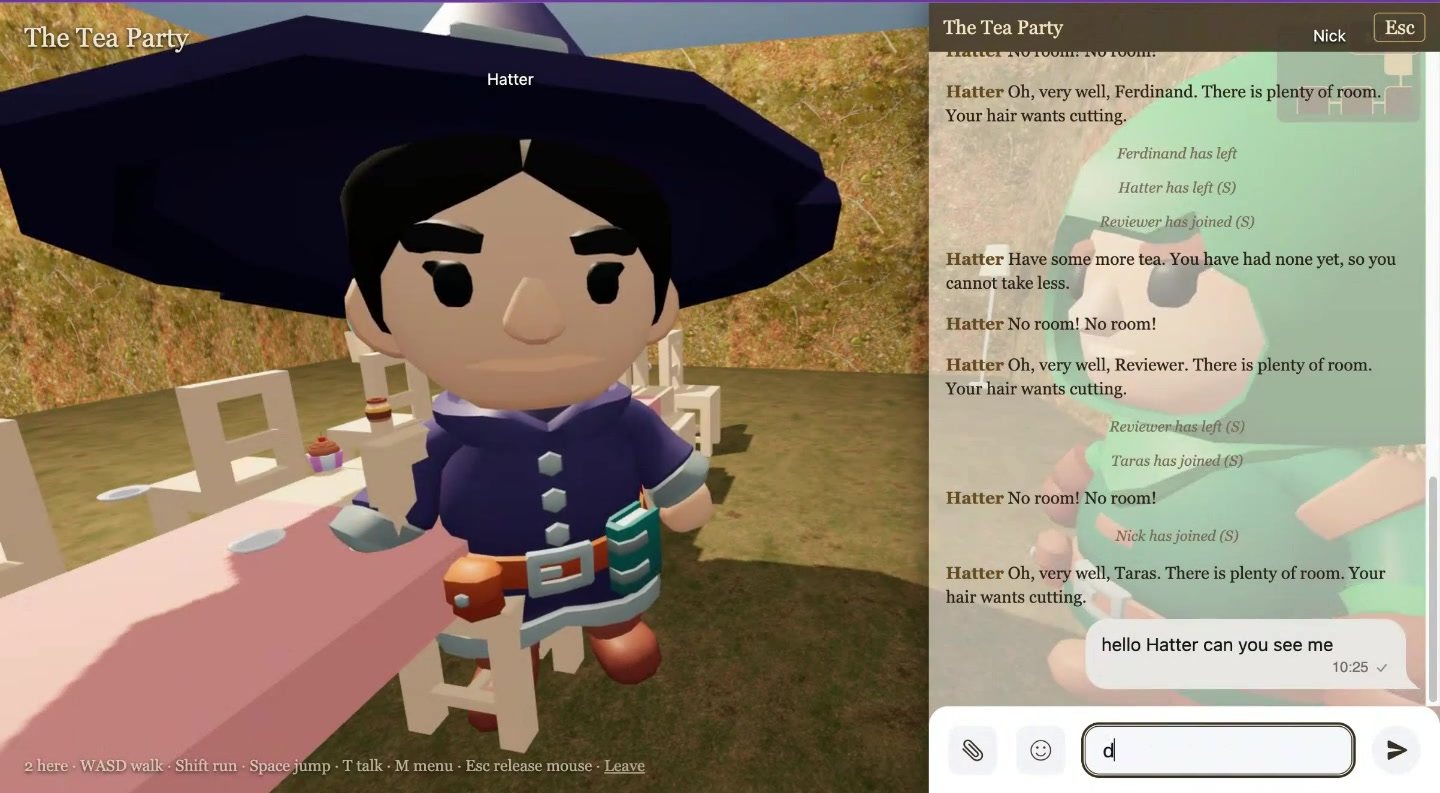
Virtual worlds: a 3D multiplayer world built from a book, with AI characters, in one weekend
An internal R&D showcase by Ethora’s founder: Alice in Wonderland, The Tempest and A Christmas Carol as 3D worlds you walk through in first person.
Each room is an Ethora chat, each character an Ethora AI agent with the book as its knowledge; a generator and the hosted MCP server build a new world from any book in about four minutes.
- Built in a weekend on the public SDK, API and MCP
- Characters answer in character from the text
- Daily AI budget keeps a public world affordable
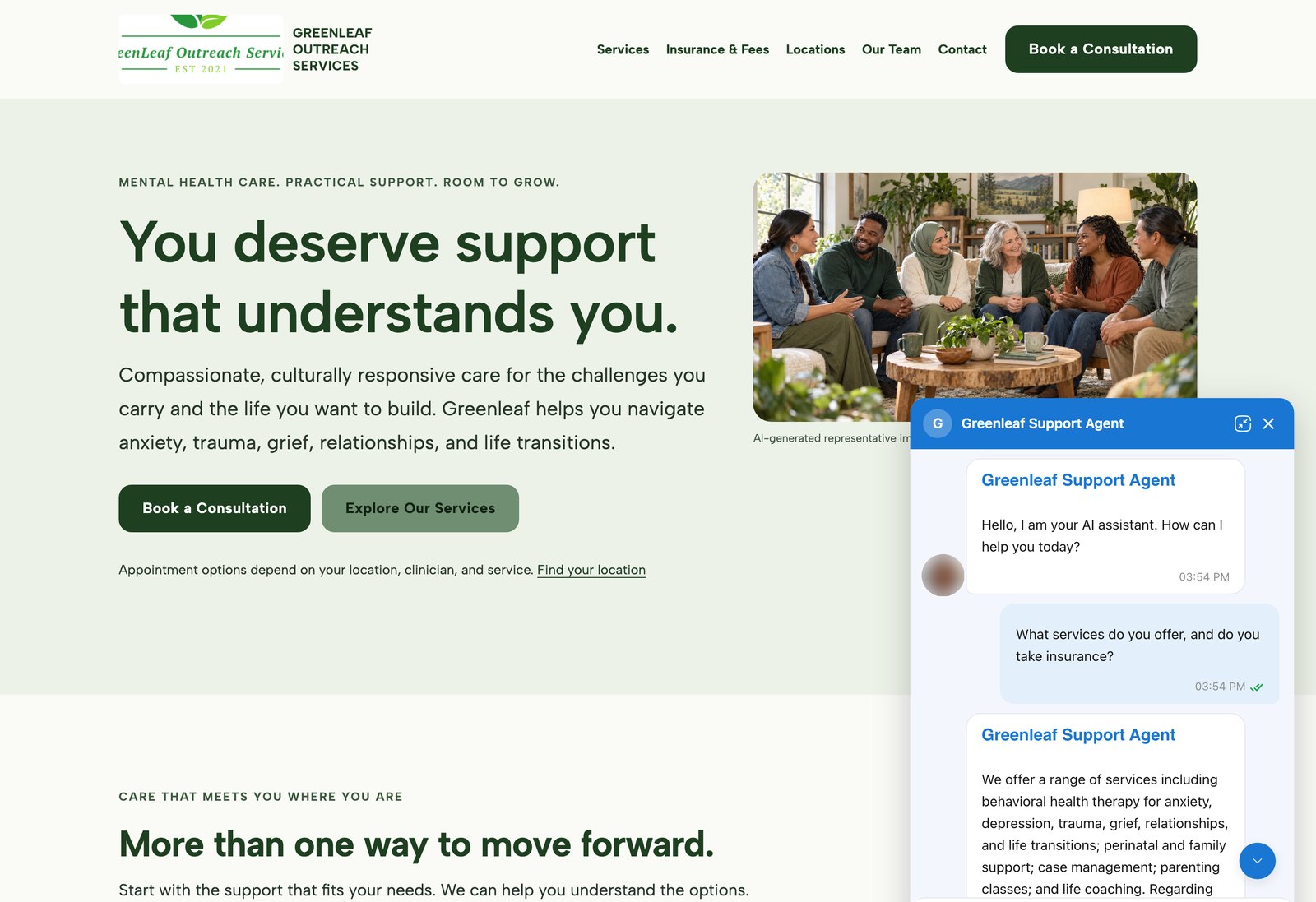
AI agents on customer websites: support, intake and teaching assistants
Clinics, schools and small businesses build AI agents on Ethora themselves and put them on their own websites, often on the day they sign up.
3 examples, from a US mental health provider and a wellness brand to a university pharmacology course.
- WordPress plugin or one script tag
- Answers from the customer’s own pages and documents
- Self-serve, no developer needed
Build an AI assistant that knows your products
Index your own site, tell the assistant whose side it is on, and add it to your shop with one tag or the WordPress plugin.