“Most secure chat app” only means something when you define the threat. Signal is excellent against passive network interception, yet it still requires a phone number and runs on centralized US infrastructure. Session removes the phone-number identity but routes traffic through onion networks that can feel slower. Briar works with no internet at all, but it is Android-only and now in maintenance mode.
For enterprises, “most secure” usually means the chat runs on your infrastructure, in your jurisdiction, under your keys, and produces an audit trail your regulator will accept. They can’t just take any consumer app, as they don’t support this kind of security.
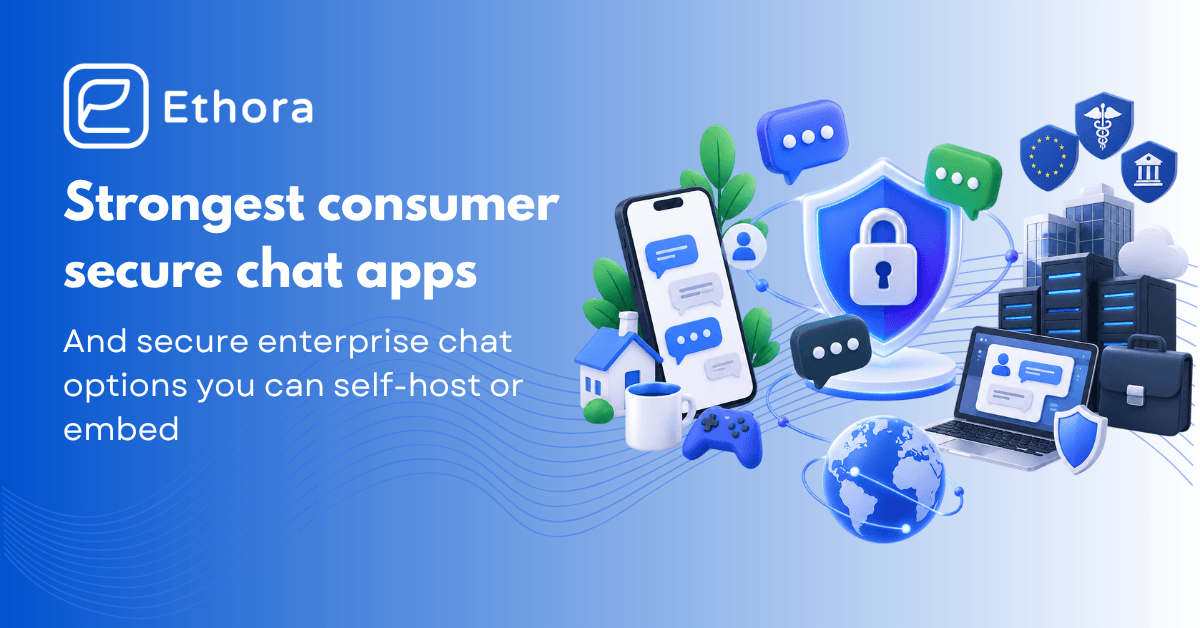
In this blog, we’ll consider the strongest consumer secure chat apps, a practical threat-model framework, and secure enterprise chat options you can self-host or embed.
In this blog:
- Is end-to-end encryption safe and secure?
- The threat-model framework: what “secure” actually means
- Part 1 – Consumer secure messaging apps in 2026
- Part 2 – Enterprise secure chat: the developer/CTO buyer question
- Decision framework: pick your app in 60 seconds
- Build Your Own: Enterprise Secure Chat with Ethora
Is end-to-end encryption safe and secure?
End-to-end encryption (E2EE) doesn’t allow the server to read your messages. Messages are encrypted, and they can be decrypted only on the recipient’s device. It works this way:
- You create a message on your device and click “send”
- The app encrypts your message before it leaves your device
- The encrypted message is sent to the server, which simply stores and forwards it. The server cannot read its contents.
- Once the message reaches the recipient’s device, the cryptographic key on their device decrypts the message and the recipient can read it.
E2EE ensures that if anyone intercepts the encrypted data – or the server itself – cannot read the original content without the decryption key.
Modern protocols such as the Signal Protocol (Double Ratchet), Olm/Megolm on Matrix, and MLS (RFC 9420) give you confidentiality, integrity, forward secrecy, and post-compromise security. When they’re implemented properly, they protect against passive network eavesdroppers, service-provider access to message bodies, and most legal demands for the content itself.
What E2EE does not protect against
If the phone itself is compromised by malware, the plaintext is still visible. Metadata – who talked to whom, when, and how often – remains exposed. Sophisticated spyware can bypass encryption by attacking the operating system. Some jurisdictions can compel key handover. And any server-side backup that the provider can decrypt re-introduces risk.
So yes: E2EE is safe and secure for protecting message content. It is not a complete anti-surveillance solution on its own.
The threat-model framework: what “secure” actually means
Before ranking any most secure chat app, decide which of these eight dimensions matter most to you.
- Content confidentiality. Solid E2EE against passive interception. Almost every modern encrypted chat app delivers this.
- Metadata resistance. Does the operator (or an observer) learn who you talk to, when, and how often? Signal knows more than Session or SimpleX.
- Forward secrecy and post-compromise security. If one key is later stolen, older and future messages stay safe.
- Deniability. Сan you plausibly deny having sent a message?
- Jurisdiction. Where the company and servers sit determines legal reach (US CLOUD Act, Swiss privacy law, etc.).
- Identity minimization. Phone number, email, or no persistent identifier at all.
- Open source and independent audit. Can outsiders inspect the code, and has anyone serious done so?
- Enterprise controls. Audit trail, legal hold, SSO, retention policy, admin governance. Consumer apps deliberately lack most of these.
Part 1 – Consumer secure messaging apps in 2026
A lot of things in our lives happen online today, from day-to-day communications to managing our bank accounts. This makes privacy a concern for ordinary users, not only enterprises.
This section examines the consumer secure messaging landscape in 2026, focusing on the leading platforms, the security and privacy features they provide, and the key factors consumers should consider when choosing between them.
Signal
Signal remains the gold-standard mainstream secure chat app. It uses the Signal Protocol (the same cryptography later adopted by WhatsApp and others), is run by a US 501(c)(3) nonprofit, and publishes both client and server code.
Strengths: Strongest practical content confidentiality and forward secrecy among widely used apps. Free, no ads, repeatedly audited. Roughly 70-100 million monthly active users as of mid-2025 figures still cited in 2026 reporting.
Weaknesses: Requires a phone number (identity leak). Centralized US infrastructure means metadata is visible to Signal and reachable under US legal process. Plausible deniability is limited in the current design.
Session
Session is a Signal Protocol fork that removes the phone-number requirement and routes traffic over its own onion network.
Strengths: No phone or email needed. Strong metadata resistance. Random-string user IDs. Australian origins with a privacy-focused foundation. Protocol V2 work (perfect forward secrecy and post-quantum elements) is underway.
Weaknesses: Higher latency from onion routing. Smaller user base. Earlier protocol versions drew academic criticism regarding authentication and sequence binding; the team is addressing these issues in V2.
SimpleX Chat
SimpleX is currently the strongest mainstream option for pure metadata resistance. It assigns no persistent user identifiers at all – not even random numbers.
Strengths: No phone, no email, no long-term user ID. Open-source. Server operators cannot enumerate users or easily map social graphs. Connections happen via one-time invitation links or QR codes.
Weaknesses: Smallest network of the major privacy apps. Adding contacts requires sharing a link (higher friction than a searchable directory).
Briar
Briar is peer-to-peer and works over Bluetooth, Wi-Fi, or Tor. There is no central server.
Strengths: Functions without internet infrastructure – useful in censored networks or protest situations. Strong privacy by design. Open source.
Weaknesses: Android-only. No voice or video. Messages deliver only when peers are reachable. As of July 2026, the project is in maintenance mode (security fixes and bug fixes only).
Element (Matrix)
Element is the best-known client for the federated Matrix protocol.
Strengths: True federation (like email). E2EE via Olm/Megolm. Adopted by multiple European governments (France’s Tchap, Germany’s BwMessenger and BundesMessenger, Swedish agencies, and others). Voice, video, and bridges to other systems.
Weaknesses: Running your own homeserver is heavier than a simple Signal install. Federation creates additional cross-server metadata surfaces. Consumer UX is less polished than Signal for casual users.
Threema
Swiss-based paid app that has long prioritized minimal metadata.
Strengths: Swiss jurisdiction. No phone number required. One-time purchase model removes advertising pressure.
Weaknesses: Smaller network. Contact discovery has historically used hash lookups that drew academic critique in earlier versions.
Wire
Swiss- and Germany-based, with a stronger team-collaboration focus.
Strengths: EU and Swiss legal environment. Open source. Solid secure video.
Weaknesses: Many advanced business features sit behind paid tiers. Smaller ecosystem than the big collaboration platforms.
WhatsApp and Telegram (context only)
WhatsApp correctly implements the Signal Protocol for content, but Meta holds extensive metadata, and the company is US-based. Telegram’s default chats are not end-to-end encrypted (only the optional Secret Chats are, and only for 1:1). Neither belongs on a “most secure” shortlist for high-threat users, despite massive popularity.
Part 2 – Enterprise secure chat: the developer/CTO buyer question
No audit trail, no legal hold, no admin controls, no single sign-on, no integration surface that you can embed in your product – this is what consumer-grade messengers like Signal, Session and SimpleX don’t provide.
But industries like healthcare, finance, government, or defense can’t rely on common popular messengers. Their communication system should be self-hosted (or support dedicated tenancy capabilities) and auditable. Besides, it needs encryption (either E2EE or encryption at rest with managed customer keys), legal hold, single sign-on, admin controls, necessary certifications (SOC 2, HIPAA BAA, GDPR DPA, ISO 27001), and a good messaging API/SDK to embed it. Now, let’s consider possible solutions.
Ethora
Modular Chat & AI SDK built to be embedded inside your product rather than to replace Slack.
Strengths: True self-hosted chat server on cloud, on-prem, AWS Marketplace or private cloud. Encryption at rest with customer-managed keys. Native audit trail. HIPAA-ready patterns, GDPR and SOC 2 support. SDKs for React, React Native, iOS, Android, Node.js and Python. BYO LLM for moderation and assistants. Flat-tier pricing instead of per-MAU taxes.
Weaknesses: Smaller community and ecosystem than Rocket.Chat, Mattermost or Element/Matrix. Newer brand for large enterprise RFPs that prefer long track records.
Rocket.Chat
Open-source Slack-style platform with strong adoption in regulated industries.
Strengths: Free Community Edition plus commercial Enterprise. Native self-hosted chat server and on-premises chat server options, including air-gapped. ISO 27001, HIPAA-ready, GDPR support, SOC 2 Type II on the hosted offering.
Weaknesses: Better as a team collaboration suite than as a lightweight embedded component inside a consumer-facing product. MongoDB operations can become a burden at large scale. Some advanced compliance features require the paid edition.
Mattermost
Open-source secure team chat with deep roots in DevOps and defense.
Strengths: Go-based, scales well when self-hosted. FedRAMP High authorization available via partner paths; used in IL4/IL5 environments. Strong documentation and ops tooling.
Weaknesses: Many enterprise compliance features sit behind commercial licenses. Embedding it as a white-label component inside an unrelated product is not the primary design goal.
Element/Matrix (enterprise)
The same protocol used by governments, packaged for organizations.
Strengths: Protocol-level federation and strong E2EE. Proven in public-sector deployments across Europe. Flexible deployment models.
Weaknesses: Synapse (Python) can be resource-heavy; Dendrite is newer. Turning Matrix into a polished, branded SDK inside your own application still requires significant engineering.
MirrorFly
Commercial chat SDK that offers a real self-host / one-time license path.
Strengths: Predictable cost at scale, chat + voice + video in one package, self-host option.
Weaknesses: SDK polish and component maturity lag behind those of top open-source and specialist platforms.
Wickr (AWS)
AWS-owned enterprise messenger oriented toward defense and regulated US government work.
Strengths: FedRAMP High and DoD IL5 authorization in GovCloud. Strong administrative controls and retention.
Weaknesses: Tied to the AWS ecosystem. Product direction has been quieter since the acquisition.
Decision framework: pick your app in 60 seconds
- Casual consumer who mainly wants protection from passive interception → Signal
- High metadata-anonymity threat model → Session or SimpleX Chat
- Offline / censored networks / activist use → Briar (with eyes open about maintenance mode)
- Federated, government, or privacy-conscious community → Element (Matrix)
- Swiss jurisdiction preference → Threema
- On-prem team collaboration → Ethora, Rocket.Chat, or Mattermost
- Embedded secure chat inside a regulated product (HIPAA / GDPR / SOC 2) → Ethora, MirrorFly
- US defense / federal → Wickr or Mattermost Government
- Building a modern React / mobile product with BYO LLM moderation → Ethora
Final Word
“Most secure chat app” is two different decisions. As a consumer, match the app to your actual threat model: Signal for most people, Session or SimpleX when metadata resistance is paramount, Briar for offline scenarios, Element when federation matters.
If you’re an enterprise looking for a self-hosted chat, build with Ethora. The Chat & AI SDK drops into a React, iOS, or Android product, with BYO LLM moderation and a clean audit trail. Ethora’s Chat & AI SDK was built for that exact bucket – npm install @ethora/sdk – your data, your keys, your infrastructure.
Here’s what makes it better than other options:
- Purpose-built to live inside another product, not as another standalone team suite
- Native BYO LLM support for moderation and assistants (including self-hosted Llama Guard-style models)
- Modular deployment so chat, AI, RAG, video, and widgets can each sit in the compliance zone they need
- Flat-tier pricing instead of per-MAU charges
Setup is straightforward: install the package, deploy the self-hosted chat server on the infrastructure you choose (cloud, on-prem, AWS Marketplace or private cloud), configure encryption, audit logging and optional BYO LLM moderation, then ship.
If you’re building a HIPAA-compliant chat, insurance support, or any other messaging solution that requires security and regulatory compliance, and would like to learn more about how Ethora can simplify and accelerate development, contact us. Our experts will answer all of your questions.

Share with your community


More Articles
Development
Oct 5, 2026
Cross-Platform App Development Frameworks in 2026: 10 Options Compared, Real Trade-offs, and Chat + AI SDK Fit
In 2026, evaluating cross-platform frameworks is a complex matter. There are many practical questions: Which ones have solid chat and AI SDK support today? Which ones won’t force a painful migration when the next major OS version drops? And what are the real engineering trade-offs once you move past the marketing claims? We’ll look at […]

Healthcare
Oct 1, 2026
HIPAA-Compliant Video API in 2026: What Actually Makes One, Vendor Comparison, and Twilio Video Migration
Consultations, psychiatry meetings, medication management, triage, and other medical encounters often do not require physical presence. Adding video to your healthcare app or platform can be a great idea, as it allows you to hold sessions online without losing the human touch. Using a messaging API to incorporate video into your application makes the whole […]

Try Out Ethora in Action
Experience Ethora's messaging with a dedicated demo from our CEO or start building your App right now!