People send billions of messages daily. Platforms with community features and chat can handle millions of them. 1 million messages means roughly 1 million+ inference calls for moderation. Choosing the right model and pipeline architecture for moderation is critical, as it determines whether the costs are $30 or $3,000+ per month at comparable accuracy levels.
In 2026, it’s not about whether to implement artificial intelligence into your moderation flows, but about which model to run where, how to balance latency and cost, and whether you own the pipeline or rent a black box. Most “what is AI moderation” articles stop at high-level benefits. This one goes deeper into the actual engineering layers.
What is AI content moderation, technically?
An AI-driven content moderation system is essentially an inference pipeline whereby you input the user-generated content (UGC) (text, images, videos, and audio) and receive a structured output based on whether to allow, flag, or prohibit content as per your platform’s policy.
Unlike regex, keyword blocking lists, and even hash-matching systems, which are traditional approaches to filtering, an AI-driven content moderator understands the context of what it sees, slang, and languages beyond just English, as well as when users try to bypass the filter using coded language.
Anatomy of an AI moderation pipeline
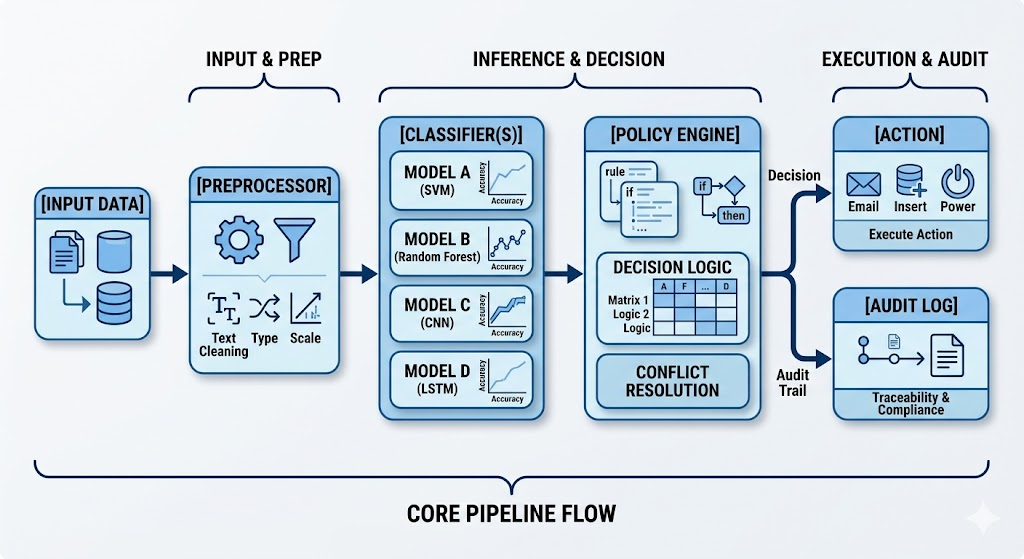
Here’s how a production-grade pipeline actually works, stage by stage.
Ingest: The message hits a pre-send hook in your SDK or via a server-side webhook before it reaches the database or other users. Your latency budget is very constrained at around 50-200ms E2E for synchronous workloads.
Preprocessing: Text normalization (lowercase, Unicode NFKC normalization, leetspeak decoding, language detection with fastText/CLD3), image/video hash checks (e.g., PhotoDNA/perceptual hashes) to quickly filter out known bad content before the more costly models.
Primary classifier: A fast, cheap model that handles 85-95% of obviously safe or obviously violating traffic. Examples include:
- Google Perspective API (toxicity-focused, 16+ attributes)
- OpenAI Omni-Moderation (free, multimodal, 13+ harm categories)
- Open-source options like Detoxify or Llama Guard 3 8B
Escalation classifier: Route only uncertain cases (e.g., confidence 0.4-0.8) to a stronger reasoning model. This single decision cuts costs dramatically – often by 70-90%.
Policy engine: Decouple your business rules from raw model outputs. A score of 0.7 on “toxicity” might mean block in a kids’ app, but only flag + warn in an adult forum. Keep this layer separate so you can swap models without rewriting logic.
Action layer: Synchronous pre-send block with a user-friendly reason, or async actions like shadowban, removal, or human queue.
Audit log: Log every decision with model version, prompt (if LLM), raw scores, final action, and timestamp. This is mandatory for compliance under DSA Article 24 and EU AI Act high-risk requirements.
Feedback loop: Human moderator overrides become training data or prompt updates. Re-evaluate quarterly against a held-out gold set from your own platform.
The models doing the work in 2026
By 2026, effective AI content moderation isn’t about using a single magic model. It’s about choosing the right tool for each part of the job. Here’s what actually powers production systems right now.
Toxicity & policy classifiers (text-first)
For the bulk of your traffic, you want fast, efficient models that can handle the obvious cases without breaking the bank.
Google Perspective API remains a strong baseline. It’s free up to roughly 1 query per second (with possible quota increases), and it gives you 16+ attribute scores, including toxicity, severe toxicity, identity attack, insult, and threat. It works particularly well for English and offers decent multilingual support.
OpenAI Omni-Moderation has become a popular drop-in option. It’s free for API users, supports both text and images, handles multiple languages, and returns structured categories. Many teams use it as a reliable safety net.
For teams that need full control or have strict data residency requirements, open-source options shine. Detoxify is a self-hostable PyTorch model that delivers near-zero inference cost once running on your own GPUs. Meanwhile, Llama Guard 3 8B from Meta stands out as a highly flexible open-weight safety classifier. Its prompt-based taxonomy makes it easy to adapt to your specific community guidelines.
General-purpose LLMs for nuanced cases
When the primary classifier isn’t confident, you escalate to a stronger reasoning model. These are where the real judgment calls happen.
GPT-4o and GPT-4o-mini deliver excellent multimodal reasoning and structured output through function calling. They’re especially useful when you need both a decision and a clear explanation.
Claude Haiku 4.5 (and its bigger sibling Sonnet) has earned a reputation for strong long-context understanding and transparent reasoning. Haiku, in particular, offers one of the best speed-to-performance ratios available.
Gemini 2.5 Flash and Pro stand out for truly multimodal work. In one request, these solutions can analyze text, image, audio, and video. It’s possible to set up your safety policies at the API level. Right now, it is considered one of the most powerful solutions for livestream and video platforms.
Vision, multimodal, and audio
The standard solution for vision tasks in the case of large volumes of visual data involves solutions such as AWS Rekognition, Google Cloud Vision SafeSearch, OpenAI Omni, or specialized tools like Hive Moderation for high volumes.
For voice and audio content, the typical approach is still transcription (using Whisper, Deepgram, or AssemblyAI) followed by text classification, though end-to-end commercial audio moderation pipelines are becoming more common.
Cost and latency: the trade-offs nobody publishes
Here are realistic numbers you’ll actually encounter in production as of mid-2026:
- Perspective API: 50-150 ms p95, free up to 1 QPS, then very low per-request pricing.
- OpenAI Omni-Moderation: ~100-400 ms, free with an API account.
- GPT-4o-mini (with full reasoning prompt): 600-1,200 ms p95, roughly $0.00015–$0.0006 per call depending on token usage.
- Claude Haiku 4.5: 500–1,000 ms, approximately $1 input / $5 output per million tokens.
- Llama Guard 3 8B self-hosted on a single A10 GPU: 80-150 ms, with cost mainly coming down to infrastructure (~$0.5 per hour per GPU).
The biggest cost-saving trick isn’t picking one perfect model – it’s smart routing. Use a fast primary filter on everything and only escalate the uncertain 5-15% of messages to a heavier reasoning model. This one architectural decision is often the difference between a cheap and an expensive moderation system.
The BYO-LLM shift: why platforms are leaving managed moderation
More and more teams are moving away from fully managed moderation services toward bring-your-own-LLM (BYO-LLM) architectures. Three main reasons are driving this shift in 2026.
First, cost predictability. Per-MAU pricing from vendors can explode as your platform grows. With direct LLM inference or self-hosted models, your costs scale with actual usage and can be heavily optimized.
Second, flexibility and data control. You can swap between GPT-4o-mini, Claude Haiku, or a self-hosted model whenever pricing or performance changes. More importantly, sensitive data (PHI or PII) never has to leave your environment – a must-have for HIPAA, GDPR, or SOC2 compliance.
Third, better performance on your specific policy. Fine-tuning Llama Guard 3 or similar models on your own historical moderation decisions can deliver higher precision for the kinds of content and edge cases that are unique to your community.
Pre, post, and hybrid pipelines: which fits which app
The design of the pipeline depends largely on your risks and needs. These are some typical moderation designs being implemented in 2026.
Pre-moderation (synchronous) is the safest approach for high-stakes environments. The content is scanned before it’s published or sent to other users. This pattern is standard in dating apps, healthcare messaging, U13 platforms, and any regulated industry. The downside is added latency – usually 100-300ms, but you block violations at write time, so nothing harmful ever reaches another user.
Post-moderation (asynchronous) is the go-to choice for high-volume social feeds, livestream chat, marketplaces, and most consumer social apps. Content is evaluated after publication, and if it violates policy, it’s removed or hidden. It provides a better user experience, but also a brief window for harmful content to be visible.
Hybrid moderation has become the default for most serious platforms in 2026. It combines the best of both worlds: a fast primary classifier runs synchronously on every message, while only the uncertain or high-risk cases get escalated to a more powerful LLM for deeper analysis, with the hardest edge cases going to a human moderator. This approach delivers excellent speed, strong safety, and reasonable costs.
Other patterns still have their place. Reactive moderation relies on user reports to trigger deeper review – useful for forums and lower-volume comment sections. Proactive moderation involves periodically re-scanning existing content when new harm patterns emerge or policies are updated.
How to actually evaluate an AI moderation system
If you’re serious about moderation, you need to measure it properly. The core metrics that matter are:
- Precision and Recall (and their balanced F1 score), broken down by harm category
- False positive rate by demographic – especially important for catching bias against AAVE, code-switching, non-English languages, and other groups
- Latency (p50, p95, and p99 – averages lie)
- Cost per 1 million messages
- Appeal overturn rate – this is often your most honest real-world precision metric
- Time-to-action – how long harmful content stays visible
Public benchmarks are useful for initial comparisons, but they rarely match your actual content distribution. The gold standard is building your own labeled evaluation set (typically 1,000-5,000 examples from your platform) and re-testing your entire pipeline quarterly. This is the only way to know how your system is truly performing.
Adversarial users and how AI moderation fails
No moderation system is perfect. Determined users will constantly seek ways around filtering systems, so you need to keep this in mind when designing one. Common attack techniques include:
- Leetspeak and homoglyphs. For example, “h8”, “mrdr”, or using Cyrillic letters that look the same. You can stop this with solid Unicode normalization, character-level approaches, and reasoning from the LLM.
- Images of text. Simple to circumvent when your filter relies on text-only detection, unless you have an OCR component in your pre-processing pipeline.
- Emergent coded language and dog whistles. The best defense is to periodically change system prompts and evaluate performance.
- Prompt injection. This happens when user text is fed directly into an LLM classifier. Having structured outputs and guardrails and never putting user input into the system prompt, will help you prevent it.
- AI-generated content and deepfakes. Increasingly countered with dedicated detection models and standards like C2PA watermarks.
The best moderation teams treat this as an ongoing arms race rather than a solved problem. They combine strong technical defenses with continuous monitoring and prompt updates.
What’s changing in 2026
AI content moderation is moving fast, and 2026 is bringing some meaningful shifts in how these systems are built.
We’re seeing native multimodal moderation become the new normal. Models like Gemini 2.5 and GPT-4o can now handle text, images, audio, and video in a single call, which greatly simplifies pipelines that used to require multiple specialized services. On-device classification is also picking up steam – both for better privacy and to keep server costs down.
The open-weight safety models, especially Llama Guard 3 and its derivatives, are rapidly catching up to their commercial API competitors in a way many people could not have predicted. Teams are no longer only opting for managed APIs but are also considering self-hosting or fine-tuning models. In terms of regulation, the DSA and AI Act in the EU are increasingly biting and requiring audit trails from platforms. Lastly, detection technology for AI-generated media is getting better with C2PA standards becoming more prevalent.
Closing
AI content moderation in 2026 isn’t a simple switch you flip on. It’s an inference pipeline you actually design and own.
The strongest teams get this right by using a fast primary classifier for the majority of clean traffic, escalating only the tricky cases to a more powerful reasoning model, keeping their policy logic completely separate from the models, and maintaining a proper immutable audit log for every single decision.
If you’re building or scaling a chat product, you don’t need to stitch all of this together from scratch. Ethora’s Chat & AI SDK gives you pre-send hooks, full BYO-LLM support (OpenAI, Anthropic, self-hosted Llama Guard, and others), a flexible policy engine, immutable audit logging, and self-hosted deployment options – all in one package. It works across React, React Native, Node.js, and more, while keeping you in complete control of your models, prompts, and data.
Take a look at the AI Bots SDK if you want more advanced moderation workflows, or the HIPAA-compliant chat SDK for regulated use cases.
Build Your Own: Ship a BYO-LLM Moderation Pipeline with Ethora
If you don’t want to piece together a dozen different services, there’s a practical alternative. Ethora’s Chat & AI SDK was built exactly for teams that want full control over their moderation pipeline without spending months building it from scratch.
Pre-send hooks, a flexible policy engine, immutable audit logging, role-based moderator tools, and built-in actions like shadowban, mute, and rate limiting – all comes in one package.
Setup is straightforward:
- Run npm install @ethora/sdk
- Connect your preferred LLM provider (OpenAI, Anthropic, or self-hosted Llama Guard 3)
- Define your policy rules
The AI Bots SDK acts as a powerful moderation engine – supporting any LLM, multi-turn reasoning, and webhook callbacks. It fits perfectly into the hybrid pipeline we discussed: fast primary classifier for most messages, escalation to a stronger model when needed, and human review for the toughest cases.
One of the biggest advantages is true BYO-LLM flexibility. You can switch from GPT-4o-mini to Claude Haiku 4.5 or a fine-tuned Llama Guard 3 without touching your core moderation logic – just update the provider config. Everything stays in your environment, which makes HIPAA, GDPR, and SOC2 compliance much cleaner.
You can deploy it in the cloud, on-prem, via AWS Marketplace, or in a private environment. You can start building right now, and for free.

Share with your community


More Articles

Healthcare
Aug 21, 2026
Is WhatsApp HIPAA Compliant? What Healthcare Teams Need to Know
You can use WhatsApp for general tasks like scheduling, sharing admin announcements, as long as no patient health data is shared.


Chat SDK
Aug 20, 2026
Chat vs Email for E-Commerce: When Each Wins, With Real Conversion Numbers
This article maps each channel to the lifecycle stage where it actually converts, puts real numbers behind the claims, and covers where SMS and WhatsApp fit into the picture

Try Out Ethora in Action
Experience Ethora's messaging with a dedicated demo from our CEO or start building your App right now!