Every Ethora release is numbered by year and month: 26.06 is the release we cut at the start of June 2026, containing everything our team built in May. It was one of the busiest cycles in the product’s history, with over 300 commits landing across the platform, four client SDKs, and our developer tooling. Here is what is new, why it matters, and where to dig deeper.
AI agents are now part of the platform, not a feature you bolt on
The headline of 26.06 is a re-architecture of how AI agents live inside Ethora.
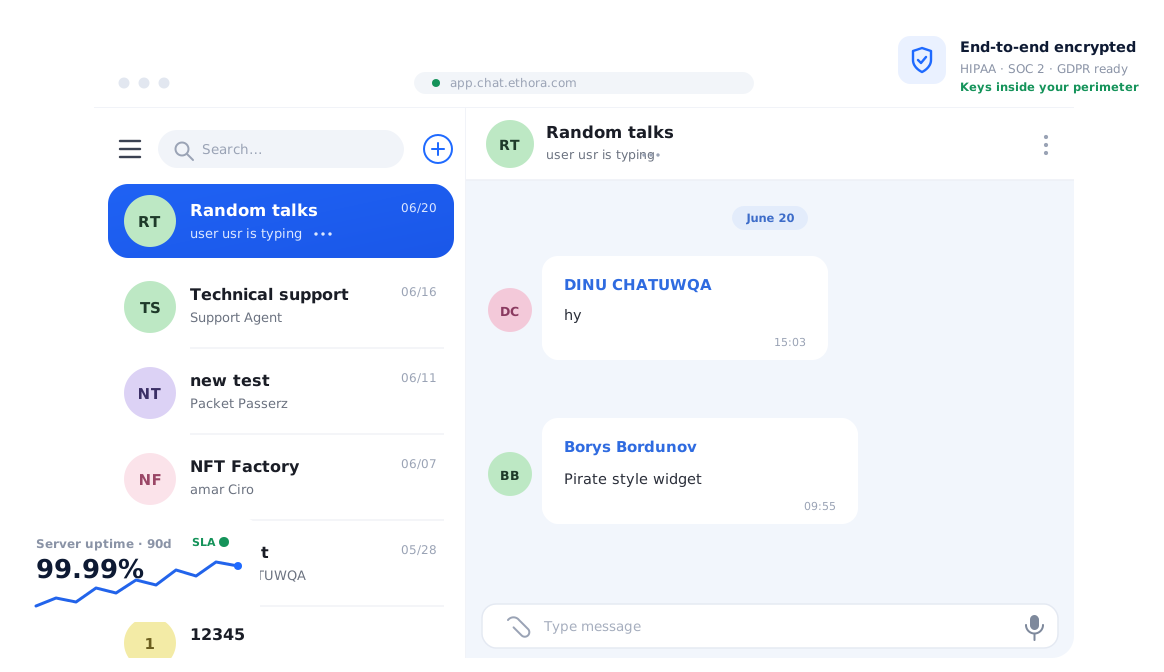
Every new app now starts with a working AI agent. When you create an app on Ethora, the platform automatically attaches a Support Agent to it. Your first chat room already contains an assistant that can answer questions, and you can replace or customize it with your own agent persona at any time. There is no setup step, no API call, no configuration file. Sign up, create an app, talk to your agent.
The website widget got a real backend. You can now drop an embeddable chat widget onto any website with a one-line snippet. Behind the scenes, the platform provisions each visitor with a persistent chat room, invites your app’s active agent into it, and keeps the full conversation history in the server archive. Visitors get instant answers; you get a complete record of every conversation.
Admins can finally see everything. The new Widget Conversations panel in the admin app shows every visitor conversation with full message history, visitor metadata (country, browser, OS), CSV export, and bulk cleanup tools. If you run a sales or support operation, this is your daily view of what your agent is telling prospects.
Agents scale down as well as up. A new lazy lifecycle means agent bots disconnect when idle and wake the moment someone opens a chat. On a self-hosted server with hundreds of apps, this cuts steady-state connections dramatically without changing anything about how agents behave for users.
If you are evaluating AI chat for your product, the Ethora AI SDK page covers the embeddable agent approach, and self-hosted LLM and AI agents explains how to run the whole stack on your own infrastructure, which matters if you operate in healthcare, finance, insurance, or another regulated industry.
The React Native SDK was relaunched as a true drop-in library
Our React Native chat component received around 110 commits in May, which amounts to a relaunch:
- Drop-in installation.
@ethora/chat-component-rnnow ships as a compiled npm library with a metro shim helper. Expo packages moved to peer dependencies, so it respects your project’s versions instead of fighting them. - Feature parity with the web component. Bootstrap flow, offline persistence, push notification hooks, a built-in room list, and optimistic sending with delivery confirmation were all ported from the web SDK.
- Voice messages. Opt in with
config.enableAudio: trueand the send button becomes a microphone when the input is empty, with tap-to-record and the same single-button pattern as the web app. - A reconnect engine that never gives up. Connection loss handling was rebuilt after live bad-network testing: exponential backoff that retries indefinitely, a foreground watchdog, and automatic room re-join so messages sent after a drop actually deliver.
- Test coverage to back it up. The SDK now runs more than 580 Jest tests plus Maestro end-to-end flows on real simulators.
The SDK is MIT licensed. Start at the React Native chat SDK page or go straight to the GitHub repository.
Unread counts you can trust, on every platform
Unread message tracking sounds simple until you ship it across four platforms, multiple devices per user, and hosts that mount chat inside tab navigators. In this cycle we rebuilt it properly:
- Android (v1.0.34 through v1.0.42 of ethora-sdk-android) gained cross-device read marker sync, a lifecycle API for hosts that swap tabs inside one Activity, automatic detection of whether the chat is actually visible, and one-line diagnostics for integrators.
- React Native and web components moved to an explicit visibility model, so a chat mounted in a hidden tab no longer silently marks messages as read.
- iOS (ethora-sdk-swift) received a reliability sprint covering reconnection, message retry after disconnect, real-time room create and delete, and unread tracking driven from the host app.
Android also picked up a full dark mode theming API: per-mode colour overrides for bubbles, headers, and input bars, plus a forceDarkTheme switch for hosts that own their own theme toggle. Details are on the Android chat SDK and iOS chat SDK pages.
Developer experience: one command to a running chat app
A few quality-of-life upgrades for developers evaluating Ethora:
@ethora/setupis now on npm. One command clones the sample app for your platform, checks your environment (Java, Android SDK, emulator), writes credentials into gitignored env files, and starts the app against Ethora Cloud or your own server.- The Ethora MCP server joined the official MCP Registry. If you use Claude, Cursor, Cline, or any MCP-capable AI assistant,
@ethora/mcp-servergives it 80 tools for managing your Ethora apps, users, and chats. This cycle trimmed its context footprint by about a quarter and added one-click installs. - Message search API. New endpoints let you search message archives with visibility filtering and fetch the conversation context around any hit.
- A cross-platform testing layer. Shared test-id conventions now span Android (JUnit and Compose), iOS (XCTest), web (Vitest and Playwright), and React Native (Jest and Maestro), so a flow tested on one platform has a named twin on the others.
Smaller but notable
- Video calls landed in the web app.
- Broadcast messages now display the sender name you configure, with a per-broadcast override.
- Tenant owners can switch between their apps directly inside the Chats page.
- A new Book a Call flow and a Help and Support section make it easier to reach us from inside the product.
- Custom font support arrived across the web, React Native, and Android chat components.
Why the year.month versioning?
Ethora releases follow a simple calendar scheme: version YY.MM ships at the start of month MM with everything developed the month before. 26.06 is the June 2026 release built during May. It keeps our self-hosted customers on a predictable upgrade rhythm and makes it obvious how current any deployment is. The full week-by-week changelog, with links to every commit, lives in RELEASE-NOTES.md on GitHub.
Try it
The fastest way to see 26.06 is to create a free app on Ethora, talk to the Support Agent that comes with it, then embed the widget on your own site. If you are weighing a self-hosted deployment for compliance reasons, start with self-hosted chat server on AWS or book a call and we will walk you through it.

Share with your community


More Articles

Healthcare
Sep 28, 2026
Telemedicine App Development in 2026: Architecture, HIPAA, AI, and the Build-vs-Buy Decisions That Matter
Telemedicine app development in 2026: HIPAA + EU AI Act, architecture, AI-native patterns, video/chat SDK decisions, and real cost math.


Embeddable AI Widget
Sep 24, 2026
How to Add an AI Chat Assistant to WordPress in Under 10 Minutes
Adding a live, AI-powered chat assistant to your WordPress site does not require writing a single line of code. This guide walks through installing the free Ethora Chat Assistant plugin, connecting it to your Ethora agent, and confirming it works live on your site, screenshot by screenshot.

Try Out Ethora in Action
Experience Ethora's messaging with a dedicated demo from our CEO or start building your App right now!