Blog
Development
Blog
Development
Development
How to Make an App for Free: A Step-by-Step Guide to No-Code and Professional Scaling
Usually, to build business software, you either need to learn to code or hire a professional team. This process can take months, and it’s quite expensive – the price tag for building an app in 2026 starts at $5,000 and can reach as much as $300,000. These days, that barrier has largely disappeared. No-code tools enable non-tech people to quickly turn ideas into working apps without overpaying.
Whether you’re a solopreneur, small business owner, or just someone with a great idea, this guide walks you through the entire process. We’ll cover the no-code path first, then show when and how to scale to something more robust with tools like Ethora.
Planning Out Your Free App Idea
Before you start building your app, get clear on the fundamentals.
Does my app solve a real problem?
Great software answers a genuine need. Perhaps you want to optimize your inventory in a small warehouse, develop a community quiz, or create a basic client portal. You need to be sure that your app solves a real problem – otherwise, no one will use it.
Android, iOS, or web?
Think about your audience. This will help you make your application discoverable for them.
Internal team tools often work great as web apps or progressive web apps that feel native on phones. Consumer-facing apps might need native publishing to the App Store and Google Play.
Creating a wireframe
Sketch it out. Just to visualize how your app will look. You can do it on paper, on a whiteboard, or in Figma – there’s no need for some fancy software. Map the main screens, user flows, buttons, and what happens after key actions.
Pay special attention to the chat UI design. A clean, simple chat UI makes or breaks user experience. Think about message bubbles, timestamps, read receipts, emojis, and how group chats should look. Search for “chat app UI” inspiration – there are thousands of great examples online.
Wireframing answers questions like: What does a first-time user see? How does navigation work? Do I need push notifications? This step saves endless rework later.
How to Make a Free App in 4 Steps
When you have answers to your questions, you can start building. It will take four steps. Here they are.
Step 1: It All Starts with Your Data
Every app is really just data presented nicely. User inputs, lists, calculations – it’s all data. Start simple:
- Google Sheets (free and familiar)
- Airtable (free tier available)
- Or the built-in database in your no-code platform
Your app needs to read data (show inventory, messages, and profiles) and write data (update counts and save new entries). For something like a chat app, this means pulling message history and saving new ones reliably. Users should be able to write messages, instantly see them (read), and load conversation history. Many platforms let you begin with their native tables for free. Later, you may need to connect external sources, as no-code builders often have limitations.
Step 2: Design Layouts & Screens
With data in place, you can now move to building screens. Your application should look great and be easy to use. This will catch the eye of the users, make things convenient, and enhance the user experience.
Use your wireframe as a guide. Drag-and-drop components: forms, buttons, lists, images. Collections are powerful here – they automatically display entire databases in tables, grids, or cards. Look at the applications you use and admire – and borrow some ideas for your design.
When developing an application with messaging functionality, plan ahead for the chat interface design, including bubble-style messages, timestamps, avatars, and group chat look.
Step 3: Build Workflows & Actions
This is where your app comes alive. Static screens become dynamic software through actions and workflows. Examples:
- Button click → update database → send notification
- New entry → trigger email or SMS
- Barcode scan → adjust inventory and alert the team
Visual workflow builders make this feel like connecting blocks. Start simple and add complexity as needed. Your earlier wireframing will help tremendously here.
Step 4: Adjust Settings & Launch
Now polish and publish:
- App name, icon, and colors
- Login requirements and privacy
- Navigation placement
- Light/dark mode if supported
Before going live, test your solution. Make sure it works properly across platforms and devices, layouts don’t break no matter the screen size, all buttons work, and nothing lags when you switch OS. When it’s done, collect real user feedback by organizing beta-testing. Let them find bugs and tell you what they’d like to improve, and fix the issues. Then, hit publish – and celebrate. You’ve just built your own app.
When It’s Time to Scale: Moving Beyond Basic No-Code
No-code platforms are fantastic for MVPs and internal tools. You can run such projects successfully for quite a while, yet sooner or later, free or low-cost plans won’t be enough. Your app will grow, and you’ll need to handle more users and add new features. Visual builders just can’t easily handle real-time messaging that scales, AI features, advanced security, or custom needs.
That’s where a professional Chat & AI SDK becomes valuable. One strong option is Ethora – a modular platform that gives developers (or teams working with developers) a production-ready communication infrastructure. Why consider something like Ethora?
- Saving time. You can drastically cut development time – no-code already helps, but proper SDKs can reduce custom coding effort by a huge margin compared to building everything from scratch. Instead of building your application for months, you can do it in a few weeks or even days.
- Cross-platform support. Ethora supports React Native SDK and React Native chat library, ensuring smooth iOS and Android experiences.
- Artificial intelligence. Built-in support for AI agents. You can easily teach them on your data, using RAG (Business Website Crawler) and Document Indexer.
- Enterprise features. Enterprise-level capabilities, including E2E encryption, compliance settings (which are very important in regulated industries such as banking and healthcare), a self-hosted chat server (AWS, cloud, on-prem), and Web3 support, are available.
- Ready-to-use components. No need to reinvent common chat features. Ethora offers pre-built React chat components and messaging UI kits so you can easily integrate them.
No-code platforms offer you unprecedented speed, which is why many teams start from no-code. Then, when their demands grow, they move to professional SDKs to keep moving fast but also ensure reliability at scale.
Ready to Get Started?
Today, you don’t have to be a developer or have a big tech team to build a solution for thousands of people. In this guide, we described the steps to take to build an app. Everything can start with an idea and a clear problem to solve.
If you are creating an app that requires an in-app chat feature or developing a messaging app from scratch, Ethora is the solution you need. Our no-code and low-code platform scales alongside your application’s growth, ensuring that you don’t need to move platforms at any point in time.

Share with your community


More Articles
Development
Oct 5, 2026
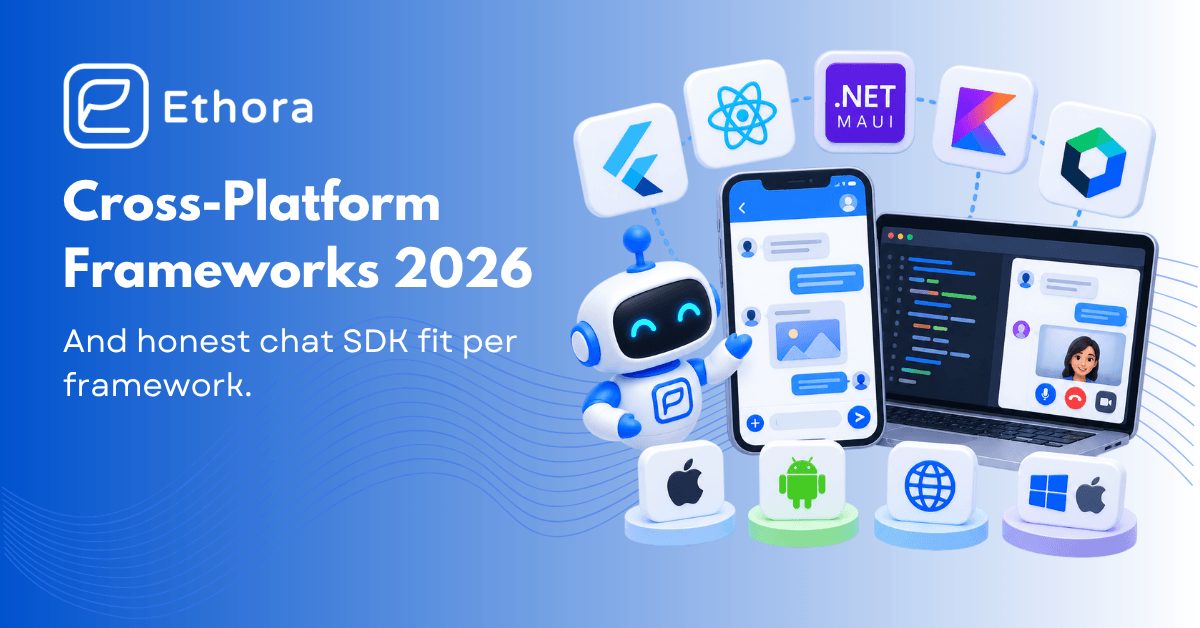
Cross-Platform App Development Frameworks in 2026: 10 Options Compared, Real Trade-offs, and Chat + AI SDK Fit
In 2026, evaluating cross-platform frameworks is a complex matter. There are many practical questions: Which ones have solid chat and AI SDK support today? Which ones won’t force a painful migration when the next major OS version drops? And what are the real engineering trade-offs once you move past the marketing claims? We’ll look at […]

Healthcare
Oct 1, 2026
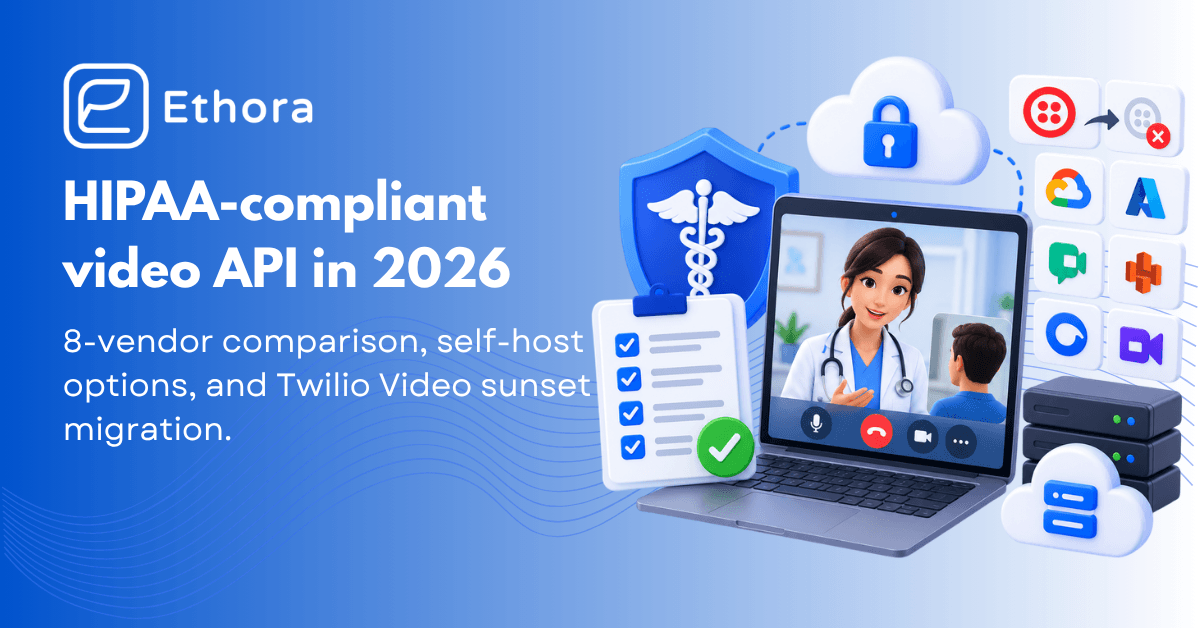
HIPAA-Compliant Video API in 2026: What Actually Makes One, Vendor Comparison, and Twilio Video Migration
Consultations, psychiatry meetings, medication management, triage, and other medical encounters often do not require physical presence. Adding video to your healthcare app or platform can be a great idea, as it allows you to hold sessions online without losing the human touch. Using a messaging API to incorporate video into your application makes the whole […]

Try Out Ethora in Action
Experience Ethora's messaging with a dedicated demo from our CEO or start building your App right now!