Building chat from scratch is one of those things that looks straightforward until you’re four days in and still wiring up WebSocket reconnection logic. Real-time delivery, message persistence, typing indicators, file uploads, offline queueing, and push notifications – all of these are separate projects.
In this guide, we’ll add a complete chat module to your React application via the Ethora React Chat SDK. We’ll get you from npm installation to a fully functional group chat and direct messaging, along with an optional AI assistant. If you have an active React app set up, the process will take just about 15 minutes.
Here’s what you’ll need before you start:
- A React app (Create React App, Vite, or Next.js all work)
- Node.js 16+ and npm or yarn
- A free Ethora account – sign up here
Now, let’s move to adding chat.
Step 1. Install the SDK
npm install @ethora/chat-component-reactOr with yarn:
yarn add @ethora/chat-component-reactNo manual installs of companion libraries and no version-matching headaches – UI components, a real-time messaging engine, and the required code are already included.
Step 2. Get Your App Credentials
- Go to https://app.chat.ethora.com/register and create a free account
- Create a new app from the dashboard
- Copy your App ID and Host URL from the app settings page
By default, your application will be connected to Ethora’s cloud backend. If you have the Enterprise version and have set up a self-hosted server, then you will change your host URL.
Step 3. Add the Chat Component
Open whatever file renders your main layout and drop this in:
import React from 'react';
import { EthoraChat } from '@ethora/chat-component-react';

function App() {
  return (
    <div className="App">
      <h1>My Application</h1>

      <EthoraChat
        host="your-server.ethora.com"
        appId="your-app-id"
        theme="light"
        height="600px"
      />
    </div>
  );
}

export default App;
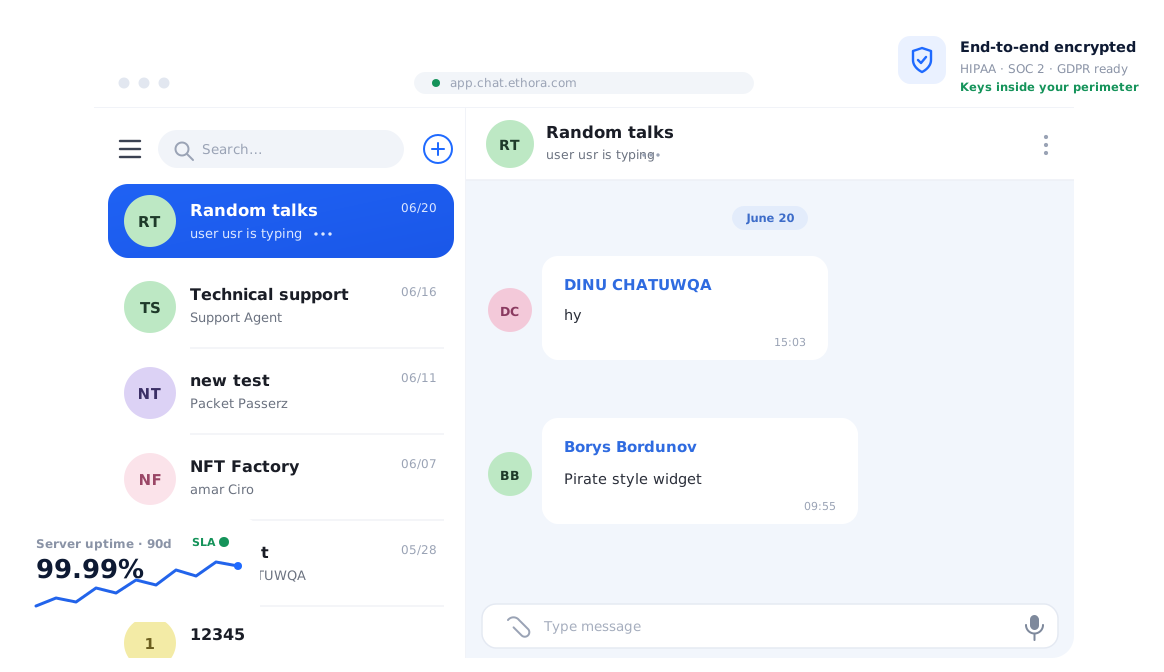
Just run npm start, and you’ll get a ready-to-use chat interface. It already supports chat rooms, group and private messages, file sharing, typing indicators, and read receipts – all working out of the box, no extra setup needed.
Next.js users the Chat component should be run in a browser, not on the server. Use the dynamic() method with ssr: false to avoid errors in rendering:
const EthoraChat = dynamic(() =>
import('@ethora/chat-component-react').then(m => m.EthoraChat), {'{
ssr: false }'})
Step 4. Customize the Appearance
Pass a theme object to match your app’s design system. At minimum, you’ll want to set primaryColor and hideBranding:
<EthoraChat
  host="your-server.ethora.com"
  appId="your-app-id"
  theme={{
    primaryColor: '#4F46E5',
    backgroundColor: '#F9FAFB',
    fontFamily: 'Inter, sans-serif',
    borderRadius: '12px',
    headerStyle: 'compact',
  }}
  hideBranding={true}
  height="100vh"
/>
Key theme props:
| Prop | What it controls | Default |
| primaryColor | Buttons, links, sent message bubbles | #6C63FF |
| backgroundColor | Chat container background | #FFFFFF |
| fontFamily | Font stack for all text | System fonts |
| borderRadius | Message bubbles and containers | 8px |
| headerStyle | full, compact, or hidden | full |
| hideBranding | Remove Ethora logo (paid plans) | false |
Need deeper control? You can override individual component styles via CSS class names or swap out the theme object entirely. The SDK docs cover the full theming API.
Step 5. Connect Your Existing Auth
If your app already has users, you don’t want them to log into chat separately. Pass your current user through the user prop:
import { EthoraChat } from '@ethora/chat-component-react';

function App({ currentUser }) {
  return (
    <EthoraChat
      host="your-server.ethora.com"
      appId="your-app-id"
      user={{
        id:     currentUser.id,
        name:   currentUser.displayName,
        avatar: currentUser.avatarUrl,
        email:  currentUser.email,
      }}
      authToken={currentUser.ethoraToken}
    />
  );
}
authToken is a signed JWT your backend generates for each user. The SDK supports three auth approaches:
- JWT – sign a token on your backend, pass it here
- Social login – Google, Apple, Facebook, MetaMask
- Guest mode – anonymous users for public chat rooms, no account required
Don’t generate the JWT on the frontend
Your Ethora secret key should only live on your backend. Create a small API route that signs and returns the token for authenticated users.
Step 6. Add an AI Chatbot (Optional)
When building it from scratch, an AI chatbot is usually the hardest part which can take months. The SDK has an enableAI prop that spins up a RAG-powered assistant inside any chat room – trained on your own documents, not a generic model with no product context.
<EthoraChat
  host="your-server.ethora.com"
  appId="your-app-id"
  enableAI={true}
  aiConfig={{
    botName:        'Support Assistant',
    knowledgeBase: 'your-knowledge-base-id',
    model:         'gpt-4',
    welcomeMessage: 'Hi — I can answer questions about our product.',
  }}
/>
You set up the knowledge base in the Ethora dashboard – upload PDFs, point it at URLs, or paste in FAQ content. The bot answers from those sources and can hand off to a human agent when it hits something it can’t answer.
If you need the AI to run entirely on your own infrastructure – no data leaving your servers – that’s available on Enterprise plans. See self-hosted AI agents for the setup.
How Ethora Compares to Other React Chat SDKs
There are a few options in this space. The main practical differences come down to pricing model, self-hosting, and AI support:
| Feature | Ethora | Stream | CometChat | TalkJS |
| npm package | Yes | Yes | Yes | Yes |
| Self-hosted option | Yes | No | Yes, but not a standard “click-to-deploy” | Yes, but not a standard “click-to-deploy” |
| Built-in AI chatbot | Yes (RAG) | No | No | No |
| Open-source core | Yes | No | No | No |
| End-to-end encryption | Yes | No | Yes | No |
| React Native SDK | Yes | Yes | Yes | Yes |
| White-label | All paid plans | Yes | Yes | Yes |
| Starting paid price | $149/mo | $399/mo | $239/mo | $279/mo |
The flat pricing matters more than it looks. Stream, CometChat, and TalkJS all charge per monthly active user – as your app grows, so does the bill, often steeply. Ethora’s $149/month doesn’t move regardless of how many users you have.
Common Use Cases
Customer support
Integrate chat directly into your SaaS platform so that no user ever leaves your application. Add an AI-powered chatbot for frequently asked queries, and use human agents for higher-value matters.
Marketplaces
Enable the communication between buyers and sellers on your marketplace, without sharing contact details.
Healthcare/Telemedicine
HIPAA-compliant patient-provider communication with end-to-end encryption and data residency controls.
Team collaboration tools
Real-time discussion threads, file sharing, and notifications inside a project management or productivity app.
Social apps
Group chat rooms, direct messaging, and user presence. Standard features, ready out of the box.
Gaming
In-game chat, team channels, and player-to-player messaging – low latency, scales to large concurrent user counts.
Next Steps
- Create a free Ethora account and set up your first app
- Run
npm install @ethora/chat-component-react - Follow steps 3–5 above to get chat working in your app
- Check the full SDK docs for push notifications, webhooks, and custom events
- See pricing when you’re ready for production
Building a mobile app, too? The React Native Chat SDK covers iOS and Android from the same codebase.
Free plan includes messaging, file sharing, and up to 3 app environments. No credit card needed to start.
FAQ
The basic install – npm package, credentials, component rendering – takes about 10 minutes if you already have a React app. Getting auth wired to your existing users and customising the theme adds another hour or two. A full production setup with AI and custom events is a half-day project.
Yes, it does. The component should be run on the client’s side only (in the browser, not on the server). See Step 3 above to learn more about installation.
Yes, full type definitions ship with the package.
Free plan offers features like basic messaging, file exchange, some AI capabilities, and community support. You can check our plans on the pricing page.
The React Chat SDK covered here is for web apps. For iOS and Android, use the React Native SDK – same API, same credentials, different package.

Share with your community


More Articles
Development
Oct 5, 2026
Cross-Platform App Development Frameworks in 2026: 10 Options Compared, Real Trade-offs, and Chat + AI SDK Fit
In 2026, evaluating cross-platform frameworks is a complex matter. There are many practical questions: Which ones have solid chat and AI SDK support today? Which ones won’t force a painful migration when the next major OS version drops? And what are the real engineering trade-offs once you move past the marketing claims? We’ll look at […]


Healthcare
Oct 1, 2026
HIPAA-Compliant Video API in 2026: What Actually Makes One, Vendor Comparison, and Twilio Video Migration
Consultations, psychiatry meetings, medication management, triage, and other medical encounters often do not require physical presence. Adding video to your healthcare app or platform can be a great idea, as it allows you to hold sessions online without losing the human touch. Using a messaging API to incorporate video into your application makes the whole […]

Try Out Ethora in Action
Experience Ethora's messaging with a dedicated demo from our CEO or start building your App right now!