React Native
React Developer Toolset in 2026: Trends and Components
React (and its mobile counterpart, React Native) is one of the most popular interfaces for building mobile apps, and mastering React developer tools is essential if you want to create dynamic and reliable applications. This tool ecosystem includes everything from zero-config build systems and AI-powered code assistants (even though they are not part of the React toolchain by default) to deeply integrated error tracking and performance profiling solutions. They streamline development and improve the quality of React applications.
Essential Tools for Building and Optimizing React Apps
In the early days of React, its tooling was just a set of utilities. Today, it’s a comprehensive development stack of tools and libraries that supports the entire application lifecycle and minimizes development friction.
React Build Tools and optimization
Modern tools are no longer just bundlers – they are intelligent, incremental engines designed for speed and efficiency. Understanding how React build tools work helps developers choose the right toolchain that will fit their project needs, which in turn allows them to reduce development time and simplify processes.
Tools that leverage parallel processing, persistent caching, and module graph analysis can reduce compile time dramatically. Additionally, they include optimization passes like tree-shaking, asset compression, and dead-code elimination by default.
These are tools that you can usually find in reviews of React optimization tools:
- Vite. If you are unsure about what to use, this is your go-to option. Vite has become a popular choice for modern React development due to its speed, simplicity, robust plugin ecosystem, easy configuration, and excellent DX.
- Next.js (Turbopack). Mostly used for full-stack React apps, SSR, API routes, and routing. If your project needs SSR or routing, this is the choice for you.
- Esbuild. A tool that’s best used for lightweight projects. It’s fast and usually used inside Vite, but you can use it directly. Not usually used for full React apps by itself, though.
React Deployment Tools
Deployment is a crucial phase where efficiency, scalability, and reliability intersect. In 2025-2026, deployment becomes more than just about uploading files and going live. It’s about speed, scalability, global reach, and automation. Developers can choose from serverless platforms, edge-first hosting, containerized workflows, and fully managed CI/CD systems tailored for React.
Reviews of React deployment tools show a strong preference for systems that integrate seamlessly with frameworks like Next.js and Remix, offer automatic scaling, and provide real-time analytics during rollouts. Many platforms now include error tracking, heatmaps of user interactions, and instant rollback mechanisms. You can use some of these:
- Vercel. Powerful framework for static React apps or apps with some serverless backend. It offers easy Git integration, automatic builds, global CDN, and serverless functions.
- Netlify. Provides continuous deployment, built-in serverless functions, and global edge network. Great for JAMstack React apps.
- AWS Amplify. This platform supports full-stack deployment (frontend + backend), CI/CD, and integrates with other AWS services. Perfect choice if you need a backend (auth, database) along with React.
- Firebase Hosting. Good for React apps that rely on real-time DB, auth, or serverless logic. This tool by Google offers fast CDN, SSL by default, and integrates with Firebase services (Firestore, Auth, Functions).
Debugging, Error Tracking, and Integration Testing in React
Debugging has become far more advanced than inspecting console logs. Today, developers expect integrated tools to analyze component behavior, state transitions, and rendering frequency. This requires the ecosystem to adapt and evolve.
React debug tools visualize component hierarchies, track props and state changes, measure re-render triggers, and detect unnecessary renders. Combined with granular browser insights, they help teams solve issues before they reach production environments. But effective troubleshooting requires seeing the whole picture. Tools that are usually used to debug React apps are React Developer Tools and browser DevTools.
The main function of the React error tracking tools is to provide teams with valuable context about failures. Leveraging real-user session tracking, source-map decoding, and AI-assisted root-cause analysis, such error tracking platforms as Sentry or LogRocket make it easier to diagnose problems that don’t surface during development.
Integration tests are essential for stability. They ensure that multiple components, hooks, API calls, and UI flows work together correctly. This is done by simulating real user interactions. The most popular tools for integration testing are Jest, React Testing Library, and Cypress.
Specialized Tools for React Ecosystem
React has an extensive ecosystem of specialized tools. They extend beyond the browser, transforming React into a versatile platform and simplifying the development process.
Below is a breakdown of tools that you can use depending on what you’re building, whether it’s a React Native mobile application or a full‑stack React app (web + backend).
React Native Tools
React Native is used to create cross-platform applications for iOS and Android using a single codebase. Mobile development has its requirements, including device-specific debugging, performance profiling, etc.
This means, in addition to React Native’s developer menu, you may need other tools for device logs, inspecting UI layouts, testing animations, and optimizing bundle size for mobile networks. Pay attention to these tools:
- Expo. Provides a lot of built-in APIs (camera, notifications, etc.) without needing to write native code. Expo simplifies building, running, and deploying React Native apps.
- Fastlane. For automating iOS/Android builds, code signing, and app store deployment.
- GitHub Actions/CircleCI. To run CI/CD for your React Native apps.
- Detox. End-to-end testing and automation for mobile apps.
- EAS (Expo Application Services). To build and deploy applications using Cloud Build. This tool supports OTA (over-the-air) updates.
- React Native Config/dotenv. For managing environment variables in your mobile app.
These apps offer features such as automated updates, hot reloading, and cloud-based device farms, which significantly accelerate mobile development cycles.
React Full Stack Tools
Knowing how React full-stack tools can help you work more efficiently, simplify data fetching, routing logic, authentication, and deployment under a unified architecture. If you’re building a full-stack React application (frontend + backend), these are tools and frameworks you might find useful.
- Next.js. This is probably the most popular React full-stack framework. It provides server-side rendering (SSR), API routes, and more.
- Remix. Another full-stack React framework with advanced data loading.
- Nest.js. A backend framework (Node.js/TypeScript) that works nicely alongside React for a structured full-stack architecture.
- Axios or Fetch. For making API calls from the React frontend.
- ESLint/Prettier. For maintaining code quality and style (common in full‑stack projects).
AI Tools Enhancing React Development
Artificial intelligence now plays a central role in application building and optimization. Today, we witness a real AI revolution, with LLM-based tools that can generate code, suggest improvements, predict bugs, and analyze architectural bottlenecks. They aren’t just passive helpers capable of automating some tasks – they integrate into editors, CI/CD systems, and performance dashboards, providing real-time insights and suggesting fixes.
Monitoring and Performance
Building an app is not the finish, because maintaining your app’s health requires continuous performance analytics and monitoring. There are several trends worth your attention.
- Real user monitoring. Many developers today don’t just run synthetic tests, they leverage tools that capture RUM data (page load metrics, UI performance, user session traces) to analyze real user behavior.
- Observability. Traditionally, observability stacks (logs, metrics, distributed tracing) were used mostly in the backend. Today, React performs a large portion of logic ( routing, data fetching, etc) in the frontend, making extending observability to the frontend crucial.
- Lightweight, open-source & cloud-native monitoring tools. Modern React apps are becoming more complex, and their ecosystem has shifted toward distributed, client-heavy architectures. Lightweight, cloud-native monitoring tools help track everything happening in the browser.
- Full-stack monitoring. Modern React applications span both client and server, often across multiple layers, frameworks, and cloud services. Full-stack monitoring gives visibility into the entire architecture and allow to identify UI bottlenecks without extra tooling.
To understand how your applications behave in real-world environments, you can use the performance profiling tool React DevTools Profiler.
For real-time monitoring in production, platforms such as Sentry, New Relic, Datadog, and LogRocket track errors, slow network calls, user sessions, and UI performance metrics to pinpoint issues that only appear under real user conditions.
Additionally, tools like Lighthouse and WebPageTest offer audits that measure load speed, bundle size, and rendering efficiency, helping teams optimize their apps for both speed and stability.
These tools will help you measure and improve app performance, ensuring fewer bugs and a better user experience.
Conclusion
In 2026, the React developer toolset is more advanced, more integrated, and more AI-driven than ever before. What started as a set of utilities is now a comprehensive, intelligent ecosystem.
Understanding the trends that are happening in the development landscape will help you choose the right instruments that will simplify processes and increase efficiency, allowing you to build more advanced, higher-quality applications faster.
React’s strength is in its ecosystem, and mastering it is the key to staying ahead in modern software development.
Ethora provides developers with an extensive toolset for React messaging apps and chatbots. Built-in tools for monitoring, analytics, and performance optimization allow users to move faster, building advanced applications with AI capabilities. And our UI kits for React give you a fast, consistent, and reliable foundation for building interfaces. You control all the process, matching interfaces to your needs and branding, without the need to write code from scratch. It’s easy, try it now for free.

Share with your community


More Articles
Development
Oct 5, 2026
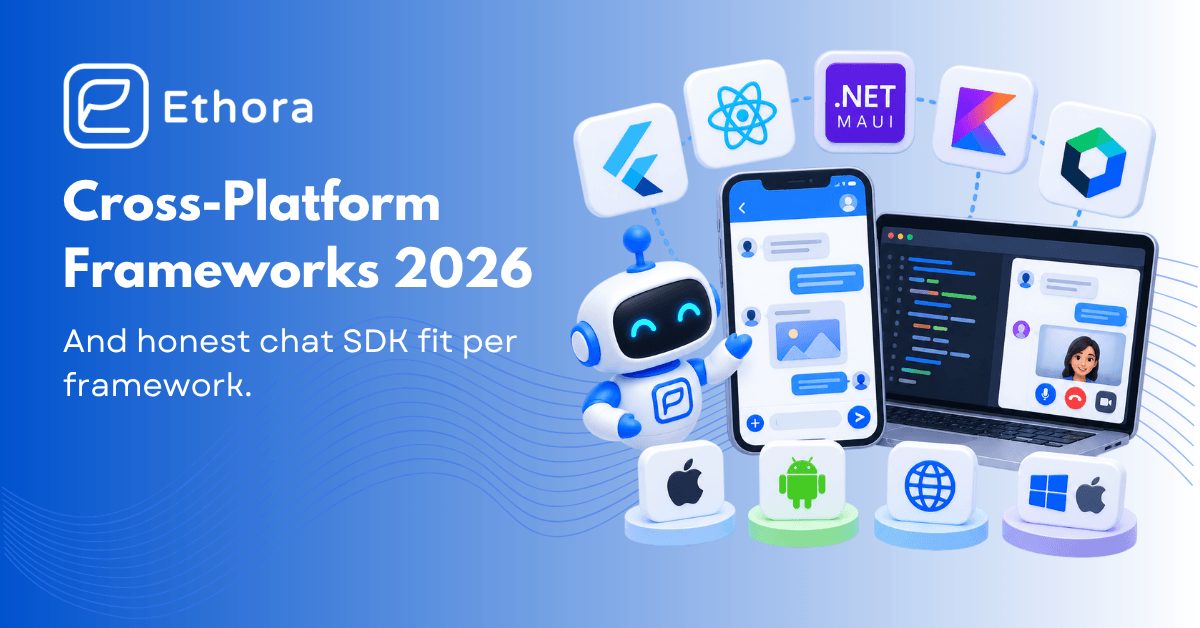
Cross-Platform App Development Frameworks in 2026: 10 Options Compared, Real Trade-offs, and Chat + AI SDK Fit
In 2026, evaluating cross-platform frameworks is a complex matter. There are many practical questions: Which ones have solid chat and AI SDK support today? Which ones won’t force a painful migration when the next major OS version drops? And what are the real engineering trade-offs once you move past the marketing claims? We’ll look at […]

Healthcare
Oct 1, 2026
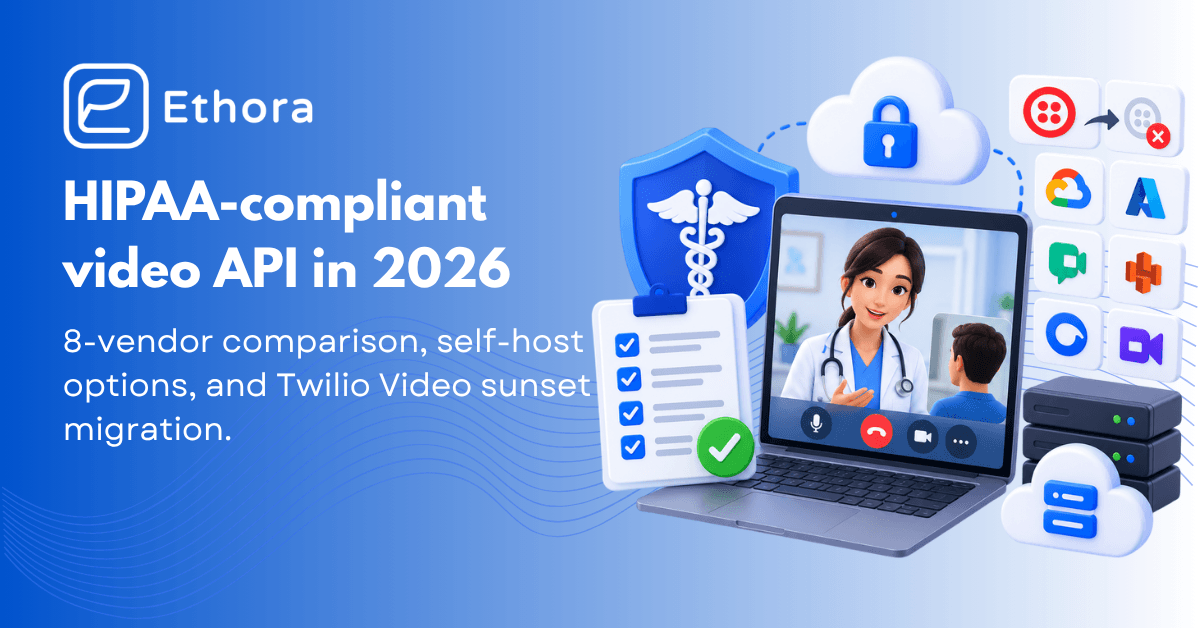
HIPAA-Compliant Video API in 2026: What Actually Makes One, Vendor Comparison, and Twilio Video Migration
Consultations, psychiatry meetings, medication management, triage, and other medical encounters often do not require physical presence. Adding video to your healthcare app or platform can be a great idea, as it allows you to hold sessions online without losing the human touch. Using a messaging API to incorporate video into your application makes the whole […]

Try Out Ethora in Action
Experience Ethora's messaging with a dedicated demo from our CEO or start building your App right now!