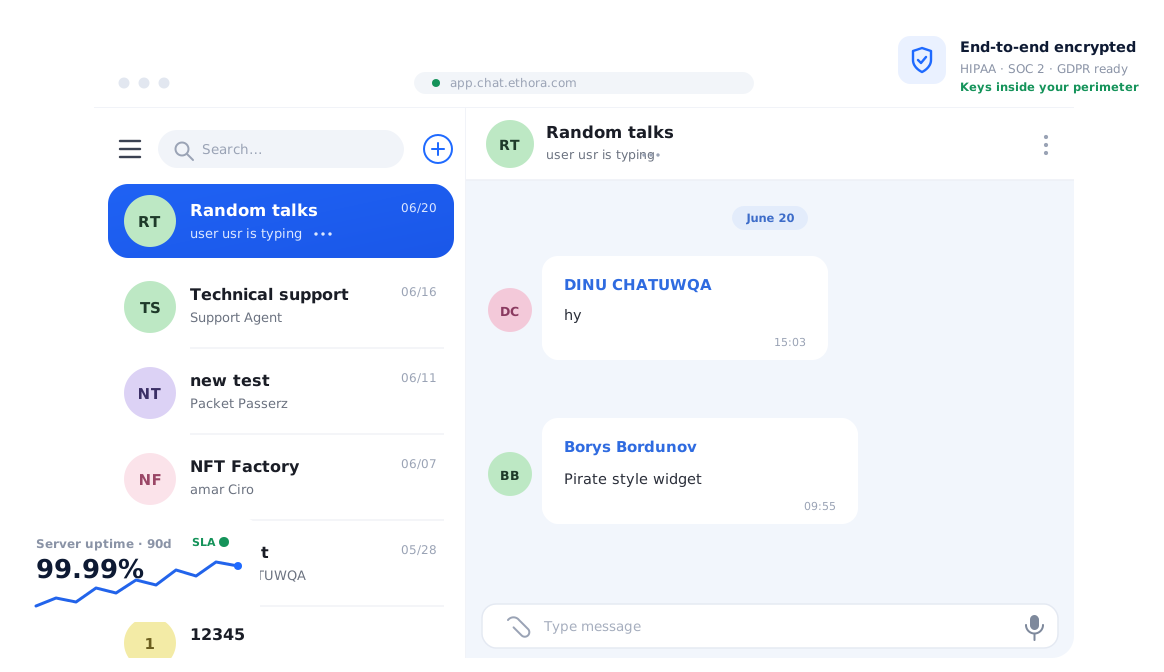
Building your own chat app may be challenging as it requires a dedicated team, significant resources, and months of work. Yet messengers still are a valuable tool for any industry, whether it’s a customer-facing app or for internal communication. They improve collaboration, enhance support and customer experience, increase engagement, and boost retention.
The good news is that you don’t have to hire more people, spend huge budgets, and a lot of time on building your application. There are app engines available as open-source that will simplify the process by offering users access to a ready-to-use code, which they can customize according to their needs.
To choose the open-source messaging system that fits your needs, you need to know what to pay attention to. In this piece, we’ll break down the details.
In 2026, the open-source messaging landscape has consolidated around a handful of serious projects. Regulatory pressure (HIPAA, GDPR, DORA) and AI integration requirements have pushed more companies towards platforms they can self-host and fully customise, rather than SaaS-only solutions. Before picking one, it’s worth understanding what differentiates the modern open-source messaging engines.
Important Features of Messaging App Engines
The best app engines don’t just provide you with snippets of code; they have a set of features that make them stand out. These key qualities are critical as they may directly impact the success of your application.
Ability to Grow with Your Needs
What works for MVP with 500 users may not work for 3000 users. Make sure to choose a scalable open-source messaging engine that can grow with your customer base and can handle massive concurrent connections. Otherwise, when your customer base rapidly expands, you risk suffering downtimes and customer churn.
Keeping Messages Safe
Data breaches can lead to fines and lawsuits, and seriously damage business reputation, especially for those operating in highly-regulated industries like healthcare or finance. Choose a secure messaging app engine that supports end-to-end encryption (E2EE), perfect forward secrecy, and conducts regular security audits.
Changing the Engine to Fit You
Customizable and extensible messaging app engines provide you with full control over the design and functionality of your chat app. You can add needed features like push notifications, voice calls, file sharing, AI chatbots, etc, as well as customize the design to 100% match your brand.
Building in Parts
The most future-proof engines allow you to build in parts, which means they follow a modular architecture. Such modular messaging app engines enable you to replace the storage backend, swap the real-time transport layer, or upgrade individual components without rewriting the entire application.
Popular Open Source Messaging Platforms Compared (2026)
The major open-source messaging platforms in 2026 fall into three broad categories: XMPP-based servers (Ejabberd, Prosody), federated matrix-based servers (Synapse, Dendrite), and team collaboration platforms (Rocket.Chat, Mattermost, Zulip). Each has distinct strengths depending on whether you’re building consumer chat, enterprise team collaboration, or an embeddable chat/AI SDK.
| Platform | Protocol | Scale proven at | License | Best for |
|---|---|---|---|---|
| Ejabberd | XMPP | WhatsApp (billions of users) | GPLv2 | Massive-scale consumer messaging; powers WhatsApp-like systems |
| Prosody | XMPP | Small–medium deployments | MIT | Lightweight XMPP server for small teams and federated chat |
| Matrix (Synapse / Dendrite) | Matrix | Element, Mozilla, governments | Apache 2.0 | Federated, decentralised communications; government & defence |
| Rocket.Chat | DDP / REST | Mid-market enterprises | MIT | Slack-like team collaboration, self-hosted |
| Mattermost | WebSocket / REST | Large regulated enterprises | MIT (with Enterprise tier) | DevOps / secure enterprise team chat |
| Zulip | Custom (REST + long-polling) | Mid-size teams | Apache 2.0 | Threaded team conversations; asynchronous workflows |
| Ethora | XMPP (Ejabberd core) + custom APIs | Multi-tenant SDK platform | Open-core (SDK) + managed SaaS | Embedded chat & AI in your own product, with self-hosted deployment on AWS |
A few notes on picking from this list. If you need to scale to millions of concurrent users, Ejabberd (and XMPP generally) has the strongest production track record — it’s what WhatsApp is built on. If you need federation across multiple organisations or governments, Matrix is the modern standard. If your need is Slack-style team collaboration for internal use, Rocket.Chat or Mattermost fit best. If you want to embed chat and AI inside your own product (rather than deploy a standalone messenger), an SDK like Ethora is the shortest path — it handles the messaging layer, authentication, push notifications, and AI agent integration out of the box.
Types of Open Source Messaging Software
Open-source messaging tools offer various capabilities, depending on how you want to communicate or build your systems. They provide developers with flexible options for building and maintaining reliable communication solutions, whether they are creating simple text-based forum systems, social or dating apps, or complex communication systems.
Common types of open source messaging tools include:
- Message boards. Text-based platforms for discussions, announcements, and community conversations.
- Messaging servers. Backend systems that manage message delivery, user authentication, storage, and secure communication.
- Messaging protocols. Open standards that enable smooth message exchange between different applications, services, or devices.
These tools offer customizable and scalable solutions for a wide range of communication needs and are the backbone of many modern messaging platforms.
How to Pick the Best Open Source Messaging App
What’s the best open-source messaging engine for your business depends on your needs, goals, and experience you want to deliver. Still, some universal tips will help you choose.
- Consider core features. Start by defining what features you want to have in your app, which ones are essential, and which can be an advantage. For example, if you’re building a chat app for gaming, voice chats are usually very important, while file exchange isn’t because it doesn’t help quick coordination or impact gameplay.
- Security. Evaluate the encryption options of the platform and how transparent the project is about its data handling. Thus, you’ll have built-in security features and compliance.
- Documentation. Look at the community and documentation, since strong support makes integration and troubleshooting much easier.
- Tech stack. Consider how well the app fits into your existing tech stack. Check compatibility, available APIs, and how customizable the system is. Choosing the wrong messaging engine can turn a 3-month project into a 12-month nightmare, leading to wasted time and money.
By balancing these factors, you can find an open-source messaging app that perfectly matches your project’s requirements.
Benefits of Open Source Messaging Services
Open-source messaging services hold many benefits for businesses and developers. They simplify the process of building your chat app while providing you with full control and flexibility. Let’s consider these benefits.
- Cost-effectiveness. Open-source solutions are usually free to use, eliminating the need to invest heavily in development and infrastructure.
- Full customization. You don’t need to build anything from scratch, while having a ready-to-use solution with code you can modify as it suits you. Thus, you can build an app according to your vision while saving time and effort.
- Greater transparency. With open codebases, it’s easier to verify security practices and understand how data is handled, reducing the risk of data misuse.
- Community support. Developer communities continuously improve features, fix bugs, and add new capabilities. Also, it makes it easy to get support.
- Flexibility and scalability. Open-source messaging services adapt easily to small teams and large enterprise systems alike.
- No vendor lock-in. You maintain full control over your data and technology stack, without relying on a single provider.
Overall, open source messaging services offer a powerful, adaptable foundation for building secure, cost-effective communication platforms tailored to your specific needs.
Frequently Asked Questions
What is the best open-source messaging platform?
There isn’t a single best open-source messaging platform — the right choice depends on your use case. For massive consumer-scale messaging, Ejabberd (XMPP) is proven. For federated cross-organisation communications, Matrix is the modern standard. For internal team chat, Rocket.Chat and Mattermost lead. For embedding chat and AI inside your own app, Ethora provides an SDK-first approach.
Is Rocket.Chat truly open source?
Yes, Rocket.Chat’s core server is released under the MIT license and can be freely self-hosted. Some enterprise features (advanced LDAP integration, priority support, advanced compliance tooling) are part of a paid Enterprise tier, following the standard open-core model.
What is the difference between Matrix and XMPP?
Both Matrix and XMPP are federated messaging protocols, but they differ in design. XMPP (dating from 1999) is stream-based and has very mature implementations optimised for scale (Ejabberd, Prosody). Matrix (launched in 2014) is event- and HTTP-based, with stronger room-state synchronisation semantics, decentralised identity, and built-in end-to-end encryption across federated servers. XMPP typically wins on raw scale and latency; Matrix wins on modern federation and compliance workflows.
Can I self-host an open-source messaging platform on AWS?
Yes. All major open-source messaging platforms — Ejabberd, Matrix Synapse, Rocket.Chat, Mattermost, Zulip, Ethora — can be deployed on AWS (EC2, ECS, EKS) or comparable cloud providers. If you’d rather avoid the DevOps work, Ethora also offers a managed self-hosted chat server on AWS with the operational work handled for you.
If you’re looking for a reliable open-source app engine, Ethora’s here. Our solution makes integration seamless, allowing you to create messengers for your unique needs, whether you’re building an MVP or a full-scale enterprise platform.
You can fully customize your chat app, embed a chat widget on your website, and take customer support to the next level with AI-powered smart chatbots. Explore the chat SDK, review Ethora pricing, or save time and build your next app with Ethora.

Share with your community


More Articles
Development
Oct 5, 2026
Cross-Platform App Development Frameworks in 2026: 10 Options Compared, Real Trade-offs, and Chat + AI SDK Fit
In 2026, evaluating cross-platform frameworks is a complex matter. There are many practical questions: Which ones have solid chat and AI SDK support today? Which ones won’t force a painful migration when the next major OS version drops? And what are the real engineering trade-offs once you move past the marketing claims? We’ll look at […]

Healthcare
Oct 1, 2026
HIPAA-Compliant Video API in 2026: What Actually Makes One, Vendor Comparison, and Twilio Video Migration
Consultations, psychiatry meetings, medication management, triage, and other medical encounters often do not require physical presence. Adding video to your healthcare app or platform can be a great idea, as it allows you to hold sessions online without losing the human touch. Using a messaging API to incorporate video into your application makes the whole […]

Try Out Ethora in Action
Experience Ethora's messaging with a dedicated demo from our CEO or start building your App right now!