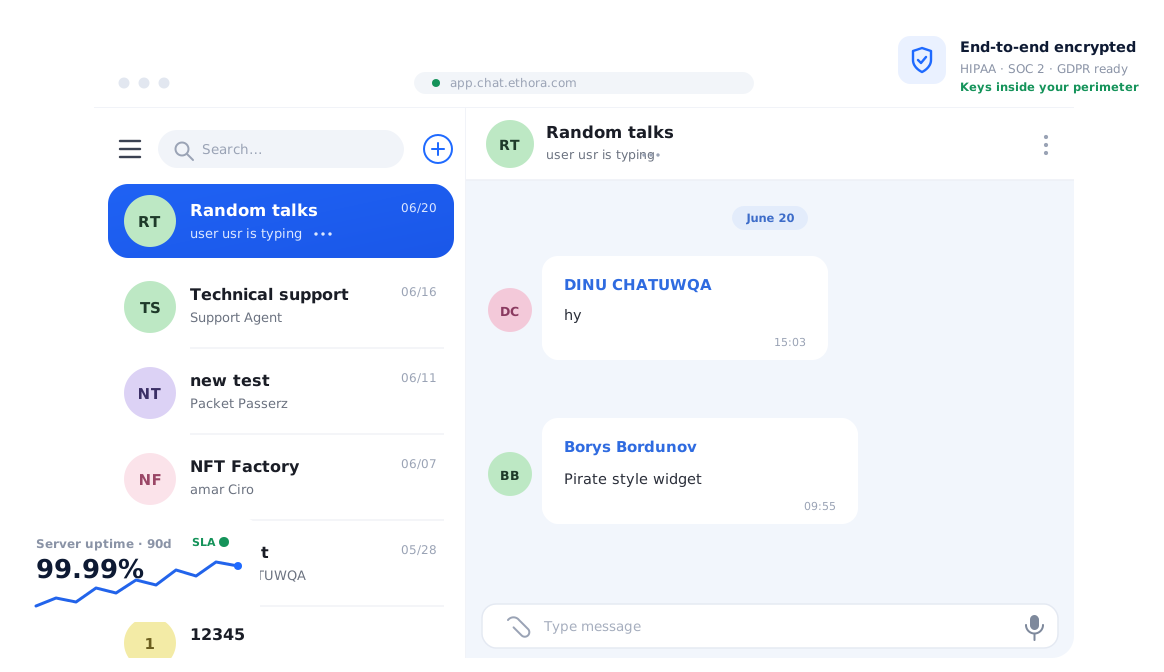
Self-hosted LLM
Build Your Own Self-Hosted LLM Chatbot With Ethora

Not so long ago, large language models’ ability to understand and process natural language caused a real revolution. Today, tools like ChatGPT, Gemini, Copilot, and others have already become an integral part of the lives of many people, from students and copywriters to developers and healthcare professionals. They improve efficiency, decision-making, and user experience.
Just a little learning about your website or documents turns your chatbot into a powerful tool that provides customers with context-aware, human-like communication instead of generic answers.
The demand for generative AI is increasing, and not having your smart chatbot may be a disadvantage, while building one can give you the edge. In this blog, we’ll consider why and how you can create your own LLM chatbot.
What Is a Self-Hosted LLM Chatbot?
A self-hosted LLM chatbot is a conversational agent powered by a Large Language Model. Self-hosted means that its infrastructure is entirely deployed and managed on your organization’s private cloud, server, or on-premises data center. This differs from using a third party’s API, for example, Google’s or OpenAI’s, when the model is run on their servers, you don’t have access to.
A self-hosted large language model works in your own environment, your prompts and sensitive information never leave your systems, ensuring data privacy and drastically reducing the risks of leakage.
Why Choose Self-Hosting for Your LLM?
The decision to host your own LLM is often driven by strategic business needs that cloud-hosted solutions simply cannot meet. This may be privacy, which is critical for highly regulated industries such as finance or healthcare, or more control over customization, retrieval augmentation, or integration flexibility. Let’s consider the main benefits of self-hosting your own LLM chatbot in more detail.
Data ownership. All data processing, model inference, and chat logic happen on your servers. This is invaluable for future model fine-tuning and business intelligence.
Security and compliance. When you deploy a self-hosted LLM, you don’t share data with an AI provider. Keeping data residency, encryption (at rest and in transit), and access logs ensures compliance with regulations (GDPR, HIPAA).
Cost-effectiveness. To host your own LLM, you need to invest in hardware and expertise, but in the long run, it can prove to be more cost-efficient. Your costs are tied to your infrastructure, meaning you don’t risk paying usage-based API fees that can rapidly escalate with high-volume enterprise applications.
Hardware and Software Requirements for Self-Hosting LLMs
Self-hosting enables full LLM hosting architecture customization. You can tailor it to your specific use cases, optimize it to your industry, and specific regional requirements. This requires internal expertise or a strong partner like Ethora to manage the infrastructure. Still, the payoff is a purpose-built system that can outperform general-purpose cloud APIs for your domain.
The first step in deploying your locally hosted LLM is understanding the required hardware and software. This knowledge will help you build the right deployment strategy.
RAM, Storage, CPU, and GPU
Hardware is the foundation of self-hosted LLM deployments. Here’s what you’ll need.
GPU. The GPU is the most critical part of an LLM deployment because the model you choose must fit into GPU memory. Large models require high-end, data-center-grade GPUs (e.g., NVIDIA A100, H100, L40). Smaller and mid-size models can run efficiently on consumer GPUs such as the NVIDIA RTX 3090 or 4090 (each with 24 GB of VRAM). As a rule of thumb, more VRAM equals larger models and faster inference, which, in turn, results in higher quality responses.
CPU and RAM. While the GPU performs the actual inference, the CPU and RAM support everything around it, such as the operating system, the application and API server, and preprocessing (e.g., tokenization).
System RAM may also be used to offload model tensors when the GPU has insufficient VRAM. This is slower but sometimes necessary, depending on the model size.
Storage. Fast SSD storage is essential for quickly loading models and storing conversation history, knowledge bases (for RAG), and logs.
Choosing the Right LLM for Self-Hosting
There are different large language models available for self-hosting, like LLaMA by Meta, Grok X, Gemma by Google, and others. Choosing the right one is crucial as it affects performance, cost, security, and usability. Here’s what to pay attention to.
Model size
Larger models typically deliver stronger reasoning and general-purpose performance but require substantially more GPU memory and computational resources. Smaller or mid-sized models (such as Mistral 7B or Gemma 7B) can be extremely efficient and often outperform larger models on targeted tasks. They are ideal for summarizing reports, sentiment analysis, translation, or lightweight chat assistants.
Performance
When self-hosting, two metrics matter most:
- Latency – how quickly the model responds
- Throughput – how many requests it can handle in parallel
This will help you choose the right model for your needs. For example, if you’re building a customer-facing chatbot, low latency is a top priority, as it enables your bot to answer questions quickly. On the other hand, for batch workloads (such as summarizing thousands of documents), throughput is more important, and slightly higher latency is acceptable.
Benchmarking models under your expected load is the best way to make an informed choice.
Quantization
Quantization reduces a model’s memory footprint by lowering the precision of its weights. In simple words, quantization enables powerful AI models to use fewer resources, allowing you to host the LLM locally.
Knowing this will help you choose the right LLM, but the main thing to consider when building a self-hosted LLM bot is always your goals. First, define the tasks your bot will perform and the goals you want to achieve.
Step-by-Step Guide to Local LLM Deployment
Deploying a self-hosted Large Language Model (LLM) provides you with full control over customization of your chatbot, as well as ensures full data privacy, as you don’t rely on any external services.
Yet deploying LLM can be challenging. To simplify the process, we prepared the instructions for you. Here it is.
- Setting up the environment and building a knowledge base
- Infrastructure Provisioning: Start by setting up infrastructure where the model will be run. This may be an on-premises server, a private cloud instance, or a GPU-enabled Kubernetes cluster. You’ll need:
- Nodes with GPU availability (e.g., NVIDIA A100, L40, or similar), configured with appropriate CUDA drivers, container runtime, and GPU monitoring tools
- Persistent storage for loading models and storing data in the vector database
- Ethora Installation: Deploy the self-hosted chat and AI server. This platform provides the core chat logic, user management, and API endpoints for your LLM.
- Knowledge Base (RAG). For most enterprise applications, the LLM needs to use internal documents, manuals, or databases, not just its pre-trained knowledge. This is achieved using retrieval-augmented generation (RAG). Ethora facilitates building this knowledge base by integrating with a vector database. You will ingest your proprietary data, which the system converts into numerical vectors, allowing the LLM to “look up” relevant context before generating a response.
2. Importing models and running the LLM
- Select and import the model. Choose a model that meets your performance requirements and VRAM constraints. In most self-hosted scenarios, this means using a quantized GGUF model optimized for GPU inference.
- Install Ethora. Deploy the Ethora self-hosted Chat and AI Server. This platform provides the core chat logic, user management, and API endpoints for your LLM.
- Configure and integrate. Now you can configure the chatbot and define the agent’s persona, its access to RAG knowledge, and the tools it can use (e.g., some of your APIs).
- Test and optimize. Test your chatbot to ensure its accuracy, speed, and safety. Monitor GPU utilization, latency, and throughput to ensure your custom LLM hosting solutions are performing optimally under expected load.
We believe this guide will help you. Anyway, if you have any questions, you can always contact our team.
Conclusion
By hosting your own LLM, you embed AI capabilities directly into your infrastructure, without relying on third parties. Building a self-hosted LLM chatbot is not just about having a nice tool on your website. It’s a strategic decision that enables greater data privacy and 100% customization.
Building your self-hosted LLM chatbot can be a complex process and can put you off. But don’t worry, we made it as simple as possible. With Ethora AI SDK, you can save effort, time, and budget. Our solution provides you with pre-built components while ensuring that you still keep full control over development and customization. Start building your self-hosted LLM chatbot today, it’s free.

Share with your community


More Articles
Development
Oct 5, 2026
Cross-Platform App Development Frameworks in 2026: 10 Options Compared, Real Trade-offs, and Chat + AI SDK Fit
In 2026, evaluating cross-platform frameworks is a complex matter. There are many practical questions: Which ones have solid chat and AI SDK support today? Which ones won’t force a painful migration when the next major OS version drops? And what are the real engineering trade-offs once you move past the marketing claims? We’ll look at […]

Healthcare
Oct 1, 2026
HIPAA-Compliant Video API in 2026: What Actually Makes One, Vendor Comparison, and Twilio Video Migration
Consultations, psychiatry meetings, medication management, triage, and other medical encounters often do not require physical presence. Adding video to your healthcare app or platform can be a great idea, as it allows you to hold sessions online without losing the human touch. Using a messaging API to incorporate video into your application makes the whole […]

Try Out Ethora in Action
Experience Ethora's messaging with a dedicated demo from our CEO or start building your App right now!