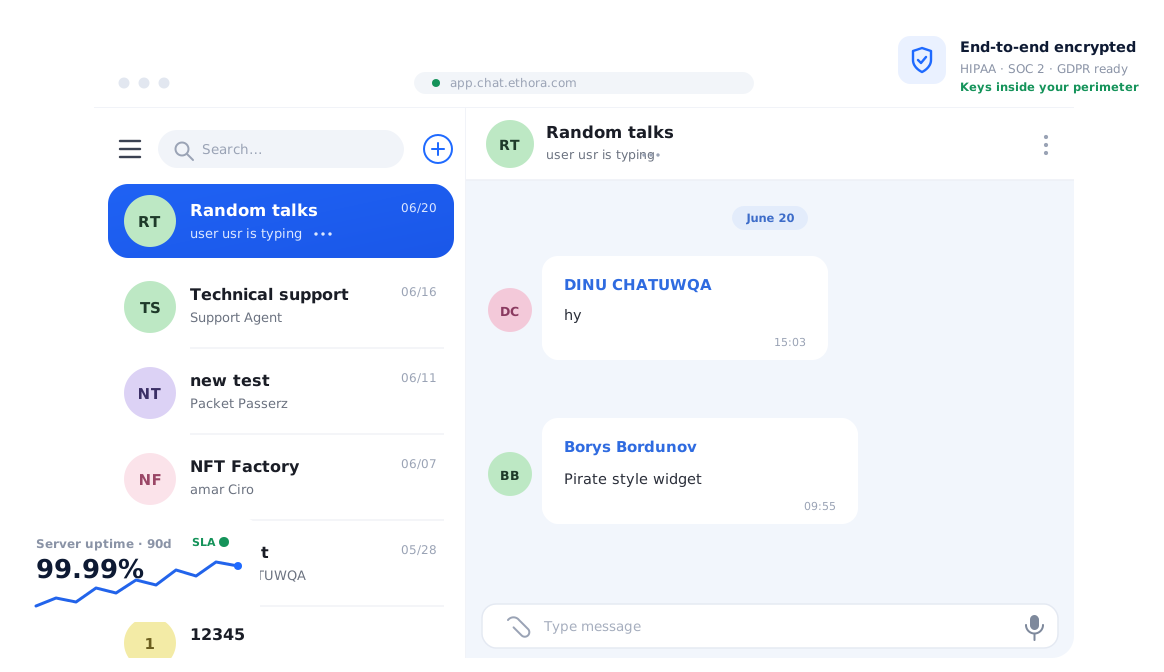
Embeddable AI Widget
How to Use ChatGPT: A Complete Tutorial for Beginners and Builders

AI chat assistants have already become a part of our lives. One of the most popular ones is ChatGPT. This smart AI chat is rapidly changing the way we write, research, program, and create digital products. It can help us create text, find bugs in code, compare various items, plan a trip, or explain astrophysics in simple words. ChatGPT demonstrates what a modern AI language model can do inside a clean, simple chat UI.
From ChatGPT consumer to enterprise AI builder: ChatGPT itself is a great consumer tool, but for businesses the real question is how to deploy LLM-powered assistants inside your own product with your own data and compliance posture. That’s where Ethora’s AI SDK fits in — it provides the infrastructure to ship an AI chatbot, agent, or RAG assistant connected to ChatGPT/Claude, or to a self-hosted LLM for data-sovereign deployments. With that context, here’s the ChatGPT tutorial for beginners and builders.
In this guide, you’ll learn how ChatGPT works, how to use its interface effectively, how to master prompts and AI Agents, and how to build your own live chat web app or AI-powered product.
Introduction to ChatGPT
ChatGPT is an AI agent built on a Large Language Model (LLM) that’s trained on vast amounts of data. It’s not disclosed yet how much data was used to train the latest version (GPT-5.2), but GPT-4 was trained on a 1 petabyte dataset (which is also 22 times larger than the dataset used for version 3.5 (45 terabytes)).
What makes LLMs like ChatGPT special is that they can process natural language, understanding the context and intent. They easily create a conversational flow, answer questions, make suggestions, and switch topics whenever you want, without the need to start a conversation over. ChatGPT is not just a chatbot – it’s rather a robot chat app, capable of much more than Q&A.
From a product perspective, it showcases what users now expect from an AI-powered live chat web app:
- Fast, real-time responses
- Clear message bubbles and readable chat layouts
- A frictionless, simple chat UI that works across devices
These expectations increasingly influence how modern chat applications and AI tools are designed
Setting Up & Navigating the UI
ChatGPT’s interface is straightforward. Once you open it, whether you’re using the web or mobile version, you’ll see a familiar chat application UI. This lowers the learning curve and makes interactions feel natural.
Developers used chat UI design best practices, such as:
- Minimal distractions to keep focus on the conversation
- Clear message hierarchy and spacing
- Responsive layouts that adapt to desktop and mobile screens
These UI patterns are simple, and users learn how to use the app in no time. So, if you’re planning your own chat product, consider using them, as that is what users expect.
Mastering Prompts & Agents
Over 700 million people weekly ask ChatGPT questions, asking it to help them plan a budget, write an essay, assist with coding and bug fixing, or just open it to have a conversation. But to leverage the full potential and get the best possible answers, you need the right prompts.
Put simply, a prompt is an instruction that you give to the AI agent via the app’s message field. The clearer it is, the better. For example, instead of asking “how to use Chat SDK”, try something like this:
Provide me with a step-by-step guide for implementing a real-time chat SDK for a web application. Include architecture decisions, security considerations, and scalability best practices.
Apply a similar method to other requests (instead of “Explain marketing,” be more specific and say “Explain SMM for a fintech startup”, or instead of “Fix this,” try to explain what exactly you want the paragraph to sound like). ChatGPT is a very smart chatbot, but you need to know how to use it.
That’s not all that AI agent apps are capable of. They can follow goals, analyze files, and perform multi-step tasks. For instance:
- Uploading a chat doc (PDF, spreadsheet, or text file) and asking ChatGPT to analyze it
- Running structured workflows instead of one-off questions
These abilities make ChatGPT a versatile tool that’s used not only as an auxiliary instrument but can also be embedded into ready-made products for healthcare, e-commerce, writing assistants, accounting solutions, and many more.
Privacy, Data, & History
Behind every ChatGPT interaction lies important considerations around privacy, data retention, and conversation history.
Chat Logs & History
ChatGPT stores chat logs, allowing users to easily access previous conversations and find messages if needed. While this improves usability, it also raises questions about data control and long-term storage.
For businesses, this is where off-the-shelf AI tools often fall short. Many teams need:
- Full ownership of conversation data
- Clear data retention policies
- Infrastructure that supports compliance requirements
Privacy and security are critical, especially today, when AI chats are often integrated into products and workflows. The safest option is self-hosted or web-based chat servers. These setups allow organizations to:
- Control where data is stored
- Integrate secure messaging flows
- Meet internal or regulatory security standards
In such environments, organizations control access to the information cause there’s no third party to store it. This minimizes the risk of data leaks or failure to meet the requirements, which is especially important for highly regulated industries, such as healthcare or finance.
Build Your Own: Scaling from ChatGPT to a Custom Solution
If you know how to use ChatGPT in your business, you can create a custom, brand-owned AI experience. Creating a smart AI agent for your app or website is easier than you might think. Moreover, with Ethora, it’s superfast, as you can use our embeddable AI agent script. It enables you to:
- Add AI chat to any app or website in minutes
- Customize the AI’s behavior and UI
- Combine human messaging and AI responses in one interface
You can train it in your business context, ensuring it provides the best possible answers to your customers. This setup is ideal for companies that want a production-ready AI chat service without giving up control over data or user experience.
With our AI agent script, you can create advanced chatbots for your business. Even if you have never written a line of code, it’s not a problem, as we also have low-code and no-code options. Try building your context-aware chatbot now. It’s free.
ChatGPT FAQs
Yes, but direct integration often has limitations around UI customization, data control, and scalability.
The best way is to use React Native Chat SDK. For example, with Ethora, you’ll get ready-to-use code for instant messaging, real-time updates, and UI components without building everything from scratch. This can save you months of work.
Embedding chat usually involves a web messaging SDK or a JavaScript-based widget, along with a React.js messaging code sample to speed up implementation.
Ready to put ChatGPT-class AI into your own product? Explore the Ethora AI SDK, build with the agent chatbot builder, deploy a self-hosted LLM, or start building for free.

Share with your community


More Articles
Development
Oct 5, 2026
Cross-Platform App Development Frameworks in 2026: 10 Options Compared, Real Trade-offs, and Chat + AI SDK Fit
In 2026, evaluating cross-platform frameworks is a complex matter. There are many practical questions: Which ones have solid chat and AI SDK support today? Which ones won’t force a painful migration when the next major OS version drops? And what are the real engineering trade-offs once you move past the marketing claims? We’ll look at […]

Healthcare
Oct 1, 2026
HIPAA-Compliant Video API in 2026: What Actually Makes One, Vendor Comparison, and Twilio Video Migration
Consultations, psychiatry meetings, medication management, triage, and other medical encounters often do not require physical presence. Adding video to your healthcare app or platform can be a great idea, as it allows you to hold sessions online without losing the human touch. Using a messaging API to incorporate video into your application makes the whole […]

Try Out Ethora in Action
Experience Ethora's messaging with a dedicated demo from our CEO or start building your App right now!