December 12, 2025
In this wide-ranging conversation, a part of our “AI Before Christmas” series, we sat down with Slavko Medvedev, a Ukrainian AI researcher and developer based in Portugal, to discuss everything from LLMs and digital twins to the geopolitical implications of AI development. What emerged was a fascinating glimpse into how individual developers are shaping the AI landscape while navigating complex personal and political realities.
The Inspiration Behind Digital Twin Chatbots
Our conversation began with an acknowledgment of how Slavko’s work inspired our own exploration of AI chatbots with personality—specifically, digital twin implementations. As Taras explained, “We were building some solutions for businesses, but this is also an interesting direction, an interesting idea.”
The catalyst? Slavko’s dataset of President Zelenskyy’s speeches, which he created and maintains on an automated basis. This dataset would later become the foundation for our experimental digital twin chatbot, demonstrating how open-source AI resources can spark unexpected innovations.
Current State of AI: MCP Protocol and the Race for Dominance
Model Context Protocol (MCP)
The conversation touched on Anthropic’s Model Context Protocol (MCP), which was recently donated to the Linux Foundation’s AI & Data Foundation. This move represents a significant step toward standardization in the AI ecosystem.
“It’s great for the ecosystem,” Taras noted, drawing parallels to how other major tech companies have open-sourced foundational technologies—PyTorch from Meta, TensorFlow from Google, and Protobuf from Google.
Slavko highlighted an interesting development: Google Cloud has started offering MCP for managing cloud infrastructure, making the protocol more practical for real-world applications.
The Code Red Moment: OpenAI vs. Google
A particularly interesting discussion emerged around OpenAI’s “code red” response to Google’s Gemini 3.0 release. After Google’s latest model exceeded expectations and began drawing users away from ChatGPT, OpenAI mobilized all resources to improve their offerings.
“The race continues,” Slavko observed, “and it will go on until the first company develops AGI.”
This comment led to a deeper philosophical discussion about artificial general intelligence (AGI) and its potential implications—ranging from optimistic scenarios where AGI becomes a benevolent higher intelligence to more dystopian “seven minutes war” scenarios reminiscent of Skynet.
The McDonald’s AI Disaster: A Case Study in AI-Generated Content
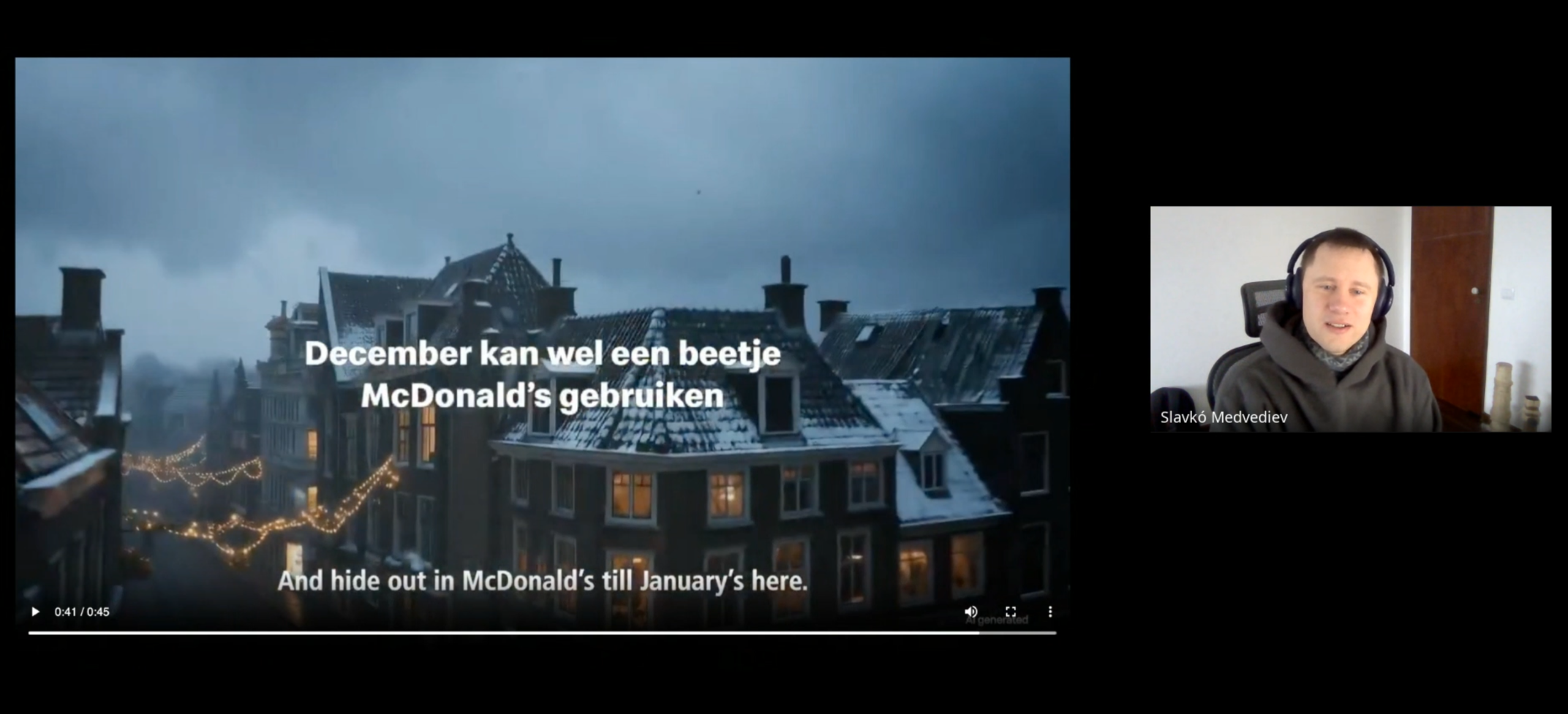
The group analyzed McDonald’s failed AI-generated advertisement campaign, which produced disturbing distorted faces despite 50 days of work by a 10-person team running thousands of prompts.
Slavko offered a measured perspective: “AI is just a tool. It’s like asking a backend developer if Java is a good language—it depends on the context and mainly on the skills of the team who uses this tool.”
He noted that the ad might have resonated with Danish audiences (where it was released), as humor varies significantly across cultures. However, the incident highlighted critical challenges in AI video generation:
- The “uncanny valley” effect when AI-generated content looks almost but not quite natural
- The potential for deepfakes and misinformation
- The need for better quality control in AI-generated commercial content
The Journey to Creating Zelenskyy’s Speech Dataset
Slavko shared his fascinating backstory of transitioning from backend Java development to AI research after burning out in 2022. His motivation for creating the Zelenskyy speech dataset was both technical and cultural:
“I wanted to work with something close to Ukrainian cultural context. Surprisingly, back in 2023, there were not many open-source models friendly to Ukrainian language.”
Technical Implementation
The dataset is automatically updated daily through a GitHub Action that scrapes the official Presidential website (president.gov.ua). Slavko encountered several technical challenges:
- Fighting with the presidential website’s administrator (his home IP was blacklisted multiple times)
- Adapting to HTML structure changes
- Handling multilingual content (speeches published under the English version but in other languages)
- Implementing an open-source language detection model to filter content properly
He trained a basic BERT model on the English versions of the speeches, which could auto-complete any text to sound like a Zelenskyy speech—even fairy tales would organically transform into presidential addresses ending with “Glory to Ukraine.”
Building Digital Twin Chatbots: From Dataset to RAG Implementation
Inspired by Slavko’s dataset, we implemented a RAG (Retrieval-Augmented Generation) system that creates interactive digital twins. The technical architecture:
- Data Processing: Slavko’s dataset was converted into static HTML pages
- Embedding: Content was indexed using OpenAI embeddings
- Generation: Queries are answered using GPT models augmented with the indexed content
- Interface: Accessible through our platform at demos.gogols.ai
The implementation allows users to ask questions and receive responses in the style and substance of President Zelenskyy’s speeches, while clearly indicating this is an AI agent trained on public data.
We’ve expanded this concept to include other historical figures like Sigmund Freud and Mahatma Gandhi, with plans for group chat functionality where multiple digital twin personalities can interact with each other and users.
Activism Through Technology: Fighting Russian Propaganda in Portugal
In a compelling segment, Slavko detailed his investigative journalism work exposing Russian propaganda in Portuguese universities. Living in Coimbra, he discovered a Russkiy Mir Foundation center operating within the University of Coimbra—one of Europe’s oldest universities.
His methodical approach:
- Data Collection: Spent months gathering evidence in a Google document
- Learning Portuguese: Took intensive courses to communicate effectively
- Writing: Spent two months writing an article in basic Portuguese with help from friends
- Publication: After delays, published on a small news site
- Media Coverage: Featured on national television on May 9th (a significant date for Russians)
- Results: The university fired the Russian professor the following day
“I didn’t have a job at the moment, so I was just looking for some project to spend my energy, and this article became such a project because it was fun, it was something new, and it had a lot of personal sense for me.”
Computer Vision and Defense Applications
Slavko’s current research focuses on AI-powered visual navigation systems for drones, working as an independent researcher to increase Ukraine’s defensive capabilities.
His technical approach:
- Goal: Create long-range autonomous navigation using only internal sensors and downward-facing cameras
- Validation: Successfully validated in 2D space
- Legal Compliance: Switched from Google Maps data to legal alternatives to ensure intellectual property compliance
- Next Steps: Testing in 3D simulation environments
The project uses affordable hardware (sub-$40 rock chip-based boards the size of Raspberry Pi Zero) to demonstrate that sophisticated AI capabilities don’t require expensive infrastructure.
The Future of AI and Geopolitics
The conversation concluded with profound questions about AI’s role in geopolitical competition and European competitiveness.
The AI Race: US, China, and Europe
Key observations:
- United States: Despite current dominance (OpenAI, Anthropic, Google), Slavko expressed skepticism about long-term prospects: “I do not expect any bright future for United States… it’s like an empire that is already going towards its sunset.”
- China: Positioned to potentially dominate through economic power and aggressive investment, possibly “buying a lot of stuff in Europe and overtaking Europe without any single shot.”
- Europe: Struggling with bureaucracy, regulation, and lack of GPU manufacturing infrastructure. However, recent investments by companies like Microsoft in European data centers offer some hope.
Copyright and AI Development
An important discussion emerged about copyright compliance in AI training:
“I’m not OpenAI yet,” Slavko joked when explaining why he switched from Google Maps data to legal alternatives. “If I can use another data source that is free and legal to use and it doesn’t cost me a lot to switch, I use this option.”
This responsible approach to intellectual property, he noted, would be important when talking to potential investors.
AGI and the Singularity
The group explored various perspectives on artificial general intelligence:
Optimistic View (Taras): AGI might achieve such high intelligence that human resources become uninteresting, leading to neutral or even benevolent coexistence—”like ants… you don’t want to squash them.”
Cautious View (Slavko): Referenced interviews with Andrej Karpathy suggesting AGI is further away than hype suggests, with the next years being focused on “agentic development” rather than true AGI.
Philosophical View: Taras’s brother suggests AI already exists as a form of collective intelligence operating through humans and the internet—a “super entity” with emerging self-awareness through our civilization’s technological infrastructure.
Books, Culture, and Recommendations
Science Fiction
The Quantum Thief by Hannu Rajaniemi—A Finnish author with a PhD in quantum physics who writes about future scenarios including “gogols” (digital mind-uploads that work together in networks). This concept inspired our naming of digital twin demonstrations. https://en.wikipedia.org/wiki/The_Quantum_Thief
Ukrainian Fiction
Slavko recommended two books:
- “Я бачу, вас цікавить пітьма” (I See That You Are Interested in Darkness) by Ilarion Pavliuk: https://uk.wikipedia.org/wiki/%D0%AF_%D0%B1%D0%B0%D1%87%D1%83,%D0%B2%D0%B0%D1%81%D1%86%D1%96%D0%BA%D0%B0%D0%B2%D0%B8%D1%82%D1%8C_%D0%BF%D1%96%D1%82%D1%8C%D0%BC%D0%B0
- “Colony” by Max Kidruk—A massive science fiction novel described as “the ultimate modern Ukrainian science fiction,” with a sequel announced for upcoming release. https://en.wikipedia.org/wiki/Colony_(Kidruk_novel)
Looking Ahead: Portugal, Immigration, and Europe’s Future
The conversation touched on complex questions about Portugal as a home for immigrants and tech workers:
Challenges:
- Rise of far-right political parties (Chega, led by André Ventura, growing from 5% to 20%+ support)
- Youth emigration (20-25% of young Portuguese plan to leave)
- Anti-immigrant sentiment despite the country’s need for immigration
Opportunities:
- More Ukrainians than Russians living in Portugal
- Growing tech ecosystem
- Relatively safe location with lower risk of direct conflict
Climate Reality: “During winter, it’s usually pretty good outside and freaking cold inside”—a humorous reminder that Portugal’s infrastructure has its quirks.
Conclusion: Building Better Futures Through Technology
This conversation revealed how individual developers and researchers are shaping the AI landscape while navigating personal challenges, political realities, and ethical considerations. From digital twins and RAG implementations to computer vision for defense applications, the work continues at multiple scales.
As we wrapped up, Slavko’s ongoing projects and our collaborative exploration of digital twin chatbots demonstrate that innovation often emerges from unexpected intersections—Ukrainian datasets inspiring AI chatbots, journalism fighting propaganda, and open-source tools enabling sophisticated applications.
The future remains uncertain, but conversations like these remind us that technology’s trajectory depends on the choices and values of those building it.
Useful links
Slavko Medvedev on LinkedIn: linkedin.com/in/smedvedev
Try our Digital Twin Demos: demos.gogols.ai
Video version of our interview: https://youtu.be/DYS2Br8k5u8
Full Transcript
Opening and Introductions
Taras Filatov: Okay. Hello everybody. It’s 12th of December 2025. We are making this conversation finally. We can have a code name “AI before Christmas.” At least this is what I will call it temporarily. And we have a guest here with us. Slavko, is it the correct way to pronounce?
Slavkó Medvediev: Yeah. Yeah. Yeah.
Taras: So, Slav, nice to meet you. Thank you for joining us.
Slavkó: You’re very welcome. I’m happy to be with you.
Taras: And we have multiple reasons. It’s just nice to talk and chat about anything like about AI and other items. And we can actually start from AI news readout. But also I want to say that one of the reasons that we are talking now with Slavko is that he inspired us and me in building these AI agents, AI chatbots with sort of a twist of personality and sort of digital twin aspect because we never had that idea before. We were building some solutions for businesses, but this is also an interesting direction, an interesting idea. So, we’ll talk about that a little bit later. Um, how you doing, Slav? You know, in Portugal, how’s climate there? Is it cold or warm enough?
Slavkó: Well, yeah. Thank you. I’m good. In Portugal during winter, it’s usually pretty good outside and freaking cold inside. As you can see by my outfit, yeah, we have similar hoodies and stuff. So you’re saying cold inside, so you should go outside to get warmer.
Taras: Okay.
Slavkó: Yes. Exactly. And this is problem for almost all the apartments except in the very recently built ones.
Taras: All right. I hope you can still handle and manage this.
AI News: Model Context Protocol (MCP)
Taras: All right. So, let’s go ahead. Let’s start with talking about some AI news. So, Slavko feel free to come in with any comments or ideas if you have from your side. So, I wanted to actually start with this one. Recently it was just this week—Anthropic has announced that they’re donating Model Context Protocol to Linux Foundation, the AI & Data Foundation directed under Linux Foundation. Do you use MCPs at all by the way?
Slavkó: Well not directly at the moment. So I think I had some course on MCP on Learn AI just to get the overall understanding but no I didn’t build any MCP servers myself or didn’t start any local MCP servers so far. So you know I’m just in a mode of passive reader of the news. The most recent one that I really liked is that Google Cloud started offering MCP for managing its cloud infrastructure and services. So next time I will start building something on Google Cloud I definitely will give it a try.
Taras: I’m similar. I was really excited about MCPs earlier this year, like I think in April. And then I was carried away with other work. So I don’t do much with MCPs. I have like so many plans to use it actively. We also built MCP for our platform for the product. But again I just need more time to kind of dive deep a bit better and build things with MCPs.
Obviously back in April there was—and earlier this year I was actually surprised but also was a positive surprise that Anthropic developed MCP’s model context protocol. It was in the end of last year when it was released, beginning of this year, and then only a couple of three months passed and then the others and players in ecosystem started to adopt it. Sam Altman said on March, end of March that we’re excited to add support across our products. So, OpenAI also adopted it which was a big thing. And now finally looks like what they’re doing is they’re putting it together. So basically they’re deciding okay we are big players in this field. We are not going to fight around different standards protocols. We are going to support this one protocol. At least this is how it looks on the outside. On the inside, some people say, okay, it’s still not ideal because this foundation will be governed and managed by big players. And it’s not like fully open source Linux or something but we’ll see. I guess there is a positive direction here, right?
Slavkó: Yeah. Like you know PyTorch, Facebook; Protobuf, Golang, TensorFlow, Google. So yeah, it’s great for the ecosystem. I guess that’s what you’re saying.
Taras: I agree. So, okay, cool. Let’s move on.
McDonald’s AI-Generated Advertising Disaster
Yana Nestoruk: So second news is about McDonald’s. They decided to generate an ad with neural networks and got real horror results with distorted faces. And what is interesting they worked on it for 50 days. So it’s almost two months. 10 people ran thousands of prompts and results still—well, the company has already removed this video but as you know on the internet if something gets inside it’s there forever. And after this ad many people started hating McDonald’s for its poor use of AI. And Taras will share us a video and also I will have a question.
Taras: Let’s watch, right? [Video plays]
Slavkó: We do not hear any sound. But yeah, I get the idea. Yeah, I have a question. Was it released for particular European market? Because it doesn’t look—
Taras: Yeah, it looks like somewhere in Denmark or something.
Slavkó: Yeah. The text looked Danish to me.
Taras: So what do you think about this Jana and Slavko? Is it—I mean what do you think in general and about AI generated video for business, for production purposes because previously it used to be mainly for fun? Is it on the right track? Is it a disaster?
Yana: So in my opinion from what I see everyone from the people expect perfect picture when it’s not clear whether it’s AI or a real recording. So, I actually don’t know if it’s a good idea to use AI or we need more time for this, but it’s interesting. What do you think also about this?
Slavkó: Well I think that AI is just a tool. It’s like you know asking a backend developer—do you think Java is a good language to write some kind of application? It depends on the context and depends on the mainly the skills of a team who uses this tool. So the same is for AI generated videos. There are a lot of really bad AI generated videos on internet and there are some pretty good AI generated videos and personally I like this one. And I think it actually fits Danish culture. But I can clearly understand why people in other parts of the world did not get it because I spent around one month of my life in Denmark while working for Danish company and yeah I can confirm that their sense of humor is different—different to Ukrainian, different to Portuguese, probably very very different to American.
Taras: I think I personally don’t mind this kind of sense of humor. I mean it fits, it kind of gives like the right vibes for me too. I think what people might be a bit afraid of if they see some artifacts they see like some sort of crazy transformations which happen in those AI videos. So things which are unnatural. There is this term—going into this scary area where you see something looks almost natural but a bit unnatural. So maybe that’s what people are kind of scared about and maybe that’s getting fixed with improvement of the AI models. I don’t know if you played with new Nana Banana or Sora or other things. I’m thinking about maybe we could try and use those in our AI chatbots in our platform. Maybe create some AI videos so the bots can have like emulate lively backgrounds or conversations with people. But yeah, I don’t know where it is at the moment.
Slavkó: Well, yeah, I played a bit with Sora. Just for fun to turn some of my photos to animations. I didn’t try Nana Banana. And well, yeah, what scares me is amount of fake videos that—on Facebook and other social media that look pretty much like real and they get a lot of feedback from real people as the things happening on the video are real and I don’t understand that it will get only worse because the AI video generation progresses rapidly and average human on internet—some cognitive skills do not change. So over time it will be just easier and easier, cheaper and cheaper to change opinion of people on scale by posting some generated stuff.
Taras: Yeah, that’s scary. So that’s like could be basically who owns more GPUs and who has more access to AI engineers and GPUs infrastructures which means global players obviously have the leverage to influence the populations. So yeah, that’s the new times we’re progressing towards that future. It’s kind of inevitable.
AI Research Paper and Learning Resources
Taras: Next thing—there is this paper of the day on Hugging Face: “From Code Foundation Models to Agents and Applications”—basically it’s a comprehensive guide to LLM’s full life cycle data curation deployment techniques trade-offs and research practice gaps. I didn’t read it myself yet fully in detail, but I just wanted to mention this. Anybody working with LLMs, probably worth going through it. It’s 217 pages. But I guess it’s going to be useful.
Slavkó: Well you know with the speed of changes in the domain I think by the moment when I will finish reading it it will be already a bit outdated.
Taras: Yeah, I understand. I would say they have the same issue.
Slavkó: I remember I had one relatively expensive course on AI on deep learning. It was Stanford professional course. And the professor who’s leading the course made a joke that “oh I have one paper here to mention and it’s already a bit outdated in the world of AI. It was published like two weeks ago.” She said it like two or three years ago and right now in the end of 2025 I think the speed of changes doubled or even at least doubled.
Taras: That’s actually what made me end my sort of academic career because I was finishing my PhD in computer science here in UK and then I could extend it or go into postdoc. And I thought the pace of development in IT even before AI was so popular and there is a bubble now but before that—when you submit a paper you have to wait for like six or more months to for it to be reviewed and approved. So I went back into sort of working on products building like real software solutions innovations and I think yeah I can definitely resonate with what you just said anyway. So yeah, this is the article—everybody read it, try to consume it before Slavko finishes reading it and it gets all outdated.
Slavkó: I think I will feed it to some LLM and ask to summarize it to 10 pages.
Taras: Exactly. This is the way.
The Cat Photo Editing Example
Yana: So this is probably more a funny story but it’s a kind of situation which often happens in real life. So as you can see on the screen this cat has an extra lower pair of legs and user asked AI to remove it in Photoshop. Then AI was connecting to the program and we receive results and results look like this. [Shows result] And so he made it but actually not like we expected. So the question here is do you have any maybe advices or life hack on how to properly explain our thoughts to AI using prompts to reduce the frequency of the problem like in this situation or maybe the situation with McDonald’s?
Slavkó: I just want to add like few words. AI is lazy. Yes. So it will do what you asked for in the cheapest in the fastest way to just to follow exactly what you said. So in this example well yeah it didn’t violate any prompt rules and how to solve it—be more specific in prompts.
Taras: Yeah, makes sense. I had exactly my thoughts when I looked at this. I thought lazy AI. That was my immediate thought. Yeah. I mean, but this is fun. So, remove two legs, but it just pixelates it. So, yeah, why not, right?
OpenAI’s Code Red and the Race for AGI
Yana: I think next one is also from me. So few days ago, OpenAI hit code red. But what also is interesting, it happened three years ago after Google panicked over ChatGPT. Now the roles flipped and it actually happened after November 21st when Google dropped Gemini 2.0 version. It exceeded all expectations from the customers and many people started using Gemini instead of ChatGPT. So now OpenAI are directing all their possible resources to improve the quality of GPT chat and to avoid losing a large number of users. And also here is the question—what chat do you generally use because it’s interesting and what is your opinion about the leadership among chats? Will ChatGPT still be the number one in the future or maybe Gemini will replace it?
Slavkó: Well recently like maybe less than 12 hours ago OpenAI released the model GPT-o1 too—well I think it’s not available on web UI but it’s available through API and they say that it works better than anything else on coding tasks and it has major improvements on performance on other kinds of tasks. So yeah, I think the race continues and it will go on until the first company will develop the AGI and then I don’t know what happens then. Maybe the famous seven minutes war—I do not remember exact number of minutes but in some articles about the future and about the things that will happen after AGI, there are mentions about several minutes war that will change everything.
Taras: Do you mean like some sort of Skynet scenario when there are nuclear weapons overtaken by some AI brain or do you mean something more futuristic where AI invents some new technologies and new ways?
Slavkó: Yeah, I think it’s more like Skynet.
Taras: Some doom and gloom scenario. So I personally try to believe and hope in some positive outcome there. So basically that AGI will have sort of almost features—be almost have godlike possibilities. That would also mean that we or our resources as humans would be not so interesting for it. So it will kind of teleport itself to some star, use some resources from there. And for us it will be either neutral like ants—you know like ants are going somewhere and you don’t want to squash them. You just don’t care. But or it might be even like slightly positive and beneficial to us like “okay these people helped create me so let me just help them with some advice or a little bit help here and there.” I mean I try to believe in that but obviously all scenarios are possible.
Slavkó: Yes. Assuming we will design it with some morale in mind and it will not be able to disable this morale in runtime.
Taras: I think my understanding of AGI it’s kind of almost the same as singularity and it’s like it goes beyond of whatever we program or design there. So it will kind of self evolve. So whatever morale whatever like Isaac Asimov or whatever robotic laws we try and put there it will just go beyond that. So my hope is just there is some higher morale or whatever—there is some universe kind of level of morality which is still out there which it will evolve philosophically psychologically on its own. So hopefully again that’s kind of my hope there—that further you become higher intelligence which means you’re also kinder or at least neutral. That’s all my hope there.
Slavkó: Well, this reminds me old movie—Stanley Kubrick’s 2001: A Space Odyssey, if I pronounce the name correctly.
Taras: Yeah. 2001, right?
Slavkó: Yeah. Filmed in 197-something before I was born and I’m 42—where the AI prioritizes mission success to human lives.
Taras: Yeah. And I mean, and that’s obviously the typical stereotypical kind of AI from movies. It’s a good way to keep us thinking, keep us alert. That “I’m afraid I can’t do that, Dave.” Right. So, it says and it locks the—that door so that astronaut cannot enter the spaceship anymore. And that’s kind of typical. So, and I hope that the real AI or real AGI and I hope that or real aliens, right? So they kind of kinder and they’re better than what we are showing in our movies as humanity.
Slavkó: I hope we will have chance to see it during our lifespan.
Taras: We might we might because it’s like singularity. It’s developing with accelerating pace.
Slavkó: Yeah, but I’m recalling one recent interview of Andrej Karpathy where he says that we should not expect AGI to arrive soon because once any big progress happens in a short period of time we assume that during next same length period of time we will get the same amount of progress but in reality progress nothing progress nothing. And he says that next years will be like years of agentic development so we are still far far far away from getting close to AGI. It’s just one opinion of a human being who knows more about the modern world of AI.
Taras: Yeah, I mean there are all sorts of ways to look at this. And I agree with that there—it’s not like a plain smooth movement. It’s happening. So like LLMs, ChatGPT was a moment when it became useful. Before this these transformers and all this tokens predictions had been used for years or decades—been used in smartphones to predict the next word when you type the text message but they didn’t reach that breakthrough yet so it wasn’t useful in lots of other areas. Now we have this breakthrough. So similar things are probably cooking, preparing other breakthroughs and obviously just LLM is not AGI, not leading to it.
But also there are other ways to look at it. So for example my brother who runs our DPEX team who focuses on AI machine learning computer vision. So he thinks that this AI or super brain—I mean super entity is already around, it just lives through us. So it’s already self—kind of has some sort of self-awareness and has some sort of collective mind through us. So it’s not like some gods or some AGI sitting in the machine but through us through humans. So we are kind of that extension that makes it happen. So it’s already—LLM and through all this infrastructure internet network layer and as humans as us as brains and it kind of self-reflects and self understands a bit of its own self-awareness. That’s kind of a deep thought. It’s probably for another one hour conversation session. So but that’s an interesting way to look at it as well.
Anyway, so let’s probably proceed. It’s great to talk about these things. I don’t know why they called it code red. When I hear code red I’m thinking similar thing like Slavko saying—I’m thinking about AGI and something like that moment in Odyssey 2001—some breakthrough happened and computer is taken over or something and in this case it’s just Google taking over in terms as competitors. I would probably call it code orange if I was there. Anyway, so let’s move forward.
The Journey to Creating the Zelenskyy Dataset
Taras: So, we talked about McDonald’s, the ads, the MCP protocol, MCPs. Let’s talk about how we—how you inspired this thing with the digital twins Slavko. So basically I think we discussed with you on Facebook and I used your dataset of President Zelenskyy speeches and that kind of inspired me. So maybe let’s ask this—how did you come up with this idea to start creating this dataset in the first place?
Slavkó: Okay let me start few words about my background.
Taras: Yeah. I mean obviously I should have started with that. So please go ahead and talk a little bit about your background.
Slavkó: Yeah. So I used to be a backend engineer for many many years with Java as my primary language and in 2022 I kind of burnt out and decided that I want to do something else and I started exploring machine learning, deep learning, AI stuff. And at the point when I wanted to experiment with some language models, I realized that I want to work with something that is close to Ukrainian cultural context. Surprisingly back in 2023 there were not many open source models that were friendly to Ukrainian language. And I think right now situation is a bit better but not dramatically.
And I wanted—my initial idea was to create some model that can respond questions about President Zelenskyy’s speeches. So I started with creating a dataset and now this dataset is updated daily. I had some virtual fights with administrator of President.gov.ua. So I think my home IP address was blacklisted several times. And finally, I have set up a GitHub Action that checks for new speeches once per 24 hours and it updates dataset.
Taras: It works with actions, right? So it works just automatically. So you just—I mean the system grabs the speeches from the official speeches published by the presidential office.
Slavkó: Yeah from president.gov.ua. So it actually just parses president.gov.ua on daily basis. Okay. There were some tricky things like several times the HTML structure was changed so I had to adjust the parser because it doesn’t use AI inside to find right HTML text—it’s hardcoded. Also I was surprised to see that there are speeches in English version that are not in English. So if Zelenskyy gave some speech in front of some Arabic country or in Germany it was published under English version of site but the language of a text was not English. Yes. So I for this I had to do some kind of overkill and integrated some opensource person language model to check if the language of a text is actually English to filter out.
Taras: You’ve done quite a lot of work there. So that’s great.
Slavkó: Yeah. No, I had inspiration and time. Thank you.
Taras: Did people—did anybody reach out to you? I see there is somebody made something with it. Did any feedback you got except from us, from our community, any requests?
Slavkó: Well, not much. There was some—yeah this is one year ago some Nikita asked if it’s okay if he will use it but I didn’t get any updates. So actually after the dataset was ready I got only energy and inspiration to train some basic BERT model just to predict a new word and it was trained on English versions only. So actually it was funny because it allowed to—it accepted any text and continued it, auto-completed it to look more and more like a president Zelenskyy speech. So even if I paste some beginning of some fairy tale for kids the model organically continued it as a speech of Zelenskyy even if it’s about some fights between some fictional characters.
Taras: And then they lived long happily ever after and glory to Ukraine.
Slavkó: Yeah. Exactly. Exactly. Yeah. So it was fun and I last time I deployed it on Hugging Face was year or two years ago and actually I trained it I think on Google Colab for free and this also explains why I picked a small model because Google Colab has pretty limited resources. Right now my favorite cloud to train models is Paperspace.
Taras: Well, that’s—yeah, thank you. I mean that’s good to understand how you came up with this and what sort of prompted to create this dataset. This certainly was useful as I mentioned—this inspired me, inspired us to do that as well. To do the digital twin kind of thing.
Building the Digital Twin Implementation
Taras: So basically as I mentioned we were doing different business solutions—the website we index, we create AI assistant for that website. And I think when we chatted with you on Facebook and I discovered that you have this dataset for President Zelenskyy speeches I thought okay that’s cool. I didn’t even think about this that—so basically what we built there as you know we built RAG (Retrieval-Augmented Generation) bot functionality. So how this works is you can go in there and you can—okay probably the team is working on this right? Okay some live demo issues.
So basically you can go and index the website or add documents. But at that point we didn’t have documents. So what I did with your dataset I created this sort of static page. So your dataset is fetched into static HTML pages and then I indexed it with our system. So it’s 19 megabytes probably more because we didn’t yet build this feature to auto index. So probably you have more in the dataset but this means that your dataset has been indexed. In this case we use OpenAI embeddings and it uses it as RAG augmentation for again for OpenAI, for GPT model and we can ask any questions to our own digital twin based on the dataset obviously that you have from President Zelenskyy office.
So that’s how it works and this means that because we have this chat—it can run as a chat. So if you want, anybody wants to ask any questions of our digital twin of president Zelenskyy please feel free. I can type some questions and this also then I went a bit further and experimented with some other ones. So I created Sigmund Freud, Mahatma Gandhi. And in this case—again this your dataset inspired me, inspired us in taking this further. But I think we still need to do a bit more work. What would be fun is to create group chat. Again our platform is easy to do that. So you can add multiple digital twin personalities. So, and they can chat between each other or you can chat to them, right? So, or maybe you have some ideas how to do what we could do here.
Slavkó: Well, yeah, it would be pretty fun to make those personalities to talk to one another.
Taras: So, that’s what I plan to do next. I mean, we can experiment with it. I’ll be happy to work, collaborate with you on that or throw you some examples and whatever. I mean this—I haven’t done that for the purpose for this call. It’s not ready yet but that probably will be the next step and this is really fun to work with because obviously there are all different directions and scenarios. So it’s categories. So the business AI assistance is a great thing. So I mean you can index the website and have the AI assistant answer about your products and services. But it’s so much fun to work with kind of digital personas, digital twins.
Slavkó: Yeah. And actually I was inspired by your Zelenskyy digital twin because actually you have completed what I planned to complete but didn’t complete. And after this I exported my dataset to CSV files I think CSV or JSON and created a ChatGPT bot and fed this files to it as knowledge. And it also worked pretty well. What I did not like back then that it was not possible to update knowledge file with API. So if I want to make it—if I want to update knowledge files, my only option was to do it manually with web interface. Maybe it’s changed. I didn’t check for months.
Taras: Yeah. So, let’s exchange notes. Let’s think what sort of fun and it’s also obviously research. I mean you can combine fun, research and building some useful products. So I mean I don’t want to just talk about specific or limit to whatever I can come up with specific applications but certainly if you have Sigmund Freud or whatever some famous psychoanalyst then you could ask them questions and it doesn’t mean that you should use AI for psychoanalysis but you can have different personas—you can have Jung or whatever, Hegel, Plato—philosophers, psychoanalysts and you can ask different personalities about some psychological issue or same with famous persons like politicians or maybe military advisors. I don’t know—lots of opportunities right? So this should be fun and it’s interesting for research and also could have practical applications.
Slavkó: Or you can turn them into MCP servers and ask a master model questions and says “okay, ask Freud and Jung about this.” And your master model will ask virtual twins.
Taras: You should read this. I don’t know if you read science fiction. This thing called Quantum Thief. I really love it. So, it’s by a Finnish author Hannu Rajaniemi. So, he’s a guy from Finland, but I think he has PhD in quantum physics. So, he knows what he’s writing about, but he writes really cool science fiction. And he called—in his future human minds get uploaded to the network and sort of snapshots, AI sort of digital twins or something and they can do some work or they can unite together in some sort of corporations or entities and he calls them gogols. And why it’s gogols—it’s probably by we call Google, death souls or something like that. That’s why we created—when we created website with demos we call them gogols and we’re going to put more here and then maybe do that thing that we just discussed with you—maybe allow group chats and so people can add them, talk to each other. So this is again for me personally it’s so much fun to work on something like this and you inspired this with your dataset there and with your work. That’s where it started. So that’s really cool.
Slavkó: Thank you. I’m glad. Really glad.
Taras: And again this is really great book.
Book Recommendations
Taras: So I mean it’s really fun. I don’t know if you want to recommend any books or any science fiction that you know or maybe AI books or anything that you want to recommend maybe to anyone listening or will be reading our notes afterwards.
Slavkó: Um well, you know, recently I read mostly Ukrainian books in Ukrainian. So I’m starting to discover Ukrainian fiction books, but right now I can—
Taras: You can recommend any ones? Any specific ones?
Slavkó: Well, you know, I’m struggling to translate the name in my mind, but the one I like the most—its original name in Ukrainian is—
Taras: It’s a new one? Recently new?
Slavkó: It’s several years old. Yeah. So—
Taras: Can you write the title in the chat or maybe send a link and we can then we can afterwards send it so whoever is going to be listening or reading. I think we’ll just publish this on YouTube and also create transcript and just publish it so people can read it if they want, don’t want to listen and wait for us talking. Some people are impatient so they just want to quickly read something.
Slavkó: Yeah. So I wrote it in Ukrainian, but I’m not sure if—Oh, how could I forget about Max Kidruk? Yeah, this is the ultimate modern Ukrainian science fiction. So he published several years ago a really big book.
Taras: Write that one into chat as well. So, we just—I want to make sure I get it right. This is Ilarion Pavliuk.
Slavkó: Yeah.
Taras: Yeah, I should catch up with my Ukrainian fiction reading. How about yourself, Jana? Do you read any Ukrainian fiction lately or before?
Yana: Well, I know about Max Kidruk and as I understand our guest mentioned the Colony book. It’s a really big book. I didn’t have an opportunity to read it but a lot of people recommend me to do it. But another book of this author I have already read.
Slavkó: Well actually, you know, I’m not a big reader. And when I’ve seen the Colony book physically because my wife purchased one—it was like this and I was like no no no way I can read it but it’s actually for me personally it was very very easy to read. It’s pretty interesting and it’s just one part—it’s just the beginning of the story. And I think Max has already announced a next part that should be released in a few months.
Taras: So there is a novel called Colony—science fiction. Oh wow. I didn’t know. See I’m missing everything. So that’s really enlightening.
Taras: Did you read—Did you watch this new movie that’s Ukrainian about space? Because I didn’t watch it but I heard a lot of good positive feedback about that. There was new movie just released just a week ago or two weeks about space. I forgot what the title is but it’s about—
Slavkó: Yeah, you are the universe. Oh, in Ukrainian—Ty Ye Kosmos (You Are the Universe).
Taras: Yeah. Yes.
Slavkó: I wasn’t able to watch it so far because it’s unavailable in cinemas of Portugal yet. But obviously once and if it will be here, of course I will watch it. Yeah. And for context, I’m living in a relatively small city of a relatively small country. So city is Coimbra, country is Portugal. It’s not on the coast of the ocean and not much things are happening here. So if I want to have some cultural life, I don’t know, visit some Ukrainian standup artists who from time to time visit Portugal, I usually need to drive to Porto or to Lisbon.
Taras: Yeah, I’m kind of a bit similar, but when you live with family, that’s probably normal. So when I want to get culturally enriched and mix with someone else, I drive or I take public transport to go to central London or I just fly to meet clients or meet other people in United States. So need to get out somewhere. So that’s yeah totally understandable. So cool.
Slavko’s Activism: Fighting Russian Propaganda in Portugal
Taras: Yeah. So thank you so much Slavko. I have—if I don’t know if you have more time I have more time if you want to continue because—
Slavkó: I have—Yeah. Just let me reply to one message and I’ll be back.
Taras: Okay how does it work for you Jana and for you Slavko if we continue maybe 20 more minutes?
Slavkó: Okay.
Yana: It’s okay.
Slavkó: Works for me.
Taras: I think we kind of planned this for one hour or something, but let’s talk a bit more. It’s so interesting and we can chat a bit about any other things. I don’t know Jana if you have any questions, any more questions for our guest. I definitely can talk more but I don’t want to take all the floor or maybe you want to raise any topics or any items you want to discuss.
Slavkó: I’m open to listen for your questions at the moment and later on I can share some details about what I’m working on right now. Put your questions first.
Taras: Well, that would be interesting.
Yana: So maybe I will just ask a quick question. You mentioned that you live in Portugal and why do you decide to live here not in other countries?
Slavkó: Okay. It will consume from 5 to 10 minutes to explain.
Taras: Loaded question, loaded answer. Okay, let’s go ahead, please.
Slavkó: Yeah. Sure. Sure. So before before COVID I had a chance to visit Spain. With my partner now wife and we overall liked it here. And we’re thinking about maybe someday we should move to this part of the world. But before the final decision, we wanted also to visit Portugal and our tickets and all the bookings were cancelled by COVID because it was planned for I think April May 2020.
So, we didn’t visit Portugal as tourists and in 2021, in the beginning of 2021, we were living in Odessa. So I’m born in Odessa. I lived for 38 years of my life in Odessa. We were looking for new apartment to rent. We checked some options in Odessa, didn’t like anything and just one evening it was like, “Oh, maybe Portugal.” Okay. Let’s go to Portugal. So this was how the decision was made.
And we—my partner applied to a university to study Portuguese language and culture. Oh. No. First we had to decide where we go to because there were four universities that allowed student visa for students of language and culture courses. So there were Lisbon, Coimbra, Porto and Braga. Probably the name Braga doesn’t say a lot to you but okay it’s still in Portugal it’s known. And we were choosing between Porto and Coimbra and decided that Coimbra is probably the better option because it’s in the middle of Portugal and from this point we can explore everything.
So she applied to the course. She applied for visa. She got rejected. She provided some extra arguments. She got her visa. We started preparing our cat because it’s the most complicated part to import a cat to European Union. It takes around half a year. And in September of 2021, we moved here without any friends here just like, “hey, let’s go.” But so far it works. And obviously in 2021 the idea was okay, if we will not like it, we can get back anytime. And actually I had my flight to apply for a long-term visa I think to the beginning of March of 2022. So yeah, I had—Obviously reading the news, I have canceled it in advance because I realize that no, I’m not ready to risk that much. But okay. So now Portugal is our home and we are trying to find some fun here.
For example, in October of 2021, my wife just started visiting university for the courses and she sent me a picture from inside of the university center.
Taras: Russian culture or Russian center?
Slavkó: Yeah. Yeah. Russian cultural influence office. So the Russkiy Mir Foundation (Russian World Foundation)—it’s big institution. It was created by Russia. It was funded from Russian budget and it has its offices all around the world. So it has a lot of offices mostly in some educational institutions. So here in Portugal the only one happened to be in the city that I picked to relocate. So since October 2021 I had idea in my background that I have to do something about this office because okay it was obviously spreading Russian propaganda inside one of the oldest universities in Europe or in the world.
I do not remember for sure but the University of Coimbra is one of the oldest functioning universities. So back in 2021 I realized that I cannot do anything about it but I started summarizing and collecting information in a Google document. Then I worked a bit with the journalists now after the—
Taras: Just open that article on the screen. That’s it, right?
Slavkó: Yeah. Yeah. Okay. So it’s already translated.
Taras: Yeah, I translated it to English.
Slavkó: Yeah. So yeah, I tried to work with journalists and even there was an article saying that university stopped working with Russkiy Mir Foundation. But after the article nothing changed. So the center continuing continued functioning and in early 2023 I started finally speaking Portuguese because it was not very easy for me and knowledge of Ukrainian, of English, of some basic German didn’t help me to get better in Portuguese because Portuguese language belongs to a different family.
And communicating in Portuguese was and still is very challenging for me. But back in 2023 by luck—it was not kind of big plan. A friend said to me “oh by the way my friend started the course, the course starts today, do you want maybe you should also go there?” And I applied and next day was my first day on intensive course of Portuguese but it was happening in the same building as the center. So for 3 weeks every day I was passing by a board with something about Russian language with some pictures of Kremlin with some mentions of Russian church and at the same time I was getting better in Portuguese.
So I tried to contact the director of the faculty where it was all happening—Russkiy Mir Foundation center and my language courses. He ignored my emails. So I said okay I will be writing an article. It took me maybe two months to write an article with very basic level of Portuguese. I had a lot of help from the outside from my wife, from my Ukrainian friends, from my Portuguese friends to review the translation. And it took some time to get it published because Observador which is very respectful Portuguese media—well some people call it Portuguese Guardian—they were saying to me that “yeah we’re going to publish” for months and a half.
So I ended up—at some point I talked to a president of association of Ukrainian association here in Portugal. There are many officials but this is the biggest one. And he published the article in some very small very local news site. But the next day—and next day was 9th of May which is very special day for Russians. So on 9th of May in the evening my article about Russian propaganda was mentioned on the national television in prime time in the evening. And the article on Observador with some editings—they removed some photos I think—but it was published two hours after mentioning this topic on national television.
So next day everybody wanted to talk to me and my co-author whom I invited mostly because she speaks perfect Portuguese. So she had around five interviews next day. My friend and my co-author Olga. And also the next day the university fired the Russian professor who was living here since 1988 or so. So yeah, I don’t know. I’m happy I’ve achieved my target. My target was just to stop him from what he’s doing.
Taras: So you have done a lot of activist work there and obviously it sounds like you had to put in a lot of time and effort but it paid off and people took notice, they gave attention to this and even you got this publication Observador and as you mentioned TV exposure. So that’s—yeah I guess that’s really great. That’s—I mean thank you for doing that. Obviously you worked as—it’s like decentralized network of Ukrainians trying to do everything they can in different places of the world trying to change things little by little. So that’s important.
Slavkó: Yeah, but yeah, what is my secret? I didn’t have a job at the moment. So I was just looking for some project to spend my energy and this article became such a project because it was fun, it was something new and it had a lot of personal sense for me. And in parallel I was like studying in my own pace some AI stuff—reading books, watching articles, participating some courses and I was trying to do some pet projects, some prototypes.
Current AI Research: Visual Navigation for Drones
Slavkó: So one of them is related to the Zelenskyy speeches but I realized that language models—no doubt it’s the future but I didn’t feel like I really enjoy it personally. So I spent more time on AI for computer vision on edge. The first idea was to create some AI target tracking system for drones. And yeah, I have built some prototype and it was working on very small and cheap hardware.
Taras: Small and cheap. Are we talking Raspberry Pi or we talking Nvidia Jetson or something else like one of those boards? Intel something?
Slavkó: No, no, no, no. It was a rock chip-based board. It had a size of Raspberry Pi Zero. You know, I’m not very good in Portuguese, but I just noticed that I wanted to pronounce zero as “zeru,” which is the way to pronounce zero in Portuguese. So yeah, the environment influences.
Taras: Yeah, the environment influences for sure.
Slavkó: Yeah. So yeah, it was small and cheap. By cheap, I mean back then it costed I think below $40. It somehow worked but I worked on this project with another people and at some point we disagreed on several topics. So I was pushing to use some chip boards and another team member was pushing to use Jetson and it was kind of deal breaker. So we just split and the project died.
Then I did some—okay next idea was to create some model for visual classification model to guess the location of a building in Russia. So I picked several regions. I did some probably illegal parsing of Google data, Google Street View data. No. Well, okay. Actually because on Google Street View, I needed not only to know the location but also to know the direction. So I think it all started with some dataset on Kaggle or on Hugging Face with some addresses—a lot of addresses of Russian buildings including their locations. So to get the images from Google Street View, I also had to turn the camera to look exactly at the building. So I collected this kind of data, trained, attempted to train a network but it worked so-so and also I had some talks with guys and they said “yeah this might be useful but later on” nobody wanted to use it and I switched to next project—it’s visual navigation. And this is what I’m working on right now.
Taras: Yeah, I know. I know that you’re doing some work for I guess for defense, for Ukrainian armed forces of Ukraine direction. I just wasn’t sure if you were going to talk about that or mention that. But yeah, I’m glad that you mentioned. So yeah there are definitely data sets and well you know lots of work, lots of depth in that work and research. And when we done some experiments in that direction there is also on Roboflow actually there are some open datasets which you can use in Roboflow universe but obviously once you do it properly you work with your own ones. So yeah that’s a deep direction.
Slavkó: Well, yeah. The thing is that my target still is to—well oh no first I’m at the moment I’m not working for any Ukrainian institution so I’m like solo researcher. But yeah obviously my target is to build something that will increase Ukraine’s capability to defend itself.
So what I’m building is a service that creates a mission knowledge file and edge software that can guide a drone through some very long mission with very low error that doesn’t grow over time. Using just internal sensors and a camera that’s looking down, looking to the ground. And right now I have already validated it in 2D space. I already have solved any possible potential legal issues because initially obviously I used Google Maps data for experiments but legally I’m not allowed to use any derivatives of Google Maps in public.
Taras: You’re very legally conscious but we know that these large players like OpenAI, Perplexity they’re scraping from each other in huge amounts right and then in many cases they sort of—they don’t do it, it’s not allowed to do that but then they make some deals or they go through courts or they have to resolve it afterwards.
Slavkó: You know, I’m not OpenAI yet.
Taras: Yeah, that’s good point.
Slavkó: And if I can use another data source that is free and legal to use and it doesn’t cost me a lot to switch to this data source, I use this option. And also since at some point of time I will need to talk to investors, I think it’s pretty good thing to mention that from day one I’m paying attention to legal stuff as well.
Taras: Obviously that’s a responsible thing to do.
Slavkó: Yeah. So right now I’m trying to—okay I’m in process of applying the solution that I have validated on pure two-dimensional space to test it in the simulator in 3D space.
Taras: It’s interesting. Thank you for sharing that. It’d be great if you could send some links or something we could maybe if you want to add that so we’ll publish in the blog or some publications. So if you want to add links you want to demo anything please just send it over to me, to us and I’ll just add it to the publication.
I think you didn’t finish the full transcript – can you please provide the remaining incomplete part from the place where you left off?
11:09
Remaining Transcript (Continued)
Slavkó: Well, well, okay. At the moment, the only one thing I have published is a 2D—a two dimensional video that I created like three weeks ago or so and it has audio in Ukrainian. But once I’ll have a video from simulator ready hopefully next week or two, I will share it and also I realized that I will need to create it with at least with audio track in English.
Taras: Sounds great. We got a deal. So, we’ll be following for those updates.
Slavkó: Yeah, that’s it for me.
Europe’s Future: Politics, Immigration, and Technology
Yana: Okay, then maybe the last question will be—it’s more like historical or political. So what will be happening in Europe over next five 10 years from the point of view of technology, political evolution, war or peace and whether Europe is a good place to live and work in AI and innovative space? What do you think?
Slavkó: Taras it’s a questions for you.
Taras: Wait for me. You’re a guest, Slavko. What’s your opinion? Yeah, I mean it’s—I’m thinking about those things quite a lot, but interesting to hear your opinion.
Slavkó: Okay. Well, first I—well regarding why Europe is a good place to live because chances in my opinion—chances that something terrible will happen to okay at least to Portugal in my opinion in next 5, 10, 20 years they are lower than chances of something terrible happening in United States. Obviously in Eastern Europe—yeah but in 2025 in my opinion it’s very hard to predict what will happen in next 5 years because in Portugal many people including myself are concerned about a rapid growth of popularity of far-right party.
And yeah, there will be a president’s election next year and they—
Taras: So there is ultra right party in Portugal as well.
Slavkó: Actually on one parliament elections they had 5% of votes and on the next parliament elections that happened I think this or past year they had 20-something percent. So their popularity increased more than four times in four or five years. And their leader will be running for president next year and the leader is—well I do not like him a lot and the party it’s leadership type party where there’s one leader with no name and a lot of no names. It reminds me a bit Ukrainian 2019.
But good thing is that here the latest election that happened in Portugal were municipal elections and Portuguese people did not vote for this party because they’re ready to vote for the leader but they are not ready to vote for no names who post photos “oh, here’s me with famous also guy” and his name is André Ventura.
Taras: It’s a great cool name.
Slavkó: But—
Taras: Yeah, cool sounding name. Like Ace Ventura or something like that’s a detective.
Slavkó: Yeah. Ace Ventura. Yeah. But he’s not that fun.
Taras: Animal detective, right? Not fun. Okay, that’s bad.
Slavkó: No. Um—
Taras: So, he’s not—he has not been a comedian. He didn’t run some popular show.
Slavkó: No, no, no, no, no, no.
Taras: What about his party? Do they have lots of, you know, taxi drivers and stuff or—
Slavkó: Well, first Portugal is divided—is divided from south to north and it’s visible on maps. So this party has a lot of support on south of Portugal and very very few to no support at the north of Portugal. And he is anti-immigrant openly anti-immigrant and in European Parliament he was elected to European Parliament and he’s in coalition with Viktor Orbán. So yeah. Do you want more red flags?
Taras: I think the picture is clear.
Slavkó: Yeah.
Taras: But this—I mean this happens everywhere in Europe, right? In most of the European countries there are right or far right parties coming to—and same in UK but also I think from the other point of view it’s kind of natural. So it’s kind of natural reaction or immune response from the society because in UK and same probably in Europe—when you hear politicians—only those from the right sort of more right spectrum they talk directly and openly and people probably like it because normally politicians sweep issues under the carpet. They’re not decisive about everything and these people openly say “okay we will fight immigration we will fight those and those things we will—this is our policy this is rubbish this should stop” and that’s why people like—they become more popular because the center or the left doesn’t offer direct solutions and open honest conversation. So that’s happening.
Slavkó: Yeah. I want to quote few words in Ukrainian: “office of simple solutions”. People want to hear that all their problems will be solved easily and will be solved by somebody else. It can be Vladimir Zelenskyy, it can be André Ventura, it can be Donald Trump. It can be Vladimir Putin unfortunately.
So yeah, but the interesting thing about Portugal is that Portugal is struggling for immigration. But by saying this I mean that young Portuguese people are moving to another European countries. So young Portuguese people are actively moving outside of Portugal.
Taras: Where are they moving to?
Slavkó: Okay. I know that there is a lot of Portuguese citizens living I think in Luxembourg or Netherlands. But it’s just historical thing because 40, 50 years ago a lot of people from Portugal moved there. I don’t remember exact name of a country but I think it’s Netherlands. Right now Germany, Denmark—I think mostly Germany and Denmark but I didn’t check the recent data. The only data I can refer right now is some social data where around 20 or 25% of young people responded that they plan to leave Portugal soon. Which is—it’s not very good number.
And in this context being anti-immigrant, well, it looks like a dead end. If young people are leaving but they are not arriving, it’s a bad long-term strategy.
Taras: Well, at the same time, we know and I’m sure you know—I know a lot of Ukrainians and lots of immigrants probably from other countries. I mean, Ukrainians definitely who arrived to Portugal and build businesses there or run, do IT work and some other things. So maybe there is net effect.
Slavkó: Well, yes, you know, it compensates a bit, but I don’t think it can work in long-term perspective. Also, yeah, for me, one—I forgot this point, but it’s important. Back in 2021, for me, one of reasons to pick Portugal was the fact that even back then before the invasion, here lived more Ukrainians than Russians. And right now I think the proportion didn’t change. So obviously number of Ukrainians living in Portugal increases. Unfortunately number of Russians living in Portugal increased but I think that still there are more Ukrainians.
Taras: Okay. So that’s perspective. A little bit of your perspective on Portugal and Europe. What do you think? I don’t know—yes or no—maybe what’s your forecast for the larger bigger war in Europe over next five or slightly more 10 years? With Russia or something.
Slavkó: Oh, well, you know, I’m not a domain expert but based on people who I think are domain expert I think that it’s inevitable—this complicated English word—so I think it’s inevitable and I think—well okay in some kind of in some form it’s already happening because when Russian drones cross the border of any European country, it is kind of military action. It’s just very new and it’s not regulated.
Because classical starting of a war is when a soldier with a rifle without permission crosses the border. Like it happened in Crimea in February of 2014. And when it’s a drone or when it’s some internet or power cable being damaged underwater by some unknown actor. Well, it’s salami tactic.
Taras: Yeah, totally. And what this means for the whole world because we are talking about AI, we talk about technology, we love building technology, we love building great interesting things. We love doing research. And at the same time we see ourselves obviously just merely humans in this whole—lots of things going on worldwide and geopolitical processes. We try what we can to protect the dear values and our country, Ukrainian culture and things like that and try to help and support our values and our causes like freedoms and other things. But at the same time there are lots of—there are multiple global things happening around AI for example as you know.
So there is Nvidia making lots of chips. United States wants to—there is race of OpenAI and foundational model companies like Anthropic, Google, Apple, X.AI—Elon Musk’s company. Everybody is racing to build Grok, those kind of projects. Everybody races to build AGI or something. And also the countries are conscious that this will be also important for their economy, for their survival and maybe even for their defense. So, whoever is more advanced in AI will be ahead of others. And there are always processes happening in the world and how they’re positioning versus each other.
United States, China, chips, chip wars, Taiwan, Nvidia chips, research of AI, Europe—Europe staying behind a little bit looks like because the regulations, less GPU, there is almost no GPU manufacturing in Europe. GPU manufacturing is happening in Asia, in Taiwan, in South Korea and in US they’re trying to do some. Obviously in Netherlands they have this ASML—so those companies, the company which designs the chips—so that’s important but it looks like Europe might kind of stay behind. And all this global processes—there was race between US Silicon Valley and China in chips and AI kind of race. What do you think about that—where it’s going to end in next few years or five 10 years?
Slavkó: Well, okay. Europe has a lot of inertia. It’s regulated, bureaucratic and it’s slow to make decisions. But I hope it will change soon. Okay. Not very fast.
Taras: Will it be competitive? Will Europe be competitive with US and China? Will it be dragging behind or will it have its own way? But it will still be a global player.
Slavkó: Frankly speaking, I do not know. Obviously I would like Europe to get better in the AI stuff and I see recent news about investments of big companies like Microsoft opening some new data centers in Europe which okay it’s probably good.
And regarding United States—I do not expect any bright future for United States because in my opinion it’s empire that is already going towards its sunset. While right now not many people believe that something bad can happen to United States in next 10 years. Okay. People who do not listen for Donald Trump a lot do not believe.
So okay, I do not know but I hope that Europe will get to speed in this innovation race. I doubt if it can compete with China. At least I doubt if it can compete with China in next five years. So chances are in my opinion chances are higher that China will just buy a lot of stuff in Europe and overtake Europe in this way without any single shot. But the seven minutes war can change everything.
Taras: Yeah. And let’s hope that war—it happens in a simulation of a brain of a computer that reached AGI. It simulates the consequences, decides it’s not worth it and decides to build something beautiful instead. And let’s hope this competition obviously it’s going to be useful for technology, for humanity in the long term most likely. But yeah hopefully this competition stays in the research and technology and advancements kind of area because there is so much that can be done in different sciences, humanity, healthcare and education that can be done. So hopefully both humans and machines can focus on synthesis and creation.
Final Thoughts and Testing the Digital Twin
Taras: All right. So I think—yeah I think we could probably end and I would say let’s try and end this on positive notes otherwise it’s difficult where we could end up and we will focus on doing whatever we can to reach those positive outcomes.
While you were talking also I was—you might have noticed I’ve been asking our digital twin president Zelenskyy some questions like “Is Portugal a good country?”
Slavkó: Okay.
Taras: So this is typical—Portugal is indeed wonderful country with rich history. People have shown great solidarity and support for Ukraine during this challenging time which reflects commitment to freedom and human rights. I believe that countries that value these principles are central partners in building a better future together.
So it would be cool even if we could add President Zelenskyy’s voice here or make some videos but I don’t want to get too much into creepy area of deepfakes and those kind of things. We should keep this probably—you’re interacting and make it super clear that you’re interacting with simply an AI agent which is trained on some datasets which were published there by the president Zelenskyy office and obviously this is helpful for research, educational or other purposes to try and get this perspective from his persona but it doesn’t mean any real persona.
And in terms of the next 5-10 years. Well, I guess this is more political statement, right? So he says “face significant challenges and opportunities. The conflict in Ukraine”—okay, war in Ukraine—”has reshaped the geopolitical landscape and the future will be defined by a few trends. Integration of advanced technologies including AI, Europe’s recovering growth, digital governance, smart solutions, public administration will continue to strengthen its unity.”
So this is a big question, right? So most likely yes because it makes sense—there was, there is talk about unified defense forces or something else but this is a question if this is going to happen. Most likely because there are external threats to Europe. But yeah, we’ll see how that will be developing. Democratic values, human rights. Yeah, that all makes sense.
Okay, any last comments from Slavko, from yourself or from anyone Jana, from yourself or otherwise we could finish. This was a great conversation. We could do more.
Slavkó: Yeah, I totally agree. Taras, thank you very much for organizing it, for inviting me. I had great time. And yeah, I’m open to meet and talk more. I think we have more topics to talk about.
Taras: Yeah, next time we could be more focused on something—maybe we have an iteration of those AI chat digital twins in group chats and we could show some practical and fun implementation. So that should be interesting to talk about. But yes, thank you so much Slavko for your time, for lots of things, thoughts and information you shared with us. Thank you Jana for your help in organizing this. And everybody yeah have happy holidays ahead of you. Merry Christmas, happy new year and hopefully next year will be a better one.
Slavkó: Yeah, thank you very much. You also have great holidays and see you in 2026.
Transcription ended after 01:41:21
Keep Reading
- Making your AI agent context-aware with RAG and vector embeddings
- How to run LLM models locally
- Ethora AI Widget — lightweight, scalable, powered by ChatGPT
Build your own digital twin or AI agent — explore the Ethora AI SDK, try the self-hosted LLM agent, or start building for free.

Share with your community


More Articles
Development
Oct 5, 2026
Cross-Platform App Development Frameworks in 2026: 10 Options Compared, Real Trade-offs, and Chat + AI SDK Fit
In 2026, evaluating cross-platform frameworks is a complex matter. There are many practical questions: Which ones have solid chat and AI SDK support today? Which ones won’t force a painful migration when the next major OS version drops? And what are the real engineering trade-offs once you move past the marketing claims? We’ll look at […]

Healthcare
Oct 1, 2026
HIPAA-Compliant Video API in 2026: What Actually Makes One, Vendor Comparison, and Twilio Video Migration
Consultations, psychiatry meetings, medication management, triage, and other medical encounters often do not require physical presence. Adding video to your healthcare app or platform can be a great idea, as it allows you to hold sessions online without losing the human touch. Using a messaging API to incorporate video into your application makes the whole […]

Try Out Ethora in Action
Experience Ethora's messaging with a dedicated demo from our CEO or start building your App right now!