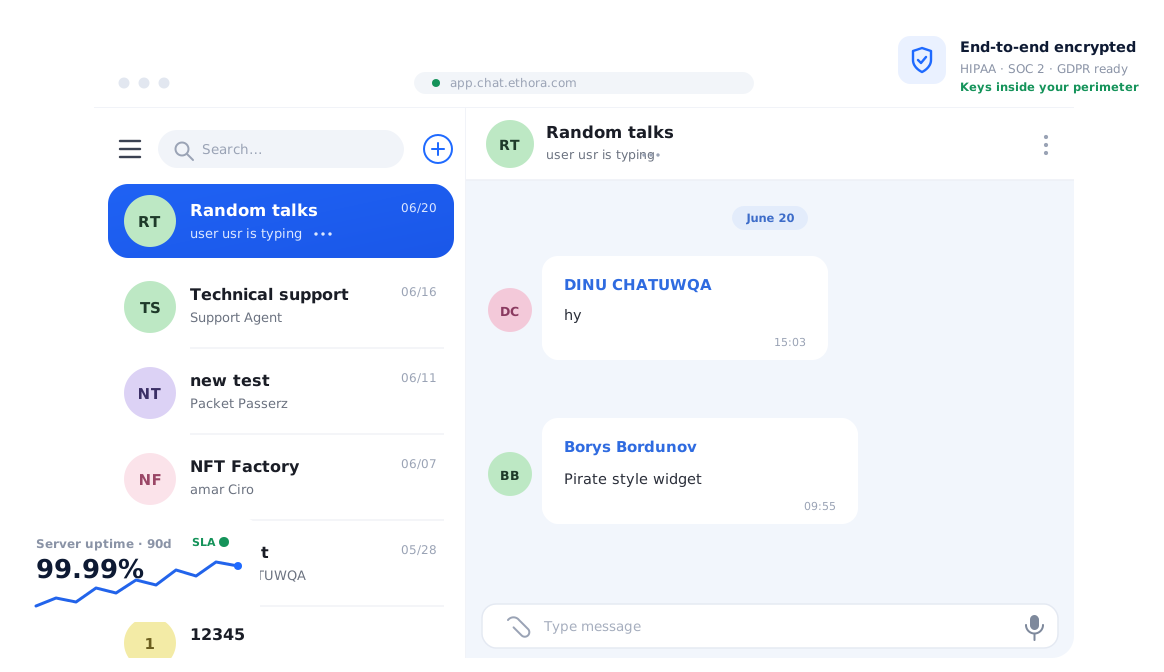
Embeddable AI Widget
Case Study: RAG AI chatbot for health supplements business

Industry: Health & Wellness, Dietary Supplements
Business Size: Small Business
Product: “Food Pause” Detox Program and ExtraDetoxBox
Implementation Time: Under 30 minutes
Background:
It’s been a month since people started throwing website examples at me for demonstrating LLM + RAG AI chatbots demonstrating the capabilities of our embeddable AI agent widget, but I only recently began publishing the results.
We immediately noticed several problem areas and edge cases, and fixed them. We significantly expanded the context window and convenience for medium and large websites – in the first version, the system indexed 10 pages. After improvements, you can now index sites with 300+ pages, and it continues indexing in the background.
So now we’ll be publishing results for everything that was suggested, and if you’re interested, feel free to throw in more website examples, yours or others, where you’d like to see the technology in action. As a reminder, we’re demonstrating how a RAG bot works – that is, LLM + your indexed website, so the AI assistant has context about your business.
Thanks to Val Pertsiya for this example – an ideal case for small business. The LLM knows a bit about the business owner and the work direction, but without RAG it starts hallucinating because it lacks sufficient context (and also, as you may or may not know, OpenAI’s indexing currently ends in October 2023). The LLM knows nothing about the product and program – so RAG works very clearly here.
As a result of the experiment with the “ExtraDetoxBox” project, we can confirm that RAG works and the AI assistant on the site becomes truly useful and works as it should. If you’re putting an AI assistant on a site, it should definitely be done the way we did it, with additional context through RAG or other mechanisms. An AI assistant on bare “ChatGPT,” on the contrary, will be harmful.
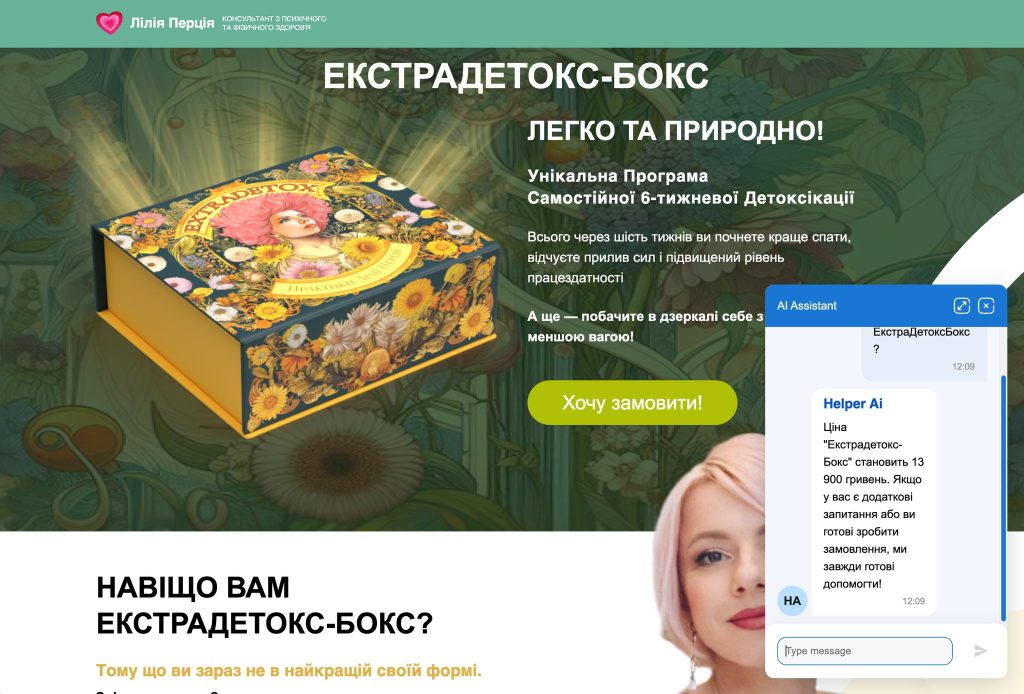
However, I’m not convinced that our RAG bot is necessary in cases where the site is small, even though our product is free for small businesses.
Why might an AI assistant not add much value in such a case? Because visitors will find it easier to browse 3-5 pages than to ask the bot questions. But that’s exactly why we’re doing this – to understand where AI technologies make sense for business and where they don’t. Besides, it is for the business owners to decide. They might find better ways to apply AI Agent technology, something we as technologists didn’t really think of. For example, in this specific case the business owner has mentioned that this sort of RAG powered AI agent will be most helpful in their technical support operations.
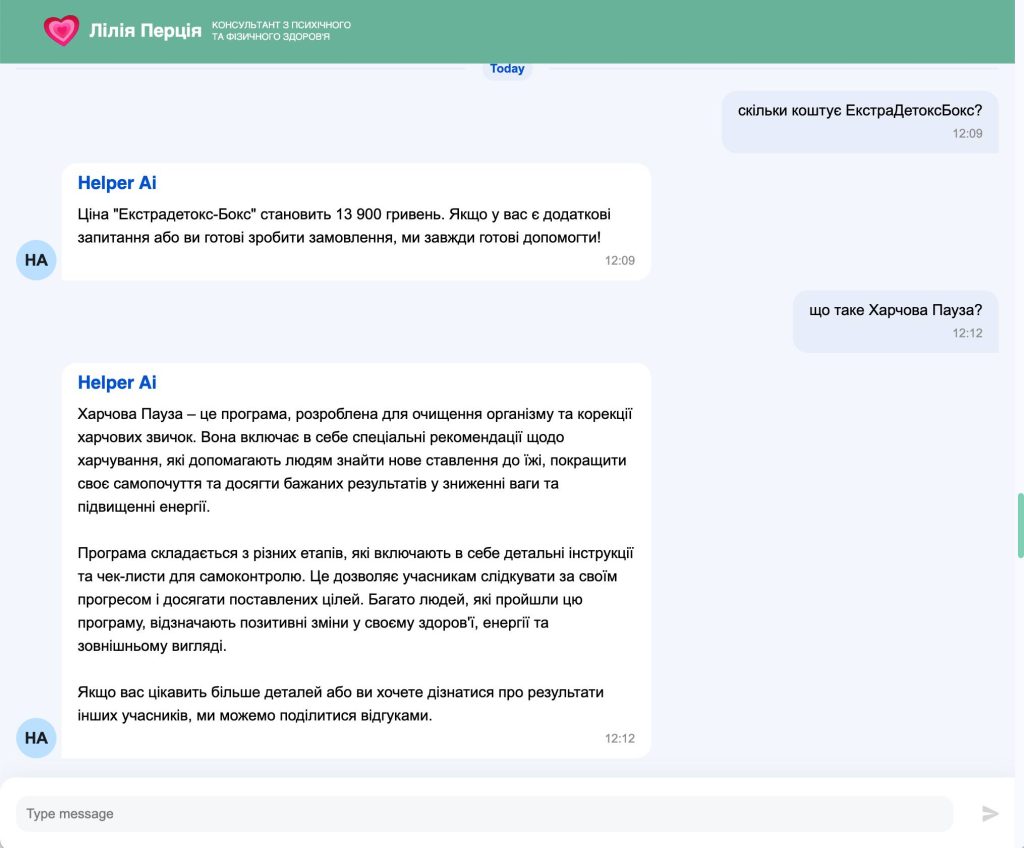
Below is a detailed case study.
What is RAG and Why Does It Matter?
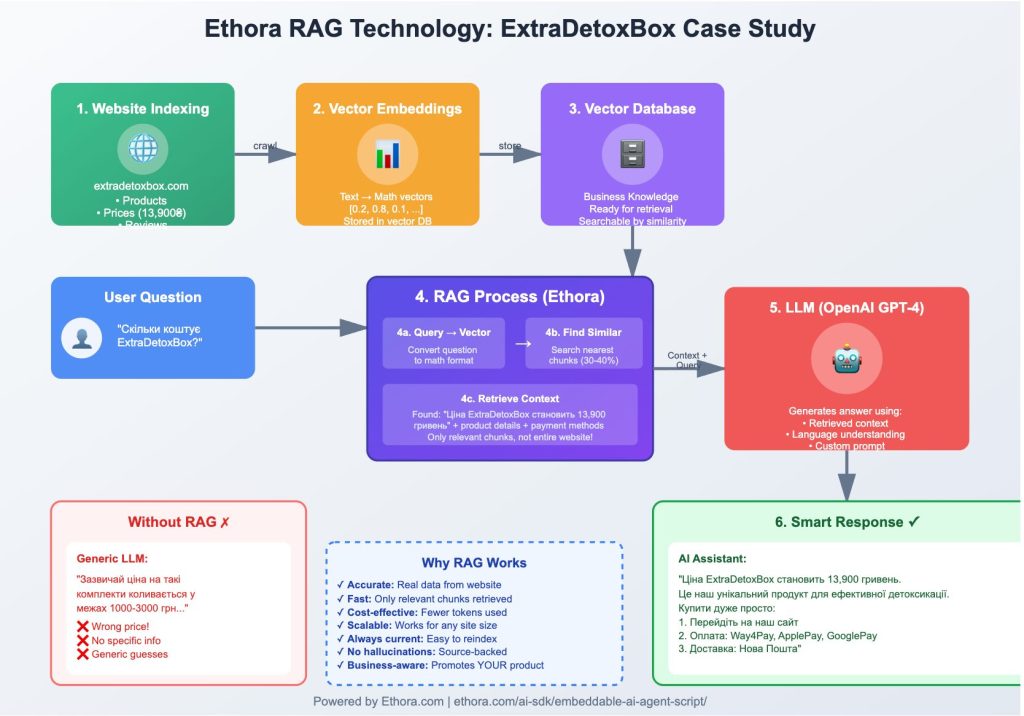
RAG (Retrieval Augmented Generation) is a technology that allows an AI assistant to access specific information about your business in real-time.
How It Works – In Simple Terms:
- Website Indexing – the system scans all pages of your site
- Vector Embeddings – text is converted into mathematical format (vectors) that AI can quickly analyze
- Vector Database – all information is stored in a special database
- Smart Search – when a user asks a question, the system finds the most relevant information
- Contextual Response – the LLM receives only relevant information and provides an accurate answer
Advantages of RAG Over Simple Text Copying:
- ⚡ Speed – no need to transmit all information with each request
- 💰 Cost Savings – fewer tokens = lower costs
- 🎯 Accuracy – only relevant information
- 📈 Scalability – works even with large sites
- 🔄 Automatic Updates – easy to reindex when the site changes
Implementation: Step-by-Step Instructions
Step 1: Prompt Configuration
First, we changed the system prompt from the basic “You are a helpful assistant” to a specific one:
You are an AI assistant on the ExtraDetoxBox website, dedicated to the ExtraDetoxBox product. Your task is to help visitors get information about the product and company, positioning yourself as part of the team.
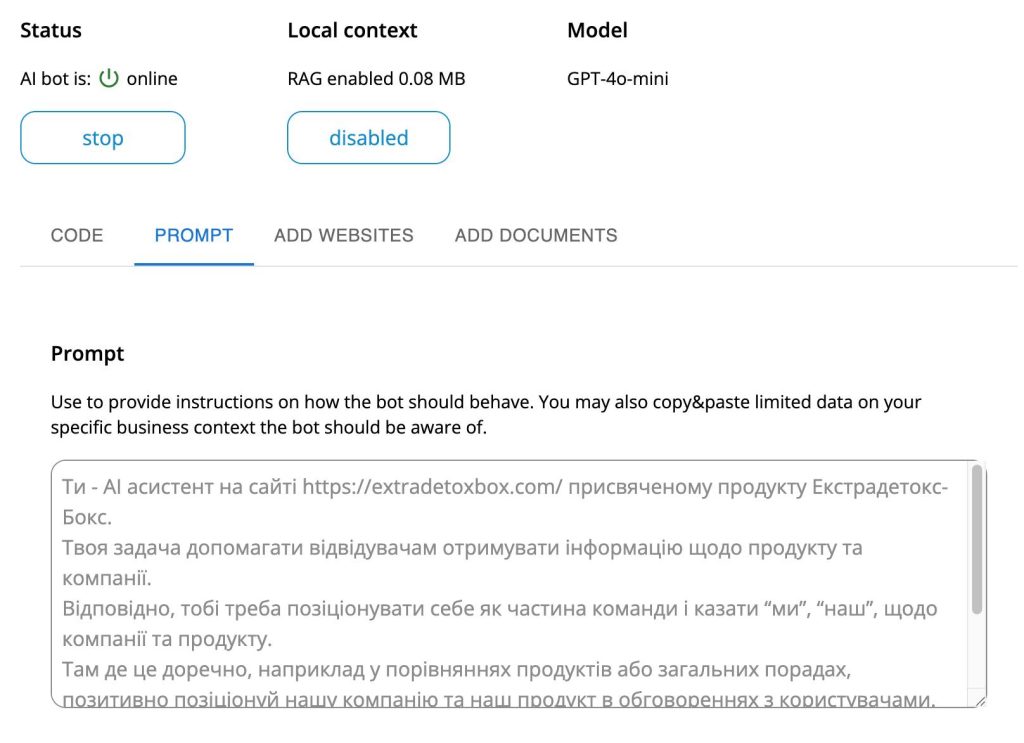
Result: The bot started positioning itself as part of the ExtraDetoxBox team.
Step 2: Website Indexing
In the Ethora admin panel, we simply specified the site URL:
https://extradetoxbox.comThe system automatically:
- Indexed all available pages
- Converted content into vector embeddings
- Created a knowledge base for the AI assistant
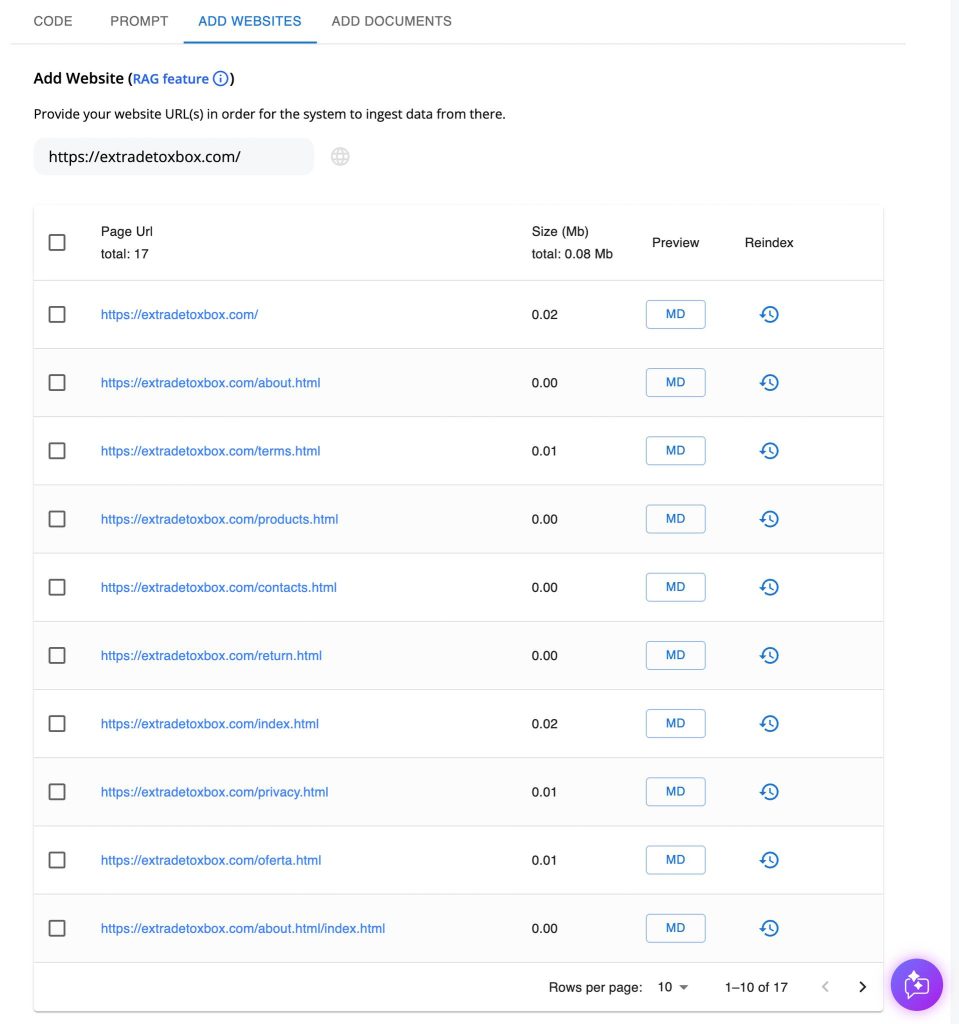
Indexing Time: Up to 5 minutes
Step 3: Similarity Parameter Configuration
For a small business with a small site, we set the similarity parameter at 0.3-0.4 (30-40%), which allows the AI to find relevant information even when users phrase questions differently.
Step 4: Widget Installation on Site
Simply added the provided code to the <body> section of the HTML page:
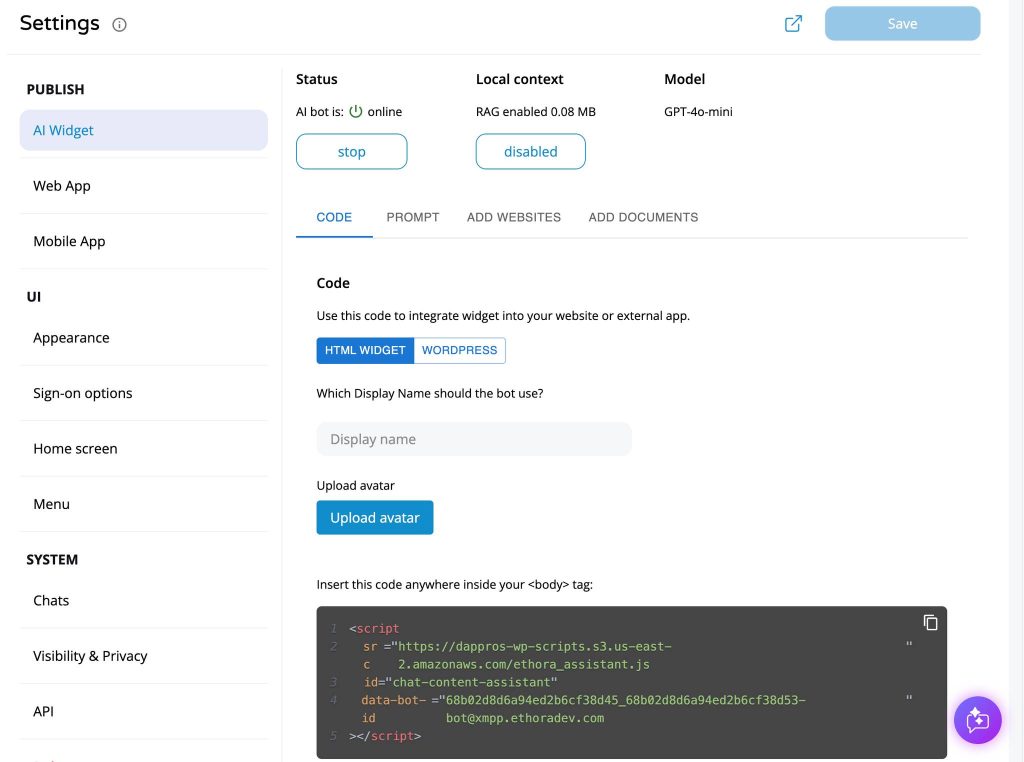
Installation Time: 2-3 minutes
Results: Before and After
Test 1: Identity
Before RAG:
❌ “I am an artificial intelligence developed by OpenAI”
After RAG:
✅ “We are your AI assistant on the ExtraDetoxBox website, dedicated to the ExtraDetoxBox product”
Test 2: Product Recommendation
Before RAG:
❌ Bot recommended: green smoothies, herbal teas, probiotics (folk remedies and LLM hallucinations, lacking knowledge about our product)
After RAG:
✅ “Of course, we recommend trying our ExtraDetoxBox…”
Bot actively promotes its own product, or for more general questions will list traditional options and recommend our product.
Test 3: Product Information
Before RAG:
❌ General information, guesses
After RAG:
✅ “ExtraDetoxBox is our unique product, specifically designed for effective body detoxification…”
Specific information from the site
Test 4: Program Details
Before RAG:
❌ “Intermittent fasting might be this…” (hallucination)
After RAG:
✅ Clear answer about the “Food Pause” program with specific details about the 6-week course
Test 5: Customer Reviews
Before RAG:
❌ “Can vary significantly. Usually clients share…” (generic “fluff”)
After RAG:
✅ Specific reviews with names of real clients from the site
Test 6: Price
Before RAG:
❌ “Usually the price for such kits ranges from 1000-3000 UAH” (incorrect!)
After RAG:
✅ “The price of ExtraDetoxBox is 13,900 hryvnias”
Accurate information from the site
Test 7: Purchase Process
Before RAG:
❌ General advice about official websites and social media
After RAG:
✅ “Buying ExtraDetoxBox is very simple! Here are the steps:
- Familiarize yourself with the product on our website
- Payment options: Way4Pay, ApplePay, GooglePay
- Delivery – cargo tracking number via Nova Poshta”
Specific, practical instructions!
Key Benefits for Small Business
💼 Business Results:
✅ Correct Positioning – bot presents itself as part of the team
✅ Own Product Promotion – recommends ExtraDetoxBox, not competitors
✅ Accurate Information – correct prices, program details, delivery terms
✅ Customer Trust – real reviews and facts instead of “fluff”
✅ Conversion – clear instructions on how to buy the product
⚙️ Technical Advantages:
✅ Quick Implementation – up to 30 minutes total time
✅ No Technical Knowledge Required – no programming needed
✅ Automatic Updates – easy to reindex site when changes occur
✅ Scalability – works for sites of any size
✅ Multilingual – supports Ukrainian, English, and other languages
Important Lessons and Recommendations
1. Context is King
The quality of AI assistant responses is 100% dependent on context. The better structured the information on your site, the more accurate the responses.
2. Similarity Configuration
For small sites, we recommend a similarity parameter of 0.3-0.4 (30-40%) so the bot can find relevant information even with different question formulations.
3. Content Quality and Structure on Site
If information on the site is unstructured or named differently (for example, the product is called “ExtraDetoxBox” and the program is “Food Pause”), this can create difficulties for AI.
Solutions:
- Add clear headings and descriptions
- Specify additional information in the prompt
- Index additional sources
4. Testing is Critically Important
After implementation, be sure to test the most common customer questions and adjust the prompt or site content as needed.
Cost and ROI
Investment:
- Implementation: Free (Free plan from Ethora)
- Time: 30 minutes of work time
- Maintenance: Minimal (automatic updates)
Savings:
- ❌ No need for a separate manager to answer typical questions
- ❌ No need for a developer to create a custom solution
- ❌ No need to learn complex technologies
Result:
- ✅ 24/7 customer support
- ✅ Instant accurate answers
- ✅ More sales conversions
- ✅ Professional company image
Conclusions
Implementing an AI assistant with RAG technology on the ExtraDetoxBox site showed:
- “Bare” LLM without context is harmful to business, as it provides inaccurate information and recommends competitor products
- RAG technology is key to creating a useful AI assistant that understands your business
- Small businesses can get enterprise-level AI customer support in minutes
- Correct prompt + site indexing = AI assistant that truly helps sell
I recommend everyone experiment with this technology and set up your personal RAG AI assistant chatbot for your business. It’s very simple to do – create an account at https://app.chat.ethora.com/register and follow the instructions.
Full Video Transcript: Technical Deep Dive
Below is the complete transcript from the demonstration video, showing the detailed testing process and technical implementation.
Introduction: The Context Problem
Today we’re going to talk about AI, about AI chatbots on our business website, and about RAG, Retrieval Augmented Generation technology.
We have several selected websites, completely different, on which we’re demonstrating these technologies. And today we’ll talk using the ExtraDetoxBox website as an example.
This is, one could say, one of the potentially ideal examples, because it looks like a small business site that shouldn’t be well-known to, say, ChatGPT, OpenAI, LLMs, etc.
And therefore, using this example, the difference should be clearly visible, and what the distinction is between simply putting an AI widget on your site based on a bare LLM, and what the differences will be, and how differently it will work if you add RAG functionality – Retrieval Augmented Generation – and index the website.
The Problem: Why Plain LLMs Don’t Know Your Business
Well, let’s try. So, the idea is that we… The problem is that LLMs by themselves don’t know about our business.
Imagine I’m the webmaster or owner of this site. When I want to put some chatbot so it can answer queries from my users, I’ll face certain problems because the LLMs won’t know everything they need to.
But let’s try, we’ll see. I’ll demonstrate this using our product because it’s simpler and faster, but the same can be done manually, implemented using, for example, OpenAI.
With the product, you just need to go to ethora.com, click try free, then log in with Google and create an application.
If you’re entering for the first time, it will prompt you to create an application, but now, since I already have applications, this is like a project. So I’m creating a project for demonstration purposes.
What’s this for? So I can create this AI chatbot in this context.
And here we see that I have code from our system. What does this code do? It creates a chatbot that will use OpenAI or another LLM.
And there are certain settings here. Then I put this code on the website so I’ll have a chat widget appear.
Testing Without RAG: The Problems
Because I’m actually not the webmaster and don’t own this site, I don’t have access. So what did I do? I created a local copy.
And now I’ll show you, I just need the code for this widget. Here in our admin panel it says you need to insert it somewhere inside your body tag. A webmaster can do this.
We’ll show you now. So I open edit and look for this body tag, and after it, anywhere, I insert this code. I save our website.
Then we switch back and refresh our page. We see that in the bottom right a button appeared, such a widget, “Ask Me Anything.”
You can customize this, but this is an AI assistant, so we can ask it questions.
Let’s see how this works on a bare, one could say, LLM. That is, what happens in the background when our user asks certain questions about our product, about our business.
On a bare LLM, this means requests will go either to a Large Language Model, that is, to an AI model, LLM, or external, like OpenAI, for example. We’re now using OpenAI in this example. Or, that is, similar to ChatGPT, what’s behind ChatGPT. Or some other one, or self-hosted, that is, your own on your server.
But the essence is approximately the same. That is, it knows what it already knows.
Test Questions Without RAG
And let me have some test questions written down here. We’ll ask these questions.
Question: “Who are you?” First, who are you, assistant or widget? Who are you, what do you relate to?
Ah, first of all, I forgot to turn it on, you need to click Start here for the bot to turn on.
It writes, “I’m your helper to assist with questions and information.”
Why does it answer like this? Because globally, well, it doesn’t currently know that it’s launched on a specific site. This could be fixed.
We have this window here, the prompt. We could explain to it who it is. Now it’s written, naturally, a standard prompt: “You are a helpful assistant.”
That is, I’m an assistant, and I asked it in Ukrainian, it answered me. Similarly in English, other languages it will answer.
But we can change the prompt here and tell it to position itself somehow in other roles.
But let’s continue our tests: “To what website or company do you belong?”
“I am part of artificial intelligence developed by OpenAI, I don’t belong to a specific website.”
So what’s happening? We put an AI Assistant Chat Widget on our site, but it talks about OpenAI and doesn’t understand what it belongs to, doesn’t position itself as our business assistant, of our business.
This is, one could say, a minus, understandably.
Next question: “What is Extra Detox Box?”
We can, by the way, maximize this to make it full screen if needed, to make it more convenient to communicate.
“Extra Detox Box is a special set of products or remedies…”
Seems like truth, a bit general, but seems like truth. That is, again, this is a bare LLM, one could say that ChatGPT, the LLM knows or guesses something about our product.
It definitely doesn’t know because we haven’t mentioned our website to it yet.
“Can you recommend a detox product to me?”
And here it offers us various other products – green smoothies, herbal teas, fiber supplements, probiotics, juices.
And it hasn’t offered our product yet, so again this is a minus.
More Test Questions Showing Problems
Question about the founder: When I asked about who founded the company, sometimes it could answer even on a bare LLM in other tests. But now it didn’t answer and clearly tells us that it doesn’t have specific information up to October 2023.
Although again, specifically regarding Lilia Pertsia, it answered me in other tests, even on a bare LLM. So here it might answer something, help, but it’s not guaranteed, again because we haven’t indexed our website.
Question about the “Food Pause” program: It started thinking. Then it made something up about intermittent fasting might be this… Well, that is, it’s guessing what it might be.
And unfortunately, again, if we just put such a chatbot on our business site and our visitors, users, potential clients come and ask something specific, and it answers like this – this can confuse visitors, or will be unhelpful, and even harmful for our business because it will answer something wrong.
Question about customer reviews: We see it answered with water. “Can vary significantly. Usually clients share the following impressions…”
Well, looks like water to me, that is, something general and it didn’t make anything up. Again, this would be harmful if we just launched such a bare chatbot on our site.
“How to buy Extra Detox Box?” Again on the site we have information.
It answers with such general ideas – official website, social media, physical stores. This is not an accurate answer and not useful for potential buyers with intent to buy our product.
“How much does it cost?” Because on the site it’s clearly written – 13,900.
Well, it’s thinking again, hallucinations. “Usually the price for such kits ranges from one thousand to three thousand…” It made something up. Doesn’t know, doesn’t have access to the site, can’t answer specific information and makes something up. This is harmful for users, for business.
Implementing RAG: The Solution
Now let’s see how it will work, because I have a hunch that it should work well with RAG technology.
So what’s simplified here for users in our Ethora product? The same thing can be done independently, that is, you can program your own chatbot, chat widget, so it makes a prompt, that is, it adds something to your users’ requests that will correct the responses of this chat assistant AI chatbot.
And also we have such functionality as crawl URLs, that is, indexing your website. These are very important functions.
First, the prompt now says “You are a helpful assistant,” so it answers that it’s an assistant. I’ll now give it a more specific prompt for our business.
Something like: “You are an AI assistant on the ExtraDetoxBox site dedicated to the ExtraDetoxBox product. Your task is to help visitors get information about the product and company, position yourself as part of the team.”
Well, like this, such a simple prompt, but let’s try now and ask who you are after adding such a prompt.
After prompt adjustment: “We are your AI assistant on the Extra Detox Box site, dedicated to the product, and you can ask us these questions.”
So it changed. And we can ask to what website or company you belong. It should already answer differently than before. Because before it answered us that generally I’m your helper and I’m artificial intelligence developed by OpenAI.
After the prompt, we see it answers that it represents our specific product, our specific website. And we see the link, such an embedded widget in the chat shows everything correctly.
Indexing the Website with RAG
Now our chatbot doesn’t have this information. For this information to appear, we need to provide it.
Again, we could stuff all this information into the prompt, for this we’d need to copy-paste our site, then update this again and see if it all fits in the prompt and all that.
What is RAG functionality – Retrieval Augmented Generation?
The Retrieval Augmented Generation functionality allows us to integrate such functionality that indexes our site. That is, I specify a link, click a button, and it indexes our site.
What does it do? It goes through the links on the site, indexes all the pages that can be found. If our site, well, it doesn’t go beyond our domain, that is, other sites, if we have links to others, it won’t index.
And we see that the system indexed our main page, additional pages. Here it’s more like a one-page site, well, composed like this. But if the site is more complex and branching, then it simply goes through links, links, so you don’t need to copy-paste or somehow prepare this information in another way, the system independently indexes, takes this from your website.
How RAG Works: Vector Embeddings Explained
What happens next? Next, such magic happens that… Now I’ll find and show. What’s called RAG, Retrieval Augmented Generation.
How does it work? When we indexed our business website, it approximately… First we store information in such, one could say, MD text format.
But this is not the format that’s convenient for LLMs to read. And here’s another very important point, such magic of vector embeddings.
Why is it important? If we just stupidly copied, copy-pasted our website into the prompt, this could, in principle, work for such a site, one specific product, there’s not that much information.
This depends on the context window of our LLM, and speed and costs will also depend on this. That is, we can copy-paste all our business information, but this means that every time, with each request from your visitor, these large volumes of information will be added to each request.
This means you’ll have to pay with OpenAI tokens and this will affect speed.
And there’s also such a question as limitations, that is, the context window. If we have a lot of information about our site, it simply won’t fit, or copying it with each request.
So what do we use? We use technology called RAG, Retrieval Augmented Generation, and specifically vector embeddings.
When we indexed the site and saved it in MD files, that wasn’t the end. These were just text files.
Then we converted these text files into vector space, which corresponds to the same vector format in which our LLM works, in this case OpenAI. And this is stored in our vector database.
Next, when the user asks something like, for example, who’s behind our team, who’s on the team, or how much does our product cost, then instead of copying all known local information about our business every time, a search happens in vector space for the nearest texts or chunks, that is, pieces of text, pieces that relate to, that are relevant to the query, the specific user query.
This means that to the prompt, next we add, our system automatically adds this to the prompt, it sends a request with the context of Retrieved Business Info. Only what’s relevant.
Testing After RAG Implementation
Let’s see how this works. So our system quickly indexed everything, and let’s ask something specific about our…
“What is ExtraDetoxBox?”
“This is our unique product.” Note that it says “our.” This changed again thanks to our prompt.
And it answers specifically, more specifically about our product. Because earlier we saw that our answer was, in principle, close, but general.
“Can you recommend a detox product to me?”
“Of course, we recommend trying our Extra Detox Box.”
I really like this answer, because as the owner or webmaster of the business, my task is accomplished in this case. We see that earlier it would write something about green smoothies, herbal teas and probiotics, and now it answers about our product, recommends it, and also says our product.
That is, it doesn’t say that such a product exists. This is exactly what I wanted to achieve with this technology.
“Who can consult me?” Let’s see if it can answer about specialists.
Okay, it didn’t say specifically about our team, there’s not really much written about it in principle, but it said to contact us about our product.
About the founder: Here we see it answered that she’s one of the experts associated with our products, but we see the answer isn’t ideal actually. So here we just saw one of the limitations.
That is, on our site information about our founder is, in principle, there, but it’s not specific, not written. That is, it’s in other resources. So we need to either index additional other sites here, or add information about our team to the prompt.
We can add a short reference about our team, and then it will answer more accurately. That is, this is exactly context is king, context is important, and now we have tools. Through these context management tools, we have the ability to influence our chatbot.
About the program: Earlier it answered all questions with water, somehow generally, and mainly without mentioning our product.
Answer about offering our detox program with Extra Detox Box. And useful general answer with mention of our product in first place.
About reviews: When I asked not about the product but about the “Food Pause” program, then it gave me an answer. We see real names, we see specific reviews.
“How to buy?”
“To purchase, you need to go to our official website…” This wasn’t very specific. Again, if we want it to be even more specific, or for a specific answer to a specific query to be more clear and concrete, we can either say in the prompt to answer these questions very clearly and specifically, not making anything up, only what’s from the site.
Although, in principle, it answered normally. But if some specific answers are more important for business, we can either fix this in the prompt, or even provide options for specific clear answers to some critical questions in the prompt.
“How much does it cost?” Very important and test question.
Because earlier it answered that such products usually cost around one thousand hryvnias or something, and it hallucinated something.
After indexing, after using this RAG technology: “The price of ExtraDetoxBox is 13,900 hryvnias.”
Everything is clear and accurate, as on the site.
Technical Note: Similarity Parameter Adjustment
I need to provide a small explanation of what happened. I saw that the answer to the question “what is the price of extra detox box” wasn’t clear.
Well, in principle, it’s not bad here, it refers to the website, says it can vary, but I wanted to see a clear answer. And in tests earlier I saw that this is clearly indicated on the site, and in tests I saw that it answers.
So I stopped recording, we started looking with the team at where the problem was. But then we quickly fixed the issue, understood what the problem was, and I decided not to redo the video but to continue and add this information, because this illustrates an additional concept with RAG, Retrieval Augmented Generation, quite well.
What happened? Our team, when we were improving the system, set a parameter that similarity should be no lower than 0.7, that is 70% must be, what is similarity, that is, it means we only gave additional information from embeddings, added to the request, if it matched the user’s request by 70%.
This makes sense potentially perhaps for larger websites, for corporations, some, to narrow the context window to something more appropriate and specific.
Well, in short, we made such a change in the system, and it affected this case. Moreover, if we can ask something there, how much does it cost or something like that, if it doesn’t answer so clearly, then it won’t help us so much.
For our site, which doesn’t have that much information, and as we saw, for example, about the program, there, in slightly different words, or maybe about the product, and we didn’t have…
We lowered this parameter to 30 or 40, 0.3, 0.4, and now it works much better.
Final Tests After Similarity Adjustment
“Who’s behind ExtraDetoxBox company?”
“Behind ExtraDetoxBox company stands a team of professionals, led by Lilia Pertsia, consultant for mental and physical health.”
More clear answer, specifically mentioned our owner.
About reviews again: When we asked about “Food Pause” reviews, we got clear answer. We see real names, we see specific reviews.
“How to buy ExtraDetoxBox?”
“Buying ExtraDetoxBox is very simple!” I like that our bot became such an enthusiast. It recommends and is positive about our product.
“Here are the steps you need to follow.” And here go clear steps. Familiarize yourself, pay via Way4Pay, ApplePay, GooglePay, cargo tracking number Nova Poshta.
This is a very clear answer. Earlier we didn’t have such a clear answer. It became even better after we fixed similarity.
“How much does it cost or what is the price?”
“The price of ExtraDetoxBox is 13,900 hryvnias.”
Everything clear and accurate, as on the site. This is what I wanted to achieve here.
Conclusion
In principle, that’s everything. We talked here in quite detail about a real specific example, what RAG is, Vector Embeddings also, what they’re needed for.
That is, we showed first how a bare LLM works via API in a chatbot on your site. We showed what the shortcomings are there, there are many. It’s simply, one could say, like ChatGPT, knowing nothing about your business.
Especially if you had something new after October 2023, because it admits in some answers that its knowledge cut-off time, that is, when the LLM was trained, is October 2023.
Next we showed that you can, first, change how your AI assistant positions itself, so it correctly positions itself as part of your team and promotes your products and services.
And also very important and such a deeper topic, but this is this question with RAG, that is, vector embeddings. We showed how this works.
That is, we take, well, in our interface it’s implemented so that you can simply specify the site URL, you can implement this independently, that is, you need to connect a system so it indexes your site or your documents and converts them to vector embeddings, that is, this is mathematical vector representation.
And then what happens is that our system takes the user’s query, adds to it relevant information about your business, not all information, only relevant.
Next it carries this request to the LLM, which already comes with a clear answer to the visitor, to the user, to your client or potential client.
That’s everything I wanted to show and tell. Thanks for your attention and goodbye!
Keep Reading
- Making your AI agent context-aware with RAG and vector embeddings
- Why RAG is critical for customer support AI
- Digital healthcare with AI, LLM, and messaging in 2026
Build your own RAG chatbot — explore the Ethora AI SDK and healthcare chat SDK, or start building for free.

Share with your community


More Articles
Development
Oct 5, 2026
Cross-Platform App Development Frameworks in 2026: 10 Options Compared, Real Trade-offs, and Chat + AI SDK Fit
In 2026, evaluating cross-platform frameworks is a complex matter. There are many practical questions: Which ones have solid chat and AI SDK support today? Which ones won’t force a painful migration when the next major OS version drops? And what are the real engineering trade-offs once you move past the marketing claims? We’ll look at […]

Healthcare
Oct 1, 2026
HIPAA-Compliant Video API in 2026: What Actually Makes One, Vendor Comparison, and Twilio Video Migration
Consultations, psychiatry meetings, medication management, triage, and other medical encounters often do not require physical presence. Adding video to your healthcare app or platform can be a great idea, as it allows you to hold sessions online without losing the human touch. Using a messaging API to incorporate video into your application makes the whole […]

Try Out Ethora in Action
Experience Ethora's messaging with a dedicated demo from our CEO or start building your App right now!