Glossary
The Communication Theorem (Shannon’s Model of Communication)
The foundation of information theory: every act of communication is a message sent from a source, encoded into a signal, carried across a channel that adds noise, then decoded at the destination. It is the blueprint behind every chat, voice and AI messaging system.
General definition
In 1948 Claude Shannon published A Mathematical Theory of Communication, which founded information theory. It models any communication as five parts: an information source, a transmitter that encodes the message into a signal, a channel that carries it, a receiver that decodes it, and a destination. Crucially, a noise source can corrupt the signal in transit. It is often called the Shannon (or Shannon-Weaver) model, and loosely the communication theorem.
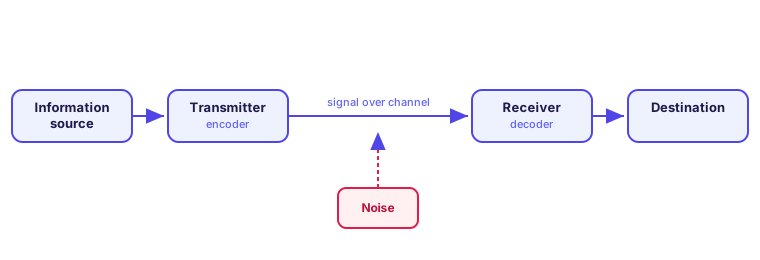
Shannon also proved the channel-capacity theorem: every channel has a maximum error-free data rate, its capacity, set by its bandwidth and its signal-to-noise ratio. Below capacity you can, with the right coding, communicate as reliably as you want; above it you cannot. Encoding, compression, error correction and acknowledgements all exist to push real systems close to that limit despite noise.
In the Ethora ecosystem
Every modern chat system is an implementation of this model. In Ethora the source and destination are your users or an AI agent; the transmitter and receiver are the client SDKs that encode and decode messages; the channel is the network path over protocols like WebSocket and XMPP; and noise is the packet loss, latency and jitter that the platform absorbs with acknowledgements, delivery and read receipts, and automatic reconnection.
The same ideas govern voice and video (bitrate, codecs and channel capacity, see the voice and video call API) and even language models, where the context window is a bounded channel for information into the model. Whether you run Ethora in the cloud or self-hosted, the job is the same: move messages reliably across a noisy channel.