AI Agent Statistics 2026
How fast the agent layer is growing - search demand, hiring, protocol adoption and framework mindshare, from primary data.
Ethora Research · Last updated 2026-09-02 · Data snapshot: August 2026 · CC BY 4.0 - free to reuse with attribution
AI agents went from a research term to the centre of the conversational-AI category in about three years. The numbers below are primary measurements from The State of Conversational AI, Q3 2026 (Ethora Research) - search demand, open-job counts, package downloads, GitHub adoption and a capability audit of 18 systems - each linking to its full dataset. Data snapshot: August 2026; page reviewed monthly.
Key statistics
- US search volume for "ai agents" grew about 700-fold - from ~60 searches a month in early 2023 to roughly 50,000 a month in 2026. Source: Search demand dataset
- "AI agent" is a top-three US AI hiring category: roughly 61,000 open roles (Aug 2026), alongside generative AI (~81k) and AI engineer (~61k). Source: Jobs demand dataset
- The Model Context Protocol (MCP), launched late 2024, hit 339 million monthly PyPI downloads ("mcp") and 198 million monthly npm downloads ("@modelcontextprotocol/sdk") by Aug 2026. Source: SDK downloads dataset
- The modelcontextprotocol/servers repository reached ~89,561 GitHub stars less than a year after creation - the fastest riser in the tracked set. Source: GitHub adoption dataset
- Agent-capable orchestration frameworks by GitHub stars: LangChain 144,246; Microsoft AutoGen 60,418; CrewAI 57,073; Flowise 55,362; LlamaIndex 51,637. Source: GitHub adoption dataset
- In a capability audit of 18 notable systems, tool use and MCP support are near-universal, while proactivity (acting on schedules or triggers, not just replying) cleanly splits the field - it is where a chatbot becomes an agent. Source: Periodic Table dataset
- RAG is a named requirement in roughly 19,000 open US roles; prompt engineering in ~20,000. Source: Jobs demand dataset
- 24 of 28 agent- and chat-related buying terms now trigger a Google AI Overview - the category is discovered through AI answers. Source: Search demand dataset
- Low-end agent implementation has commoditised: median advertised AI project on Freelancer.com is about $250 fixed-price, while skilled Upwork agent/LLM work runs a median ~$30/hour. Source: Freelance market dataset
Search demand: the 700x curve
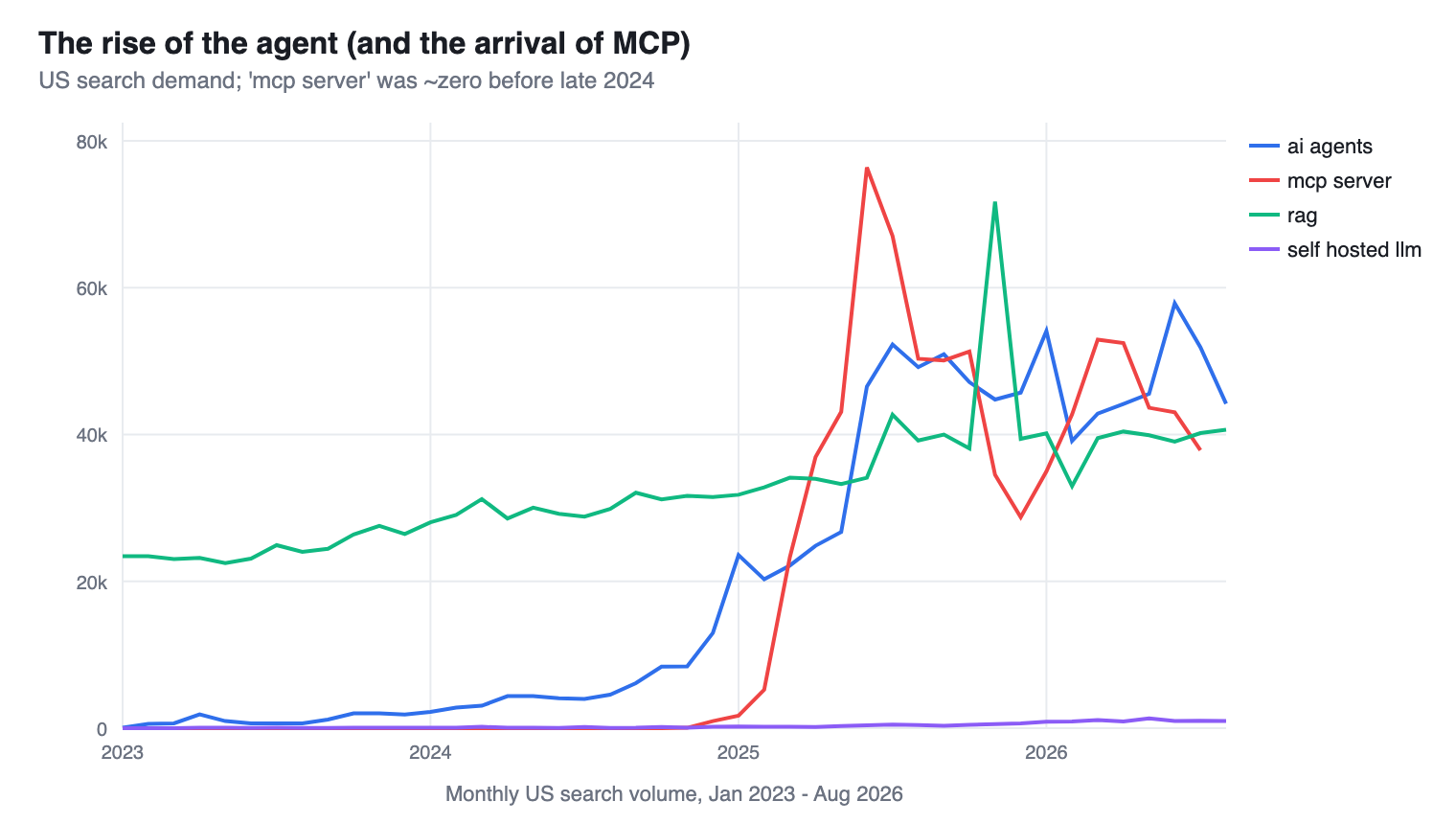
Figure. Three-year US search-volume trend: "ai agents" leads the category's vocabulary. Volumes are third-party estimates.
"AI agents" is the fastest-growing term in the conversational-AI vocabulary: ~60 US searches a month in early 2023 to ~50,000 in 2026. For comparison, "mcp server" went from effectively zero before late 2024 to tens of thousands of monthly searches, while "rag" doubled and plateaued - retrieval became assumed infrastructure while agents became the story. Full 28-term dataset: search demand dataset.
Hiring: agents are already a top-three category
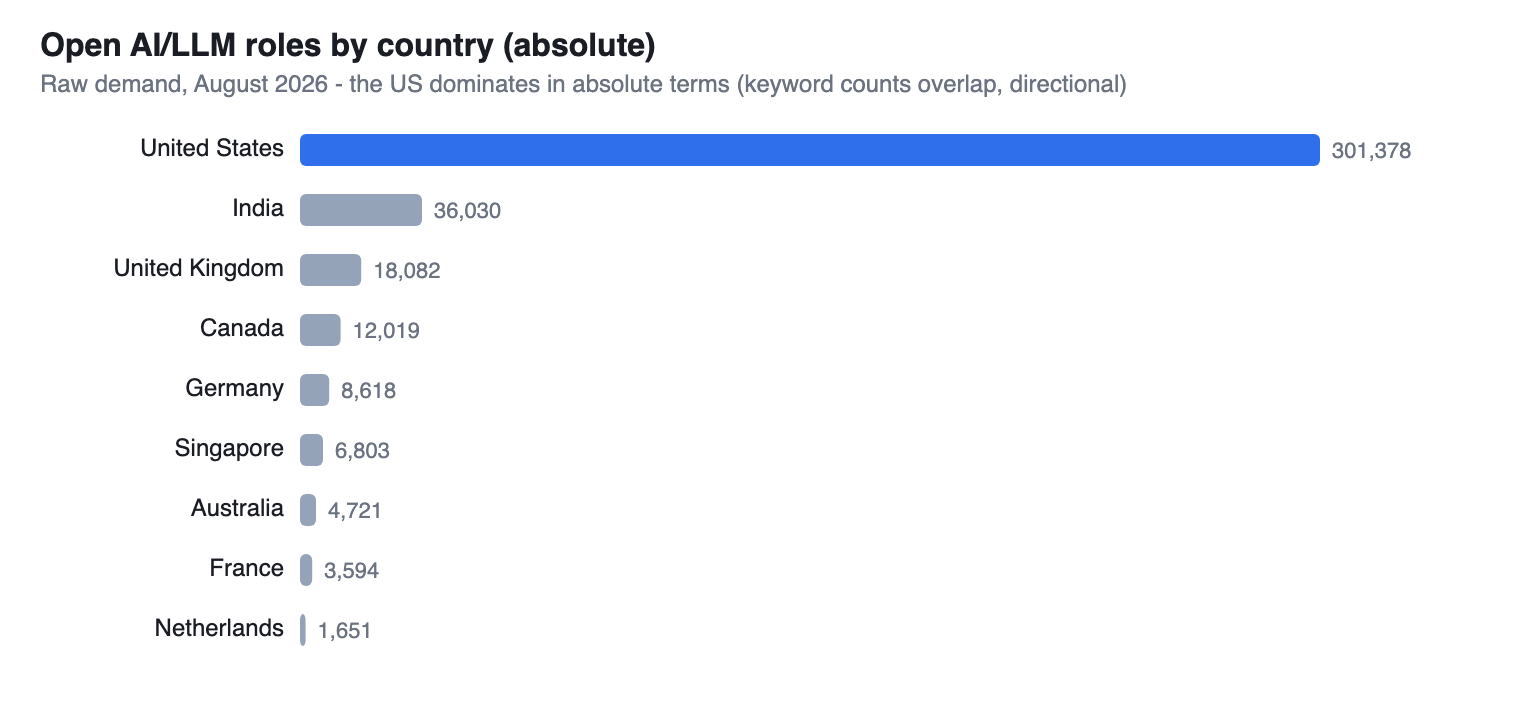
Figure. Open AI/LLM roles by country, absolute terms (Aug 2026).
In the US employer market (Aug 2026), the largest AI hiring categories are generative AI (~81,000 open roles), AI engineer (~61,000), and AI agent (~61,000) - followed by LLM (~35,000), prompt engineer (~20,000) and RAG (~19,000). The agent theme visible in developer interest and search demand now shows up directly in hiring. The US total is on the order of 300,000 open AI/LLM roles; per capita, Singapore leads at ~1,134 roles per million people. Full matrix: jobs demand dataset.
MCP: a protocol layer standardised in one year
The clearest structural change of 2025-2026 is the tools-and-protocol layer. The Model Context Protocol had no meaningful footprint before late 2024; by August 2026 the "mcp" package pulls ~339M monthly PyPI downloads, "@modelcontextprotocol/sdk" ~198M monthly npm downloads, and the modelcontextprotocol/servers repository sits at ~89,561 GitHub stars - top-of-registry adoption in under two years. In our 18-system capability audit, MCP or native tool use is supported nearly everywhere: a capability that did not exist before late 2024 is already near-universal.
| Package | Registry | Downloads / month |
|---|---|---|
| litellm | PyPI | 743,939,400 |
| openai | PyPI | 431,641,826 |
| mcp | PyPI | 339,449,172 |
| langchain | PyPI | 278,979,462 |
| @modelcontextprotocol/sdk | npm | 198,046,096 |
| @anthropic-ai/sdk | npm | 116,729,450 |
| ai (Vercel) | npm | 78,325,791 |
MCP and agent-adjacent package downloads, last month (Aug 2026). Full table: SDK downloads dataset.
Agent frameworks and builders: developer mindshare
By GitHub stars (Aug 2026), the orchestration layer where agents are built is led by LangChain (144,246), Langflow (153,239) and Dify (152,436), with the dedicated multi-agent frameworks - Microsoft AutoGen (60,418), CrewAI (57,073), Flowise (55,362) and LlamaIndex (51,637) - forming the next tier. Stars measure mindshare rather than production usage; the download table above is the usage check. Full 34-project dataset: GitHub adoption dataset.
The capability frontier: proactivity and memory
We verified ten capabilities across 18 notable systems against their current documentation (Aug 2026). Tool use and MCP are now table stakes. Proactivity is the real differentiator: acting on a schedule or trigger, rather than only replying, cleanly splits the field - and it is precisely where a chatbot becomes an agent. Persistent memory is common in name but unfinished in practice (often an add-on, a paid tier, or a consumer feature not exposed to developers). No single system is strong on control, conversation and agency at once - that unresolved middle is the category's current frontier. Full matrix with per-cell sources: The Periodic Table of Conversational AI.
Frequently asked questions
- How fast is AI agent adoption growing?
- US search volume for "ai agents" grew about 700-fold between early 2023 and 2026 (to roughly 50,000 monthly searches), "AI agent" is a top-three US AI hiring category at ~61,000 open roles, and the MCP protocol layer reached 339 million monthly PyPI downloads within two years of launch.
- How many AI agent jobs are there?
- Roughly 61,000 open US roles mention AI agents (Aug 2026), making it a top-three AI hiring category alongside generative AI (~81,000) and AI engineer (~61,000).
- What is MCP and how widely is it adopted?
- The Model Context Protocol is an open standard (late 2024) for connecting AI models to tools and data. By August 2026 its Python package sees ~339M monthly downloads, its npm SDK ~198M, and its servers repository holds ~90,000 GitHub stars.
- What separates an AI agent from a chatbot?
- In a capability audit of 18 systems, proactivity - acting on schedules or triggers rather than only replying - is the cleanest dividing line, together with tool use and persistent memory. Tool use is now near-universal; proactivity and finished memory are not.
Ethora Research. (2026). AI Agent Statistics 2026: Search Growth, Hiring, and MCP Adoption. Retrieved from https://ethora.com/research/statistics/ai-agent-statistics/
Most figures come from The State of Conversational AI, Q3 2026 (DOI: 10.5281/zenodo.22131590), released under CC BY 4.0 with open data and collection scripts at github.com/dappros/state-of-conversational-ai. Every statistic above links to its dataset or named external source. Methodology: measurement notes.Numbers are point-in-time snapshots and interest proxies, not revenue or market share: stars and downloads measure developer attention and pulls, search volumes are third-party estimates, and job/talent counts are keyword- and LinkedIn-based with stated limits. See the methodology page for each metric's caveats.