Figure 3.1: The Five-Layer Anatomy of a Conversational AI System (Q3 2026)
Figure 3.1 from The State of Conversational AI, Q3 2026. Vector version below; a PNG version is available to download.
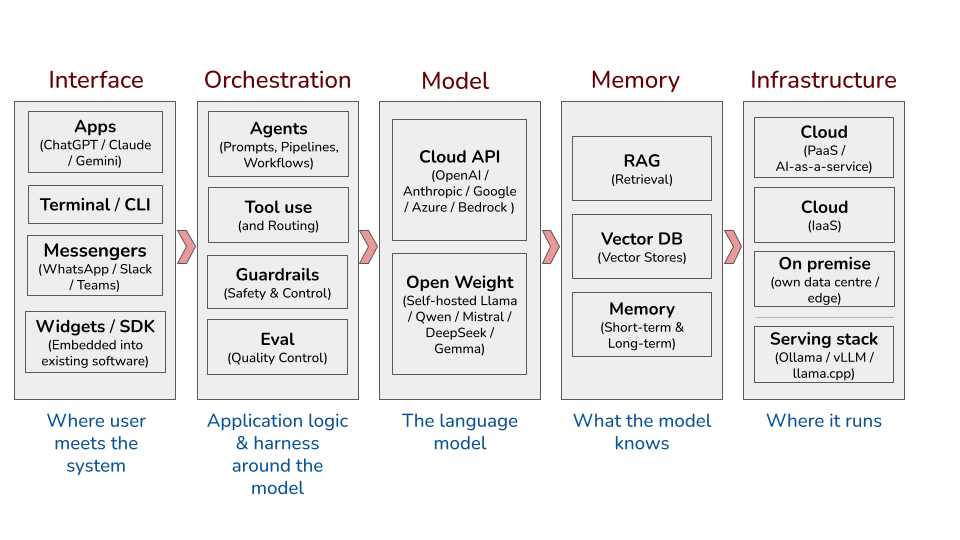
The five layers, described
Every conversational AI product is assembled from the same five layers, shown left to right:
- Interface - where a person meets the system: apps (ChatGPT, Claude, Gemini), the terminal or CLI, messengers (WhatsApp, Slack, Teams), and widgets or SDKs embedded into existing software.
- Orchestration - the application logic and harness around the model: agents (prompts, pipelines, workflows), tool use and routing, guardrails, and evaluation.
- Model - the language model itself: a cloud API (OpenAI, Anthropic, Google, Azure, Bedrock) or an open-weight model run yourself (self-hosted Llama, Qwen, Mistral, DeepSeek, Gemma).
- Memory - what the model knows beyond its training: RAG (retrieval), a vector database, and short-term and long-term memory.
- Infrastructure - where it runs: cloud (PaaS or IaaS), on premise (own data centre or edge), and the serving stack that hosts open models (Ollama, vLLM, llama.cpp).